
The average funeral cost by state ranges from $7,533 in Oregon to $9,697 in Minnesota based on 2026 industry data. But that number only tells half the story. Those figures cover funeral home charges alone. Once you add a cemetery plot, burial vault, headstone, and grave opening and closing fees, the real all-in average funeral cost by state climbs to $14,000 to $18,000 or more for a traditional burial. That gap between the advertised number and the check your family actually writes is the single most important thing this guide exists to close.
The average funeral cost by state matters most in the 24 to 72 hours after a loved one dies. That is when families are least equipped to negotiate, most emotionally overwhelmed, and facing a funeral home that is ready to take a credit card immediately. This guide gives you verified data for all 50 states, a full line-item breakdown, and the legal tools to make informed decisions before that moment arrives.
Table of Contents
A Note From the Researcher Behind This Guide
I am a personal finance researcher, but I think of myself as a guide through confusing paperwork.
My journey started with a shoebox of insurance documents and countless afternoons at my grandmother’s kitchen table, where she would puzzle over fine print between teaching me her favorite recipes. She was sharp as a tack. But those policy columns still baffled her.
I watched her spend hours circling numbers, comparing agent letters, and searching for something that offered real peace of mind after 70. Watching her struggle made it my mission to cut through the confusion for every family like hers. That same promise drives this guide: no sales pressure, no jargon, just straight numbers and real consumer rights – the kind I first sketched for Grandma on a piece of notepaper at that same kitchen table.
Why the Average Funeral Cost by State Varies So Widely
There is no single national price for a funeral. The spread between the most affordable states and the most expensive can exceed $2,500 for identical services. Three economic forces drive those differences more than anything else.
Local wages and labor markets set the floor on every price list. Funeral directors, embalmers, transport drivers, and administrative staff earn wages tied to their regional economy. A licensed funeral director in rural Mississippi earns a fundamentally different salary than one in suburban Connecticut. Those wages flow directly into the General Price List on the wall of every funeral home. The Northeast runs about 20% above the national average. The South runs roughly 13% below it.
Cemetery land values are the hidden multiplier most families never see coming. A cemetery plot in a dense Northeast metro can cost $5,000 to $10,000 or more – because it is real estate, and real estate near Boston or New York costs more than in rural Tennessee. Grave opening and closing fees add another $800 to $2,500. These charges come from a completely separate business and almost never appear in the average funeral cost by state figures quoted in news articles or industry reports.
State regulations and local competition shape the rest. States with stricter consumer protection laws give families more pricing leverage. States with fewer licensed funeral homes per capita tend to show higher prices because families have fewer alternatives. A major city in a low-cost state can still produce a surprisingly high bill for exactly this reason.
When my grandmother passed, the funeral director met with us that same afternoon. The first price list showed a dignified service at what seemed like a reasonable total. What none of us fully understood in those first hours was that the cemetery would send its own invoice days later – for the plot, the liner, and the grave opening fee. Those three items alone added over $4,000 to a number we thought was final.
Knowing to ask for both invoices upfront changes everything.
Average Funeral Cost by State: The Complete 50-State Data Table
The figures below reflect 2025-2026 averages compiled from World Population Review’s National Funeral Directors Association analysis, Funeralocity provider surveys, and Asurgo’s study of 1,012 real funeral home General Price Lists. The Full Service Burial and Full Service Cremation columns reflect funeral home charges only. Cemetery costs are billed separately and typically add $3,000 to $8,000. States run from highest to lowest so you can find your state’s position at a glance.
| # | State | Full Service Burial | Full Service Cremation | Direct Cremation | All-In Est. (Burial + Cemetery) |
|---|---|---|---|---|---|
| 1 | Minnesota | $9,697 | $7,517 | $2,955 | $15,500+ |
| 2 | Connecticut | $9,609 | $7,156 | $3,108 | $15,400+ |
| 3 | Massachusetts | $9,545 | $7,109 | $2,720 | $15,200+ |
| 4 | New Jersey | $9,443 | $6,858 | $2,511 | $16,000+ |
| 5 | Hawaii | $9,439 | $7,351 | $1,632 | $16,500+ |
| 6 | Iowa | $9,382 | $7,244 | $2,991 | $14,800+ |
| 7 | Rhode Island | $9,213 | $6,765 | $2,619 | $15,000+ |
| 8 | Delaware | $9,203 | $6,830 | $2,603 | $14,600+ |
| 9 | Maryland | $9,188 | $6,866 | $2,425 | $15,200+ |
| 10 | Illinois | $9,184 | $6,721 | $2,564 | $14,900+ |
| 11 | District of Columbia | $9,028 | $6,462 | $2,206 | $16,000+ |
| 12 | Wisconsin | $9,004 | $6,735 | $2,908 | $14,300+ |
| 13 | Michigan | $8,953 | $6,551 | $2,268 | $13,900+ |
| 14 | North Dakota | $8,868 | $6,791 | $3,183 | $13,500+ |
| 15 | New York | $8,836 | $6,289 | $2,395 | $17,000+ |
| 16 | Pennsylvania | $8,816 | $6,536 | $2,460 | $14,200+ |
| 17 | New Hampshire | $8,793 | $6,409 | $2,190 | $13,800+ |
| 18 | Texas | $8,790 | $6,461 | $2,134 | $13,500+ |
| 19 | Indiana | $8,705 | $6,385 | $2,295 | $13,100+ |
| 20 | Louisiana | $8,661 | $6,388 | $2,311 | $13,000+ |
| 21 | Kansas | $8,640 | $6,452 | $2,553 | $12,900+ |
| 22 | Nebraska | $8,620 | $6,530 | $2,958 | $12,800+ |
| 23 | South Dakota | $8,614 | $6,689 | $2,826 | $12,700+ |
| 24 | Maine | $8,594 | $6,265 | $2,372 | $13,200+ |
| 25 | Georgia | $8,549 | $6,338 | $1,939 | $12,500+ |
| 26 | Nevada | $8,538 | $6,095 | $1,467 | $13,200+ |
| 27 | Alabama | $8,428 | $6,137 | $2,032 | $12,000+ |
| 28 | Kentucky | $8,393 | $6,114 | $2,031 | $11,900+ |
| 29 | Florida | $8,385 | $5,957 | $1,698 | $12,800+ |
| 30 | Virginia | $8,321 | $6,128 | $2,515 | $13,000+ |
| 31 | Missouri | $8,295 | $5,973 | $1,852 | $11,700+ |
| 32 | Alaska | $8,272 | $6,336 | $1,972 | $13,000+ |
| 33 | South Carolina | $8,224 | $5,987 | $1,926 | $11,800+ |
| 34 | Vermont | $8,213 | $5,918 | $2,297 | $12,500+ |
| 35 | Tennessee | $8,159 | $5,922 | $1,935 | $11,500+ |
| 36 | Colorado | $8,142 | $5,825 | $1,721 | $12,800+ |
| 37 | North Carolina | $8,136 | $5,888 | $1,933 | $11,600+ |
| 38 | West Virginia | $8,074 | $5,878 | $2,289 | $11,300+ |
| 39 | Wyoming | $8,070 | $6,043 | $2,550 | $11,500+ |
| 40 | Utah | $8,028 | $5,803 | $1,627 | $12,000+ |
| 41 | California | $8,026 | $5,524 | $1,641 | $14,000+ |
| 42 | Ohio | $8,014 | $5,660 | $2,057 | $11,400+ |
| 43 | Mississippi | $7,984 | $5,837 | $1,994 | $10,800+ |
| 44 | Oklahoma | $7,966 | $5,692 | $2,159 | $10,900+ |
| 45 | New Mexico | $7,829 | $5,588 | $1,935 | $10,600+ |
| 46 | Arizona | $7,776 | $5,367 | $1,486 | $11,400+ |
| 47 | Idaho | $7,745 | $5,437 | $1,706 | $10,500+ |
| 48 | Montana | $7,742 | $5,697 | $2,476 | $10,500+ |
| 49 | Arkansas | $7,668 | $5,489 | $1,679 | $10,200+ |
| 50 | Washington | $7,656 | $5,302 | $1,531 | $11,200+ |
| 51 | Oregon | $7,533 | $5,144 | $1,319 | $10,000+ |
Sources: World Population Review (NFDA 2025-2026); Asurgo 2026 National Funeral Cost Index (1,012 GPLs); Funeralocity.com 2026 provider data. “All-In Est.” adds median cemetery costs billed separately. Actual costs vary by city, provider, and service level.
Why California’s Average Funeral Cost by State Looks Deceptively Low
California sits at number 41 on the burial list, which surprises most people given the state’s cost of living. The reason is that this table – like nearly all industry data – captures funeral home fees only. California’s cemetery costs, especially in Los Angeles and the Bay Area where burial plots run $8,000 to $15,000, are among the highest in the country. The funeral home column looks manageable. The full all-in average funeral cost by state in California does not. This pattern applies in different ways to every high-cost metro in the country.
How the Average Funeral Cost by State Changes Based on Service Type
The type of service you choose has a bigger impact on the final bill than the state you live in.
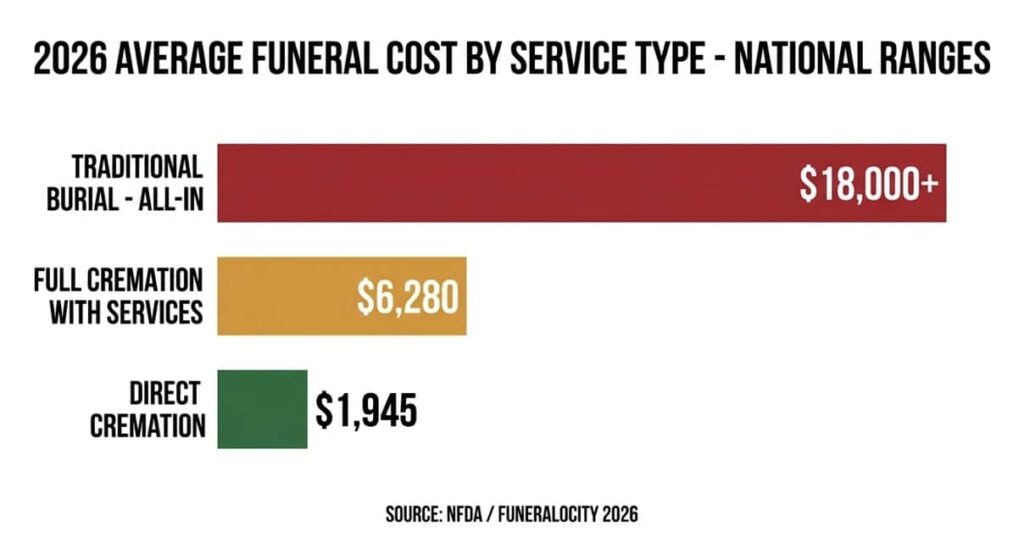
A traditional burial with full services, including cemetery, runs $14,000 to $18,000 or more. A full cremation with viewing and services averages $6,280 nationally before cemetery costs. Direct cremation – immediate cremation with no viewing, no embalming, and no ceremony – runs $1,319 to $3,108 depending on your state, with a national median of $1,945.
The gap between a traditional burial and direct cremation can exceed $16,000 for the same family in the same city. For many seniors on fixed income, that represents more than a year of Social Security payments. This cost reality is the primary reason 63.4% of American families now choose cremation, a rate projected to reach 82.3% by 2045 according to the National Funeral Directors Association.
For coverage options built around these costs, see our guides on final expense insurance for seniors and burial insurance for seniors over 70.
The Hidden Average Funeral Cost by State: Funeral Home Fees vs. Cemetery Costs
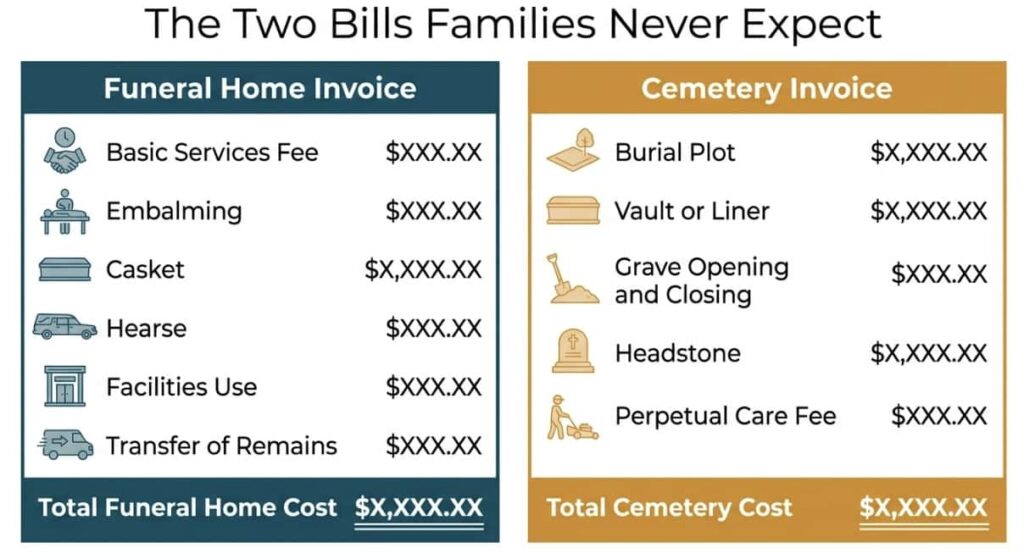
Funeral homes and cemeteries are separate businesses with separate invoices. When a funeral director quotes you a price, they are almost never including what the cemetery charges. And cemetery charges are substantial.
What the Funeral Home General Price List Covers
Under federal law, every licensed funeral home must publish a General Price List – an itemized menu of every service and its individual cost. You can request this before any discussion, and it must be handed to you for free. Here is what a typical GPL covers in 2026.
The Basic Services of Funeral Director and Staff fee runs $2,300 to $3,200. It is non-declinable – every family pays it regardless of which other services they select.
Embalming adds $600 to $900. It is not legally required and can often be declined.
Other preparation – washing, dressing, and cosmetology – costs $250 to $450.
Use of facilities for a viewing runs $450 to $950. Use of the funeral chapel adds $500 to $900.
A hearse for local transport costs $350 to $500. Transfer of remains to the funeral home adds $350 to $650.
The casket is typically the most expensive single item, ranging from $2,000 for basic steel to over $10,000 for premium hardwood.
Printed materials, death certificates, and permits add $200 to $500.
Total funeral home charges: $7,000 to $18,000 depending on service level and casket choice.
What the Cemetery Bills Separately
The cemetery sends a completely separate invoice. It typically includes a burial plot ($1,000 to $10,000 or more), grave opening and closing fees ($800 to $2,500), an outer burial container or vault ($1,200 to $5,000), a headstone or grave marker ($1,000 to $4,000), and perpetual care fees ($200 to $800).
Those cemetery items alone add $4,200 to $22,300 to whatever the funeral home charged.
The Vault Trap: A Charge Most Families Never See Coming
A burial vault is not required by federal law. Most private cemeteries require one anyway to prevent ground settling. Many families discover this on the day of burial when they receive a charge of $1,200 to $5,000 they never expected.
Ask this question upfront: “Does your cemetery require an outer burial container, and what does it cost?” That one question eliminates one of the most common financial shocks in end-of-life planning.
The Non-Declinable Basic Services Fee
Every funeral home bill includes a Basic Services of Funeral Director and Staff fee that cannot be removed. It covers planning, permits, paperwork, and coordination. It runs $2,300 to $3,200 in 2026. Even direct cremation carries a version of this charge. Knowing it is mandatory helps you identify which other line items you actually can negotiate or decline.
Embalming: Declined More Than Most Families Realize
Embalming is not required by law in any U.S. state for deaths occurring within the country. Funeral homes often require it for open-casket viewings. If you opt for a closed casket, refrigeration, or direct cremation, you can decline it in almost every case.
Declining embalming saves $600 to $900 and is one of the fastest ways to reduce the average funeral cost by state that your family actually pays versus the GPL sticker price.
For planning around these costs, see our guides on no medical exam life insurance for seniors, guaranteed issue whole life for seniors, and affordable life insurance options on a fixed income.
How to Reduce the Average Funeral Cost by State Using the FTC Funeral Rule
In 1984, the Federal Trade Commission introduced the Funeral Rule – one of the most powerful consumer protection laws most Americans have never heard of. It exists because funerals are purchased in a uniquely vulnerable emotional state. Here is how to use it.
Step 1: Request the General Price List Before You Set Foot Inside
The FTC Funeral Rule requires every licensed funeral home to give you a written, itemized GPL on arrival or by request – at no charge and with no obligation. Call or email before your visit and ask for it in advance.
A funeral home that refuses or delays is violating federal law. Collect GPLs from at least two or three providers before choosing. In the same city, identical services can differ by $2,000 to $4,000 between homes.
Step 2: Demand a Full Itemized Statement Before Signing Anything
Before signing any service agreement, ask for a written itemized statement listing every item and its individual price. You are legally entitled to this.
Do not accept a package total without a line-by-line breakdown. Packages often bundle video tributes, register books, prayer cards, and flower arrangements you did not ask for – adding hundreds to thousands of dollars to the average funeral cost by state your family ends up paying.
Step 3: Buy Your Casket Independently and Save 30% to 70%
Under the FTC Funeral Rule, a funeral home must accept any casket purchased from a third-party retailer. It cannot charge a handling fee for doing so.
Costco and Sam’s Club both sell caskets significantly below funeral home list prices. Online retailers like Overnight Caskets and Caskets.com deliver within 24 to 48 hours at 30% to 70% less than what most funeral homes charge. A casket purchased for $1,200 from a home that would have billed $3,500 for the same model is real, immediate savings with no loss of dignity.
Step 4: Decline Embalming Unless You Actually Need It
If you are not having an open-casket viewing, state in writing that you are declining embalming and request refrigeration instead.
The GPL must list embalming as optional. If a funeral director tells you it is mandatory when your situation does not require it, that is a misrepresentation of your rights under federal law – and a clear signal to find another provider.
Step 5: Pre-Plan to Lock In Today’s Average Funeral Cost by State
Funeral costs have risen approximately 28% over the past decade. The NFDA projects a 6% annual increase going forward. Pre-planning locks in current pricing and removes financial decision-making from grieving family members at the worst possible time.
Before prepaying directly with a funeral home, verify that state-regulated trust requirements protect your funds if the business closes or changes ownership.
Step 6: Fund Your Plan With Insurance, Not Just a Prepaid Contract
Final expense life insurance is specifically designed to cover the average funeral cost by state you live in. A policy in the $10,000 to $25,000 range typically costs seniors $40 to $180 per month depending on age and health.
The tax-free death benefit goes directly to your named beneficiary. It can cover funeral home costs, cemetery fees, headstone, and travel for out-of-town family – without being tied to any single funeral home or provider.
Social Security pays a one-time death benefit of exactly $255. That figure was set in 1954 and has never been updated. It will not cover a flower arrangement. The financial gap between no coverage and a $14,000 bill is one that only pre-planning or life insurance can reliably bridge.
To run a free estimate without speaking to an agent, use Mutual of Omaha’s life insurance calculator. It gives you real rates based on age, state, and coverage amount in about 90 seconds. AARP’s life insurance comparison tool is another genuinely free option with no personal information required to get a baseline number.
For more planning guidance, see our articles on life insurance for seniors over 70, whole life insurance for seniors over 80, the best final expense insurance companies, and life insurance for estate planning.
Average Funeral Cost by State: Frequently Asked Questions
Does the average funeral cost by state include the cemetery?
Almost never. The widely cited national medians – $8,300 for burial with viewing, $9,995 with a vault – reflect funeral home charges only. Cemetery plot, grave liner, vault, grave opening and closing fees, and headstone come from a separate business on a separate invoice. Always ask for both estimates before committing to anything.
What is the cheapest legal funeral option available in any state?
Direct cremation is the least expensive option across all 50 states. The national median is $1,945 in 2026. Oregon has the lowest average funeral cost by state for direct cremation at $1,319. North Dakota sits at the high end at $3,183. A separate memorial service can be held anywhere, at any time, for far less than a full funeral home ceremony.
Does Medicare or Medicaid cover average funeral costs by state?
Medicare covers no funeral expenses. Medicaid in some states offers limited burial assistance for very low-income individuals, but coverage is minimal. Veterans may qualify for burial benefits through the VA, including a burial allowance and interment in a national cemetery at no charge. Contact your local Veterans Affairs office to confirm eligibility.
Can I lock in today’s average funeral cost by state by prepaying?
Yes. Pre-need funeral contracts lock in today’s pricing and reduce the burden on your family. Some families prefer to fund pre-planning through a final expense insurance policy payable to a named beneficiary rather than directly to a funeral home. This preserves flexibility – the benefit is not tied to a single provider and can also cover cemetery costs, travel, and expenses a funeral home contract never touches.
Where can I compare average funeral costs by state near me?
Funeralocity is a free, unbiased funeral home comparison tool that lets you search providers by ZIP code, view General Price Lists side by side, and compare service options without speaking to anyone first. Parting.com offers a similar service focused specifically on cremation pricing. Both are legitimate consumer tools with no hard sales pressure.
The Bottom Line on Average Funeral Cost by State
The average funeral cost by state tells only part of the story. A family in Oregon might pay $10,000 all-in for a dignified traditional burial. A family in New York or New Jersey could face $18,000 or more for the same service. Neither family is being overcharged relative to their local market. Both families would benefit enormously from knowing those numbers before they need them.
The most powerful shift you can make is moving this conversation from reactive to proactive. Understanding what a funeral actually costs, comparing coverage options, and documenting final wishes before any urgency arrives is not a morbid exercise. It is one of the most caring things a family can do for each other.
At my grandmother’s kitchen table, surrounded by her recipes and her insurance papers, I learned that both kinds of documents serve the same purpose. They are instructions for the people you love, written in a moment of clarity so they do not have to guess in a moment of grief. That is exactly what this guide, and everything on this site, is here to provide.
Data sources: World Population Review (NFDA 2025-2026); Asurgo 2026 National Funeral Cost Index (1,012 General Price Lists); National Funeral Directors Association 2023 General Price List Study and 2025 Statistics; Funeralocity.com 2026 state provider data; MoneyGeek end-of-life cost analysis (2025); PayForFunerals.com 2026 Funeral Cost Guide. All figures represent medians or averages. Individual costs vary by provider, location, and service selections. Cemetery costs are estimates only and must be confirmed directly with the cemetery. This content is for informational purposes and does not constitute financial, legal, or insurance advice.