Avoid life insurance scams elderly consumers or their adult children encounter by learning to recognize predatory marketing tactics, verifying insurance agent licenses through national databases, and refusing to give out personal banking information over the phone during unsolicited calls. As an independent financial researcher, I have spent years digging through insurance rules so my readers don’t have to.
The thing that trips up most readers I talk to is just how sophisticated modern senior financial exploitation has become. Scammers frequently mask their true identities by posing as government employees, official veteran representatives, or recognized consumer advocacy groups, specifically targeting older adults who are looking for ways to cover their end – of – life costs without leaving a heavy financial burden on their families.
When I was looking into this topic for my own family, I was deeply unsettled by the aggressive, manipulative techniques deployed by bad actors in the senior insurance space. Protecting your hard – earned retirement savings requires moving away from emotional decision – making and anchoring yourself in a systematic verification process. This comprehensive guide will equip you with the exact strategies needed to spot red flags, understand standard policies, and confidently protect your household assets.
To help you instantly recognize the structural pattern of these deceptive schemes, I want to map out how a fraudulent transaction flows compared to a safe, independent verification process.
Table of Contents
Why Older Adults Are Targeted for Senior Exploitation
The senior insurance market is heavily targeted by fraudulent operators due to a combination of socioeconomic factors and the inherent structural complexity of life insurance products. Understanding why these schemes proliferate allows you to build stronger cognitive defenses against them.
Many older adults living on fixed incomes are highly motivated to secure burial insurance or final expense coverage. Because the average cost of a traditional funeral can easily exceed $8,000 to $10,000 depending on the state, seniors actively seek out affordable solutions. Scammers exploit this responsible desire by fabricating impossibly cheap policies that promise massive payouts with zero underwriting restrictions.
Life insurance contracts are filled with technical jargon like “cash value accumulation,” “graded death benefits,” and “non – forfeiture options.” When a deceptive agent throws these terms around rapidly during a high – pressure sales pitch, it is incredibly easy for an older consumer to become overwhelmed. Fraudsters rely on this cognitive fatigue, pushing the senior to sign an application or give up checking account numbers before they fully comprehend the terms of the agreement. To safely avoid life insurance scams elderly citizens must maintain total control over the pace of the conversation.

Common Types of Senior Life Insurance Scams
To protect yourself or an older family member, you must understand the specific blueprints used by modern scammers. Fraudulent operations generally rely on a few predictable scripts to extract money from unsuspecting seniors.
1. The Government Impersonation Scheme
In this scenario, an aggressive telemarketer calls a senior claiming to be a “Senior Benefit Specialist” working directly with or under a mandate from Medicare, the Social Security Administration, or a fictional federal program. They claim that due to recent legislative changes in 2026, the senior is automatically entitled to a state – subsidized final expense policy. The catch is always the same: to activate this “free” or discounted coverage, the senior must immediately verify their identity by providing their full Social Security number, date of birth, and routing numbers.
Critical Regulatory Truth: No state or federal government agency in the United States sells, endorses, or cold – calls citizens to market commercial life insurance policies. Any salesperson who implies their product is a mandatory government benefit is committing a federal crime.
2. Direct – Mail Lead Generation Traps
Many seniors receive official – looking postcards in their mailboxes with titles like “2026 Senior Bureau Information Directive” or “Final Notice: State Burial Benefit Allocation.” These forms urge the recipient to fill out their physical address, age, and phone number to receive a free information packet. In reality, these are deceptive lead – generation traps. Once mailed back, this highly sensitive personal information is sold to high – pressure sales rings or outright fraudsters who will call the senior dozens of times a day, refusing to take “no” for an answer.
3. Policy Churning and Twisting
This scam is often carried out by unscrupulous, currently licensed agents rather than completely unverified criminals. Churning occurs when an agent convinces a senior to drop an existing, long – held whole life insurance policy to purchase a brand – new one. The agent will claim the new policy offers superior terms, but their true goal is to pocket a massive first – year commission.
The senior suffers immensely: they lose the cash value they built up over decades, face a brand – new two – year contestability window, and pay significantly higher premiums because they are entering a new policy at a much more advanced age. If you want to avoid life insurance scams elderly family members might face from pushy local agents, always demand a written comparison disclosure.
4. Premium Stealing (The Ghost Policy)
This is an outright criminal act where a fake agent collects monthly or annual premium payments from a senior but never actually submits the paperwork to a real insurance carrier. The fraudster pockets the cash directly, often sending the victim counterfeit policy certificates created on a home computer. The senior goes to sleep every night believing their family is fully protected, but when they eventually pass away, their beneficiaries discover that no such policy ever existed with the named insurance company.
5 Critical Red Flags to Watch For
Recognizing an insurance scam early is your strongest defense. Legitimate life insurance carriers operate under strict oversight from state insurance commissioners and do not behave like fly – by – night operations. If an interaction features any of these behaviors, terminate the conversation immediately:
- Demands for Untraceable Payment Methods: If an agent insists that you pay your initial premium using cash, a wire transfer, a prepaid debit card, or a digital payment app like Venmo or Cash App, it is a definitive scam. Legitimate carriers require traceable payments, typically handled via automated bank routing or standard credit cards made out directly to the corporate entity.
- Refusal to Provide Written Disclosures: If a salesperson tells you that they can only give you the pricing over the phone and cannot mail or email you a full policy brochure, sample contract, or fee schedule before you pay, walk away.
- Artificial Deadlines and High Pressure: Phrases like “You must buy this policy before this phone call ends or you will lose your eligibility forever” are psychological manipulation tactics designed to trigger panic.
- Vague or Slightly Modified Corporate Names: Scammers frequently name their operations to sound nearly identical to iconic, trustworthy brands. They might call themselves “State Farm Mutual Association” or “Metropolitan Senior Assurance” to trick seniors who do not notice the slight variation.
- Requests for Online Banking Credentials: While a legitimate application requires a routing number and account number to set up recurring monthly drafts, an agent will never, under any circumstances, ask for your online banking username, password, or security PIN numbers.
To successfully avoid life insurance scams elderly buyers must understand that time is always on their side. No legitimate insurance policy will vanish into thin air because you asked for 48 hours to read the fine print with your children.
A Step – by – Step Guide to Verifying an Agent and Company
If you have received a quote and want to ensure it is 100% legitimate, you can verify the details yourself using public licensing architecture. Follow this verification sequence before signing any paperwork:
Step 1: Request the National Producer Number (NPN)
Every single licensed insurance professional in the United States is assigned a unique, permanent identification number known as an NPN. Before discussing your health history, ask the salesperson: “What is your full name and your National Producer Number?” A legitimate agent will provide this instantly without hesitation.
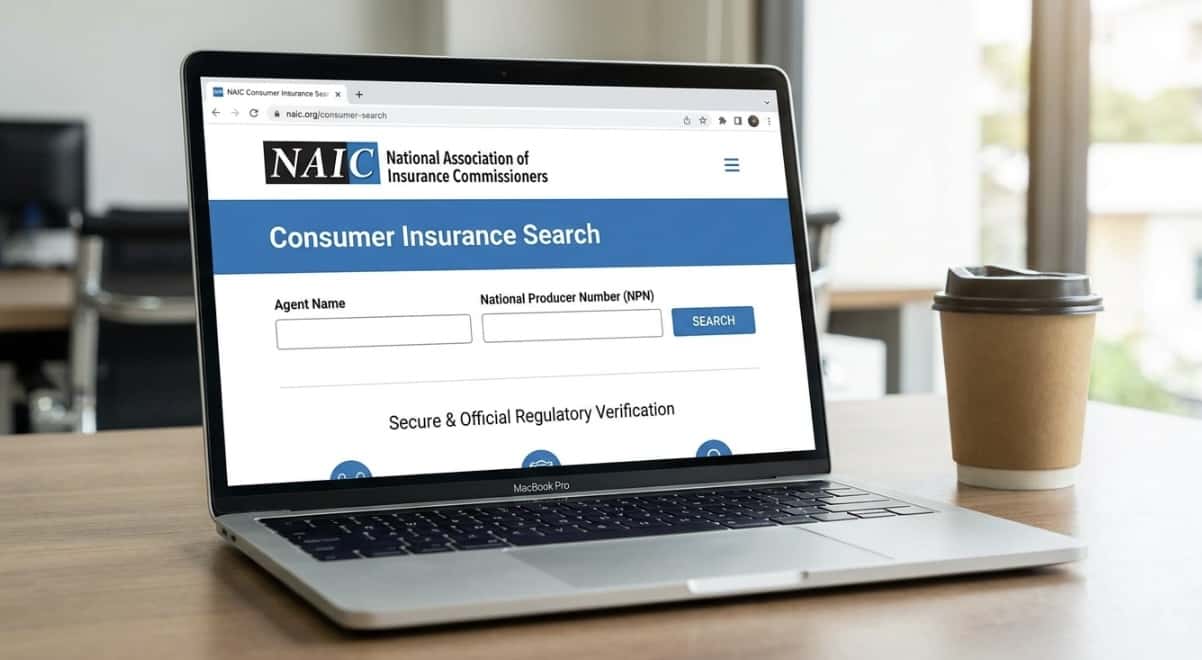
Step 2: Query the NAIC Consumer Search Database
Once you have the agent’s name and NPN, bypass their website entirely and navigate to the official website of the National Association of Insurance Commissioners (NAIC). Use their free Consumer Insurance Search tool to look up the agent. This database will show you if their license is active, which specific states they are legally allowed to sell insurance in, and which insurance companies they are officially appointed to represent. To effectively avoid life insurance scams elderly shoppers must confirm that the agent is fully authorized to do business in their state.
Step 3: Cross – Check the Financial Strength of the Carrier
Do not buy a policy from an insurance company that lacks solid financial backing. Look up the issuing company on major credit rating platforms like A.M. Best, Moody’s, or Standard & Poor’s. You want to see a financial strength rating of “A” or better, which guarantees the company has the deep capital reserves required to pay out a death benefit decades down the road.
Evaluating Legitimate Senior Insurance Options
When seeking real, verified protection, knowing what standard, legitimate policies look like makes it much easier to stay safe. Legitimate coverage for older adults typically falls into three main categories, each with distinct rules and limitations.
| Policy Type | Maximum Typical Coverage | Underwriting Requirements | Payout Structure | Best Suited For |
| Final Expense / Burial | $5,000 to $35,000 | Simplified health questions; no physical exams required. | Full immediate payout from day one if approved. | Covering funeral costs, local medical debts, and small estate closures. |
| Guaranteed Acceptance | $5,000 to $25,000 | Zero health questions asked; approval is fully guaranteed. | Graded death benefit (typically a strict two – year wait). | Seniors with severe pre – existing conditions like active cancer or recent strokes. |
| Senior Term Life | Varying limits | Full medical history review; sometimes requires a physical exam. | Expires completely when the set term length ends. | Covering a temporary debt, like a remaining 10 – year mortgage. |
Insider Insight on Graded Benefits: If you buy a guaranteed acceptance policy, protect yourself from deceptive agents by reading the fine print regarding the graded benefit period. If you pass away from natural health causes during the initial two years, your family will not receive the full face value; they will instead receive a refund of all your paid premiums plus roughly 10% interest. Legitimate agents will explain this clearly; scammers will deliberately hide it.
The Safe Path to Acquiring Insurance Quotes
Because I operate entirely as an independent financial researcher and blogger, I do not sell insurance policies, nor can I generate binding legal insurance quotes for your family. To completely bypass the world of aggressive telemarketing scams and deceptive direct – mail cards, you should always take charge of the initiation process yourself.
The safest way to evaluate real, market – grade pricing across multiple A – rated insurance companies simultaneously is to utilize a transparent, independent insurance comparison platform. I highly recommend using Policygenius at https://www.policygenius.com to check your customized, real – time rates for free. Doing your own digital research on an independent aggregator shields you from high – pressure tactics because you control the flow of communication.
If you are exploring these options for an older loved one, navigating the specific age brackets can be highly confusing. Taking the time to understand the unique landscape of buying life insurance for elderly parentrequirements can save you thousands of dollars in lost premiums and protect you from predatory replacement schemes. If you remain vigilant and implement structured checks, you can completely avoid life insurance scams elderly individuals are vulnerable to during stressful transitions.
Emergency Steps: What to Do If You Have Been Scammed
If you discover that you or an elderly relative has accidentally fallen victim to a fraudulent life insurance scheme, you must act immediately to minimize financial exposure and initiate regulatory enforcement.
1. Notify Your Financial Institution Immediately
Call the fraud department of your bank or credit card issuer. Instruct them to place an immediate hard freeze on your accounts or issue a stop – payment order on any automated clearing house (ACH) transaction details that the scammer acquired. This prevents future monthly premium drainage.
2. File a Comprehensive Report with Your State Insurance Commissioner
Every state has an official Department of Insurance tasked with prosecuting unlicensed sales activity and consumer fraud. Submit a formal complaint containing the scammer’s phone numbers, physical mailers, email addresses, and a copy of any fake policy documents. To successfully avoid life insurance scams elderlyadvocates must report these incidents to ensure state authorities can shut down rogue call centers.
3. Report the Incident to Federal Fraud Databases
Because these scams often cross state lines via the internet or phone networks, submit a digital report to the Federal Trade Commission (FTC) through their official consumer protection portal, and file a cybercrime complaint with the FBI’s Internet Crime Complaint Center (IC3).
To effectively avoid life insurance scams elderly buyers must recognize that staying educated is a continuous process. For those exploring coverage options for relatives in advanced age brackets, it helps to understand what real underwriting limits look like. For instance, reading up on the options surrounding whether an 80 year old can get life insurance safely through legitimate channels will give you a baseline of real, factual market expectations so you can spot an impossible scam offer instantly. Families must work closely together to ensure they can avoid life insurance scams elderly tricksters continuously refine.
Frequently Asked Questions (FAQs)
How can I easily avoid life insurance scams elderly family members fall for?
The most effective way to avoid life insurance scams elderly buyers target is to establish a household rule that no coverage will ever be purchased during an incoming cold call or from a direct – mail postcard. Always initiate the shopping process yourself through verified platforms.
Can an insurance company cancel my policy because I get older?
No. If you purchase a legitimate permanent whole life insurance policy or a final expense plan, the contract cannot be cancelled by the insurance carrier due to your increasing age or declining health, provided you continue to pay your monthly premiums on time.
Why do I keep getting senior benefit cards in my mailbox?
These cards are almost always created by independent, third – party lead – generation companies rather than real insurance providers. They use official – sounding titles to trick you into mailing back your phone number and signature, which they then sell to aggressive, high – pressure telemarketing groups.
How can I tell if an insurance company website is real or a fake clone?
Always look closely at the URL in your web browser’s address bar. Fake clone websites will often have slight misspellings, use uncommon domain extensions (like .net or .info instead of .com), or lack a secure padlock symbol (HTTPS). When in doubt, search for the company directly on the NAIC website to find their verified portal link.
Are no – medical – exam policies always a scam?
No. Many reputable insurance companies offer legitimate no – medical – exam life insurance options for older adults, which rely on your electronic medical prescriptions and historical medical records for underwriting.However, because these policies are widely sought after, scammers frequently use the phrase “no medical exam required” as clickbait to lure seniors into sharing sensitive identity data.
Is there a penalty if I cancel a life insurance policy during the first month?
No. Legitimate insurance policies feature a consumer safety window known as a “free look period,” which typically lasts between 10 to 30 days depending on your state’s specific laws. During this time, you have a legal right to cancel the policy for any reason and receive a 100% refund of all premiums paid.
Conclusion
Securing final expense protection should be an empowering act that delivers profound peace of mind – not an administrative nightmare wrapped in financial vulnerability. To permanently avoid life insurance scams elderly individuals face, you must commit to a family strategy of slow, deliberate verification. If you want to avoid life insurance scams elderly rings deploy, you must ensure that your loved ones never allow an inbound call to dictate their retirement budget.
By taking control of the process to successfully avoid life insurance scams elderly predators construct, you keep your sensitive banking details locked away until an agent’s license status is verified. Protecting your family helps everyone safely avoid life insurance scams elderly operators coordinate across the country, insulating your retirement assets from fraud while building a reliable, legitimate safety net for the people you love most.