
High limit no exam life insurance is a specialized financial product that allows qualified applicants to secure substantial death benefits – often ranging from $1 million to as high as $5 million or more – without undergoing a traditional physical medical examination. For decades, if you wanted to protect a multimillion-dollar mortgage, fund a corporate buy-sell agreement, or establish a robust legacy for your heirs, you had to endure an insurance nurse coming to your home to take your height and weight, draw vials of blood, and collect urine samples.
The financial landscape has completely shifted. Today, advanced data analytics, instant electronic medical records (EMR), and algorithmic risk-scoring models allow top-tier insurance carriers to review your comprehensive medical footprint instantly, making it entirely possible to secure a premium policy in minutes rather than months.
When I was looking into this type of large-scale coverage for my own family’s long-term financial planning, I was amazed at how rapidly the industry has evolved. The thing that trips up most readers I talk to is the outdated assumption that skipping the medical checkup automatically means you are restricted to a tiny burial policy with sky-high premiums. That is a massive misconception. We are talking about serious, high-leverage financial protection designed for busy professionals, high earners, business owners, and families who need robust financial safety nets without the scheduling headache of traditional underwriting.
By utilizing high limit no exam life insurance, healthy individuals can bypass the needles entirely while maintaining premium pricing parity with traditionally underwritten coverage.
Table of Contents
The Evolution of Accelerated Underwriting
To understand why high limit no exam life insurance is widely available, you have to look under the hood of what the insurance industry calls accelerated underwriting (AU). This is not a gimmick, nor is it a high-risk gamble by the insurance companies. It is a data-driven evolution powered by artificial intelligence and real-time database queries.
In the past, life insurance companies used your physical fluids to detect underlying health issues like high cholesterol, nicotine use, diabetes, or kidney markers. In the modern financial market, insurers rely on your digital footprint to assess the exact same risks. When you sign a digital life insurance application, you grant the carrier permission to query several secure, independent databases using your Social Security number and legal name.
The Core Data Networks Behind Instant Approvals
Within seconds, automated underwriting algorithms pull and analyze your records from across the country to construct an incredibly accurate picture of your overall health profile. The main data networks utilized during this process include:
- The MIB Group: A central database shared among insurance companies that logs your previous insurance applications, medical conditions, and hazardous hobbies you have formally disclosed to other carriers. It prevents fraud and flags inconsistencies across applications.
- Rx History Databases: Platforms like Milliman IntelliScript or Truven Health Analytics that track your prescription drug history over the last 5 to 7 years. This data reveals exactly what medications you take, the dosages, and your historical compliance patterns, which instantly signals chronic illnesses to the insurer’s software.
- Motor Vehicle Records (MVR): Your driving history, which flags reckless driving, driving under the influence (DUI) convictions, or major moving violations. Insurers view a history of reckless driving as a significant actuarial risk, often more dangerous than minor health fluctuations.
- FCRA-Compliant Consumer Data: Public financial records regarding active bankruptcies, significant tax liens, or legal judgments that impact an applicant’s financial stability and risk profile.
By combining these real-time data streams, carriers can offer high limit no exam life insurance to healthy individuals instantly. If the algorithms process your files and find a clean record, your policy is approved immediately at standard or preferred rates. However, if the software flags an anomaly – such as an unexplained high-risk prescription or a mismatched medical history entry – your application is simply shifted to traditional underwriting, where a physical exam may then be requested to clarify the risk.
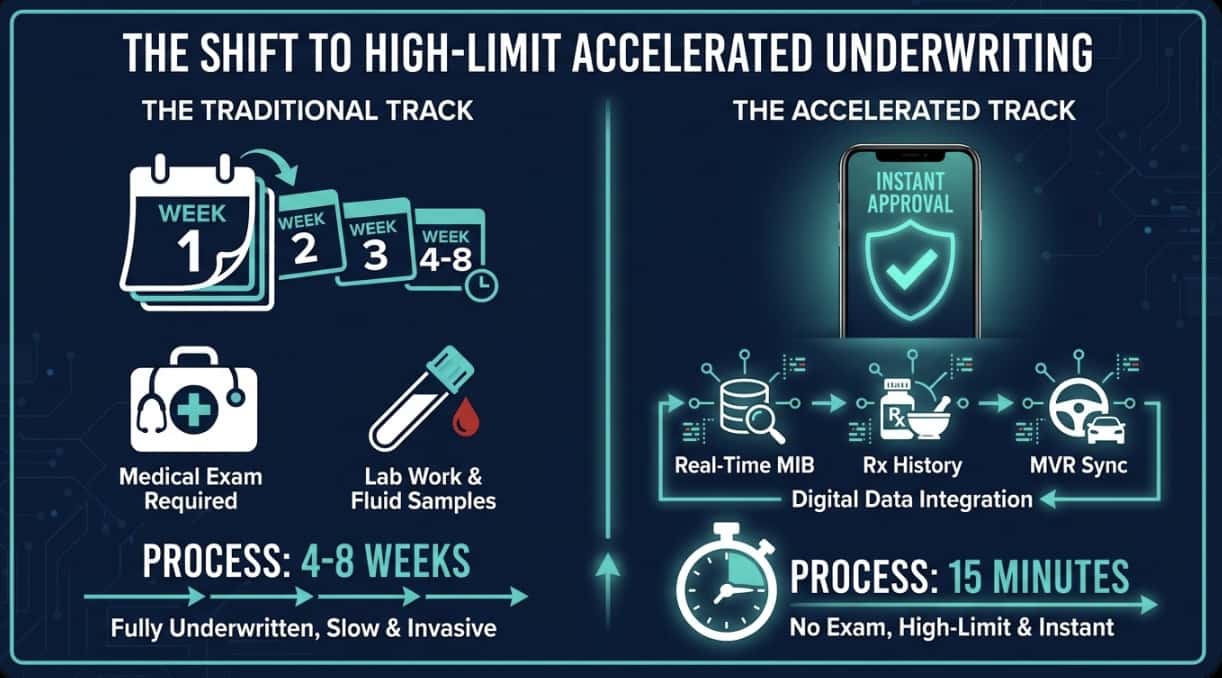
Comparing Traditional Policies vs. High Limit No Exam Life Insurance
It helps to see exactly how these two approaches stack up side-by-side in the marketplace. The right choice depends heavily on your age, your current health status, and how quickly you need the death benefit active to cover your liabilities.
| Feature or Metric | Traditional Fully Underwritten Life Insurance | High Limit No Exam Life Insurance (Accelerated) |
| Maximum Coverage Limits | Virtually unlimited ($50M+) | Typically capped between $1,000,000 and $5,000,000 |
| Time to Approval | 4 to 8 weeks on average | Anywhere from 15 minutes to a few business days |
| Physical Exam Required | Yes (Blood draws, urine samples, EKG) | No (Completely bypassed for qualified applicants) |
| Data Gathering Method | Manual physician statements and physical labs | Algorithmic database queries (MIB, Milliman, MVR) |
| Cost Comparison (Healthy) | Baseline standard and preferred pricing structures | Exact parity with traditional pricing (No premium penalty) |
| Ideal Applicant Profile | Complex health histories needing manual review | Clean health records wanting speed and convenience |
As the data illustrates, the gap between traditional structures and accelerated platforms has shrunk dramatically. If you are generally healthy, there is almost no financial downside to utilizing an accelerated path, as you receive the exact same competitive rates without the multi-week waiting period.
Critical Differences: Accelerated Underwriting vs. Simplified and Guaranteed Issue
One of the most dangerous mistakes a consumer can make when shopping for coverage online is confusing high limit no exam life insurance with other forms of no-exam coverage. The insurance market categorizes no-exam products into three completely distinct buckets, and choosing the wrong one can cost you thousands of dollars in unnecessary premiums.
1. Accelerated Underwriting (True High-Limit No-Exam)
This is the modern tier discussed throughout this guide. It offers high limits up to several million dollars, requires a detailed digital health questionnaire, uses background database checks, and provides the lowest possible rates identical to traditional medical-exam policies. It is designed explicitly for healthy individuals who want a fast, high-leverage policy.
2. Simplified Issue Insurance
This fields an option that scales back the background checks and relies on a short list of specific yes or no health questions. Because the company gathers less data, they take on more risk. To compensate, they cap the maximum coverage amounts at lower thresholds – usually around $50,000 to $100,000 – and charge higher base premiums. This is often an ideal match for individuals looking into whole life insurance for seniors with pre-existing conditions who might not qualify for elite tiers but still have manageable health issues.
3. Guaranteed Issue Insurance
This tier features zero health questions and zero medical exams. If you meet the age requirements, you are automatically accepted regardless of medical history. However, because the insurer is flying completely blind, this is the most expensive type of coverage per dollar of protection. These policies are usually capped at low amounts and include a strict waiting period before full benefits apply.
Critical Industry Warning: Never assume that high limit no exam life insurance policies are guaranteed acceptance. You must still answer an extensive online health questionnaire with complete honesty. Intentionally concealing medical history will result in your policy being flagged during the database sweep or a denied claim due to material misrepresentation during the two-year contestability period.
Strategic Financial Applications of High-Limit Coverage
Opting for a high limit no exam life insurance policy is not just about avoiding a needle prick or cutting down on paperwork; it is a highly strategic financial move used by affluent families and business professionals to secure assets rapidly.
Business Continuation and Buy-Sell Agreements
In the corporate world, if a business partner passes away unexpectedly, the surviving partners need immediate liquidity to buy out the deceased partner’s shares from their heirs. If a buy-sell agreement is valued at $2 million, waiting two months for a traditional life insurance policy to clear underwriting leaves the business vulnerable to operational disruption. High limit no exam life insurance allows partners to bind multi-million dollar coverage in days, securing the business continuity timeline flawlessly.
Collateral Assignment for Commercial Loans
If you are securing a large commercial loan or an SBA loan to expand your business, lenders almost universally require you to take out a life insurance policy equal to the loan amount, naming the lender as the primary collateral assignee. If your loan closing date is set for two weeks from today, a traditional underwriting delay can hurt the deal. Bypassing the exam via an accelerated policy allows you to secure a $1 million or $2 million policy quickly, satisfy the lender’s collateral mandates, and close on your business financing without a single delay.
Instant Estate Liquidity
For high-net-worth families, estate taxes can severely diminish the value of wealth passed down to the next generation. If your estate holds illiquid assets like real estate, commercial developments, or private equity, your heirs may be forced to sell those assets at a steep discount just to pay federal estate taxes within the government’s strict deadlines. Securing a high limit no exam life insurance policy provides your estate with instant, tax-free cash liquidity, preserving your primary wealth from forced liquidation. For those coordinating complex wealth management plans, integrating this type of quick-issue coverage with strategies like the best life insurance for estate planning ensures your heirs are protected from sudden liquidity crises without delaying your overall financial timeline.
Key Eligibility Factors: How to Stay on the No-Exam Track
Because the insurance carrier is taking on a multi-million-dollar risk without physically testing your blood or measuring your vitals in person, their underwriting software is highly selective. To maximize your chances of getting approved for a high limit no exam life insurance policy without being derailed into traditional testing, you must meet clear lifestyle and health benchmarks.

Age and Coverage Correlation
Your age dictates the absolute ceiling of your automated approval limits. Insurance companies look at age as a primary risk indicator.
- Ages 18 to 40: This is the peak window for maximum limits. Healthy applicants can regularly secure up to $5,000,000 without an exam.
- Ages 41 to 50: Limits remain highly robust, typically capping out around $3,000,000 without an exam.
- Ages 51 to 60: Limits begin to scale back, capping out around $1,000,000 to $1,500,000 without an exam, depending on the carrier.
- Ages 61 and Over: True accelerated high-limit policies become rarer. Knowing how to properly navigate this process is essential, which is why understanding qualifying for no medical exam life insurance as a senior or a mature adult can help you set realistic expectations regarding what coverage ceilings are available without a medical visit.
Height and Weight Ratios (BMI)
Your body mass index (BMI) is one of the first metrics evaluated by the underwriting algorithm. Even if your digital medical records are flawless, falling into the severely underweight or obese categories on an actuarial build chart will instantly trigger a system flag. The software will pause the automated approval and request a manual check or a physical exam to confirm your physical build and check for related cardiovascular risks.
The Prescription History Threshold
The prescription data sweep is incredibly sophisticated. The algorithm checks not only the names of the drugs you have been prescribed but also the class of the medication and how long you have filled the prescriptions.
- What Qualifies Easily: Standard medications for well-controlled, minor conditions – such as basic blood pressure regulators or cholesterol-lowering statins – generally slip through the algorithm smoothly with zero penalties.
- What Triggers an Exam: Prescriptions for complex conditions like insulin for type 1 diabetes or biological treatments for autoimmune disorders will cause the system to default back to traditional underwriting to protect the carrier from unknown health risks.
Step-by-Step Guide: How to Apply for High Limit No Exam Life Insurance
The application process for high limit no exam life insurance is built for modern convenience, running entirely through secure digital portals. Following a systematic sequence ensures your personal data aligns perfectly with automated database records, preventing processing delays.
1.Gather Personal and Medical Data:Step 1.
Compile your essential documentation before starting. You will need your Social Security number, your current driver’s license number, and a precise list of any medications you have filled over the past seven years.
2.Calculate Your Exact Financial Needs:Step 2.
Determine the exact capital required to protect your financial ecosystem. Factor in your outstanding mortgage balance, active business debts, future college tuition costs for your children, and a baseline income-replacement multiplier.
3.Complete the Digital Health Questionnaire:Step 3.
Log into the carrier’s secure portal and answer the comprehensive health, lifestyle, and family medical history section. Be incredibly specific regarding dates of past diagnoses and resolved minor surgeries.
4.Authorize Electronic Background Checks:Step 4.
Provide your formal electronic signature giving the insurance carrier legal consent to run automated checks across the MIB, prescription histories, and motor vehicle records to verify your health file in real time.
5.Receive Your Instant Underwriting Decision:Step 5.
Once submitted, the algorithm will process your entire risk profile. Within minutes, you will receive an immediate approval offer or a notification regarding secondary underwriter review.
Because I am an independent financial researcher and content writer, I do not sell insurance policies, underwrite files, or generate binding insurance quotes myself. To view your customized, real-time rates across multiple competitive tiers and see which top-rated carriers offer the best high limit no exam life insurance for your specific demographic profile, I highly recommend checking out the free, independent comparison platform Policygenius. They allow you to safely compare multiple accelerated no-exam policies side-by-side without any initial financial commitment.
Long-Term Maintenance: Keeping Your Policy Secure
Securing your high limit no exam life insurance policy is a major financial milestone, but your responsibilities do not end once the coverage is formally active. Managing your policy actively ensures it adapts seamlessly to your evolving net worth and estate planning goals over time.
Navigating the Contestability Period
Every life insurance policy features a strict two-year contestability period from the date the policy goes into effect. During these first 24 months, if the insured passes away, the insurance company has the legal right to thoroughly audit the initial application, medical files, and physician records to ensure no material information was intentionally withheld or falsified. With high limit no exam life insurance, this period is treated with extreme care by claims adjusters because no physical fluids were evaluated at the time of purchase. Ensuring absolute transparency on your initial digital questionnaire is your absolute best protection against future claims delays.
Annual Policy Reviews
Your financial landscape is dynamic. A policy that perfectly covers your financial liabilities today may leave you underinsured or overinsured five years from now. Set an annual calendar reminder to review your policy coverage alongside major life events, such as paying down a primary commercial mortgage, selling a business division, or experiencing changes in your overall family landscape. If you are tracking coverage choices as you age, reviewing resources like mistakes to avoid in life insurance for seniors over 80 can protect your long-term plan from structural gaps. Keeping your policy calibrated ensures you never pay excess premiums for coverage you no longer need, while guaranteeing your family’s core wealth remains fully insulated against life’s uncertainties.