Avoiding financial scams targeting seniors is the strategic process of identifying, intercepting, and preventing fraudulent schemes designed to illicitly acquire the retirement savings, personal identities, or financial assets of older adults. As bad actors deploy increasingly sophisticated technology – including artificial intelligence voice cloning, automated phishing networks, and deepfake communications – safeguarding generational wealth has transformed from a casual habit into an absolute necessity.
When I first began reviewing the broader landscape of modern senior finances for my own family, I realized something alarming. The financial system expects older Americans to navigate an absolute minefield of complex disclosures, digital banking setups, and high – pressure sales tactics entirely on their own. I am an independent researcher and a deeply passionate advocate for financial literacy who has spent hundreds of hours analyzing regulatory warnings, database networks, and consumer defense strategies. The reality is clear: modern fraudsters do not just look for vulnerable people – they look for gaps in education and isolation. The process of avoiding financial scams targeting seniors requires continuous vigilance and proactive education.
The thing that trips up most readers I talk to is the assumption that scams are always obvious. They assume fraud always looks like a poorly typed email from a foreign prince. In 2026, however, financial crimes are corporate, polished, and highly targeted. To help you or your elderly loved ones maintain complete control over your hard – earned assets, this exhaustive guide breaks down the psychological machinery behind these crimes, uncovers the most prevalent modern schemes, and provides an actionable blueprint for avoiding financial scams targeting seniors.
Table of Contents
Why Older Adults Are Targeted by Modern Financial Criminals
To build an effective defense, we must first understand why avoiding financial scams targeting seniorsrequires a specialized approach. Fraudsters do not pick their targets at random; they use calculated metrics based on societal trends, asset accumulation, and behavioral psychology.
The Accumulation of Generational Wealth
Seniors hold a disproportionate share of global wealth. Over a lifetime of working, saving, investing, and paying down mortgages, individuals over the age of 60 have built substantial home equity, healthy retirement portfolios, and reliable streams of passive income. Criminals are acutely aware that targeting a younger demographic yields limited immediate payouts, whereas tapping into a senior’s life savings can result in windfalls worth tens or hundreds of thousands of dollars. This high concentration of liquid assets is the primary reason why avoiding financial scams targeting seniors has become a multi – generational defensive priority.
Vulnerabilities Induced by Cognitive and Technological Shifts
The digital landscape evolves at a breakneck pace. For a senior who grew up in an era dominated by paper receipts, face – to – face banking relationships, and handwritten checks, the shift to decentralized digital finance can be disorienting. Furthermore, natural cognitive changes can sometimes impact an individual’s abstract risk assessment capabilities, making it more challenging to spot highly polished digital manipulations or recognize the subtle inconsistencies of a phishing attempt. Therefore, avoiding financial scams targeting seniorsmust account for these shifting technological baselines.
Isolation and the Weaponization of Loneliness
Social isolation is one of the most powerful leverage points a scammer can exploit. When a senior lives alone or has limited daily interactions with family members, an incoming phone call or a friendly direct message on social media can be a welcome distraction. Fraudsters are trained manipulators who use rapport – building techniques to establish deep psychological trust before executing their financial traps, which makes avoiding financial scams targeting seniors a community – wide responsibility.
Anatomy of the Most Dangerous Scams in 2026
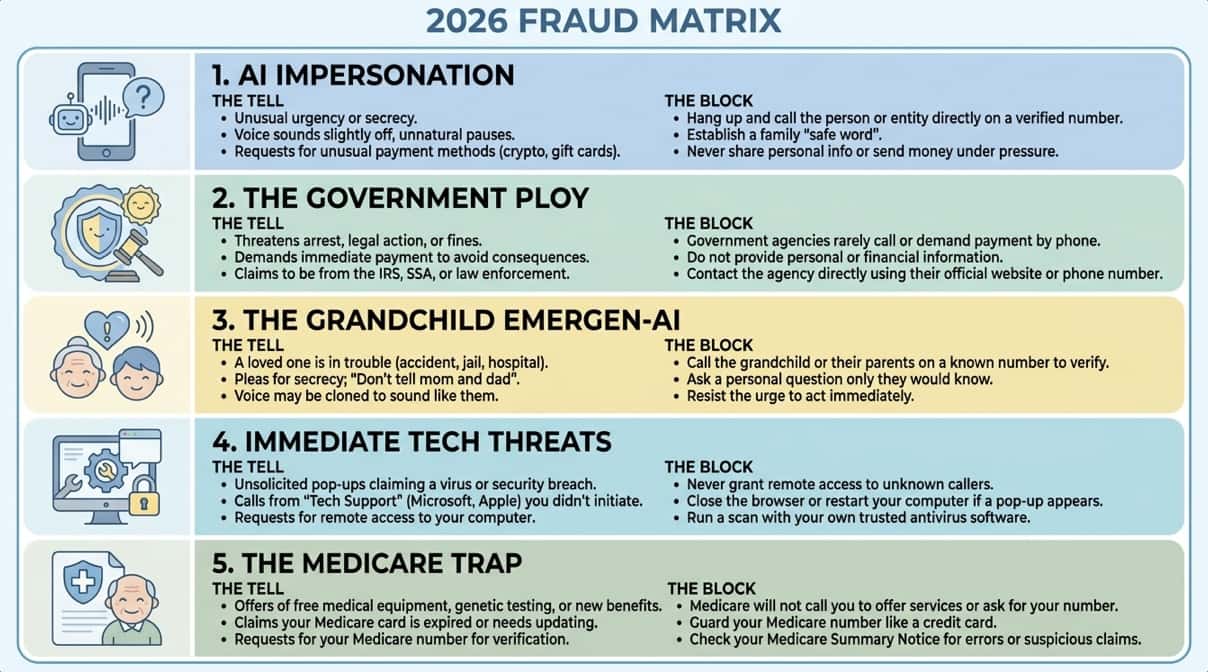
Fulfilling the goal of avoiding financial scams targeting seniors requires a granular understanding of the specific operational playbooks used by modern criminals. Below are the most disruptive and financially devastating schemes currently circulating in 2026.
1. The Artificial Intelligence Grandparent Scam
The classic “grandparent scam” has received a terrifying technological upgrade. Historically, a scammer would call an older adult pretending to be a grandchild in a desperate situation – such as being stuck in a foreign jail or involved in a car accident – and beg for emergency wire transfers.
In 2026, bad actors utilize easily accessible AI voice cloning tools. By scraping a short, 30 – second video clip from a grandchild’s public Instagram or TikTok profile, criminals can perfectly replicate their vocal cadence, pitch, and emotional tone. The senior receives a call where the voice sounds exactly like their loved one, crying and pleading for immediate financial help. Successfully avoiding financial scams targeting seniors of this nature requires establishing family verification protocols before an emergency occurs.
2. Tech Support and Computer Hijacking Schemes
This scam typically begins with a sudden, loud, flashing pop – up window on a senior’s computer screen, claiming the operating system is infected with an aggressive virus or that their bank accounts are currently being hacked. The message provides a toll – free helpline number and warns that shutting down the computer will result in permanent data loss.
Once the senior calls the number, a polished “technical support specialist” instructs them to download a remote access software utility. Once granted access, the criminal can spy on open browser tabs, scrape saved passwords, install keystroke loggers, or manually transfer funds out of investment accounts while claiming they are moving the money to a secure government safety vault. When protecting an online household, avoiding financial scams targeting seniors means never letting an unverified stranger install software on your device.
3. Government Impersonation and Regulatory Fraud
Seniors rely heavily on stable, predictable government programs to manage their living expenses. Criminals exploit this dependence by posing as representatives from the Social Security Administration, the Internal Revenue Service, or Medicare management networks.
The fraudster may threaten that the senior’s monthly benefits will be permanently suspended unless they verify their identity by revealing their Social Security number, or they may claim that unpaid back taxes must be settled immediately via untraceable payment methods like cryptocurrency or prepaid gift cards. Education is your best tool for avoiding financial scams targeting seniors, as official government agencies will never demand payment over the phone using gift cards or crypto assets.
4. Direct Sweepstakes, Lotteries, and Inheritance Traps
The victim is informed via phone, mail, or email that they have won a massive international sweepstakes or inherited a vast sum of money from a distant, long – lost relative. However, to unlock the payout, the recipient is told they must first pay a series of upfront processing fees, customs duties, or legal registration taxes. Once the initial fee is paid, the scammers invent a continuous sequence of new bureaucratic delays, requiring additional payments until the senior’s liquid capital is entirely exhausted. For those committed to avoiding financial scams targeting seniors, the golden rule remains absolute: if an offer sounds too good to be true, it is undoubtedly a trap.
Deceptive Practices in Financial and Insurance Products
While explicit criminal operations are a major threat, avoiding financial scams targeting seniors also extends to navigating the gray areas of predatory financial products, aggressive sales tactics, and misleading insurance marketing.
Predatory Insurance Policies and Overpricing
A major concern for older adults on a fixed budget is ensuring their final obligations do not place an undue burden on their adult children. Unfortunately, the market is saturated with misleading advertisements promising incredibly low rates for senior coverage that conceal structural traps.
For instance, many widely advertised term policies for older demographics feature escalating premium tiers that double or triple in cost every five years, forcing the policyholder to drop the coverage when they can no longer afford it. When researching protection options, it is critical to evaluate the differences between structural designs, such as evaluating no medical exam life insurance vs traditional life insurance for seniors to determine which structure guarantees long – term financial safety without hidden price hikes.
Insider Industry Warning: Never sign up for a senior financial or insurance product that uses high – pressure “today only” deadlines. Reputable companies will always provide written documentation, policy illustrations, and a mandatory “free look” period – typically 10 to 30 days – during which you can cancel the contract for a full refund if you spot deceptive terms. Keeping this rule in mind is an essential component of avoiding financial scams targeting seniors during estate planning.
To safeguard against predatory practices, seniors should look for structured products with fixed premiums and guaranteed growth metrics, such as exploring the benefits of whole life insurance for seniors, ensuring that the policy acts as a legitimate estate tool rather than a draining financial liability.
Comparative Matrix: Genuine Financial Protection vs. Scam Red Flags
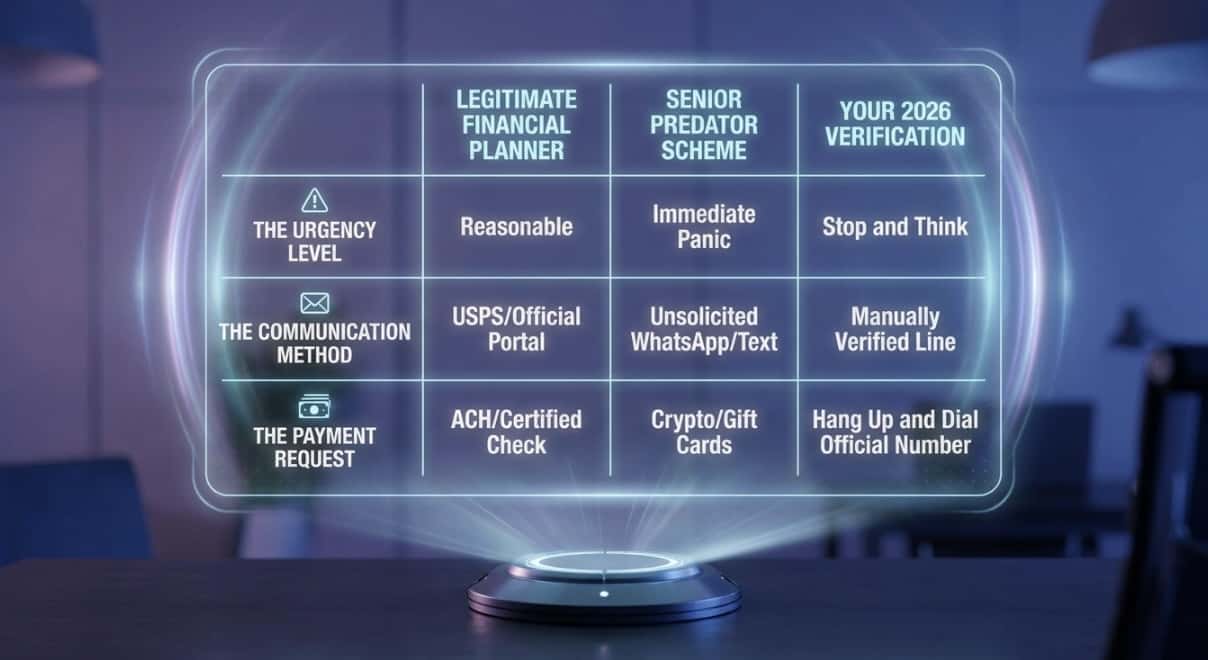
The following reference table outlines the clear, objective distinctions between legitimate financial operations and the hidden indicators of fraudulent schemes. Use this matrix to evaluate any unexpected financial communication or high – pressure sales pitch you receive, as it serves as a foundational checklist for avoiding financial scams targeting seniors.
| Operational Dimension | Characteristics of Legitimate Entities | Red Flags of Sophisticated Financial Scams |
| Primary Inbound Contact Method | Official letters sent via the USPS; authenticated notifications within secure banking portals. | Unsolicited phone calls, text messages, or direct messages on platforms like Facebook or WhatsApp. |
| Urgency and Timeline Demands | Reasonable grace periods; structured appeals processes; standard 30 to 90 – day compliance windows. | Demands for immediate action within hours; threats of imminent arrest, asset seizure, or account termination. |
| Accepted Payment Methods | Standard electronic funds transfers (ACH), physical paper checks, or secure online credit card gateways. | Requirements for prepaid gift cards, Western Union wire transfers, mail – cash shipments, or cryptocurrency deposits. |
| Information Request Scope | Will never ask for full passwords, PIN codes, or complete unmasked sensitive credentials over an inbound line. | Requests for remote computer access, screen – sharing configurations, or complete verification of sensitive personal data. |
| Contractual Documentation | Comprehensive, written disclosures; multi – page policy illustrations; legally binding terms provided before payment. | Vague verbal promises; hidden fees; refusal to provide comprehensive physical contracts prior to taking down payment data. |
Step – by – Step Blueprint for Verification and Defense
If you receive a suspicious communication or want to establish an unbreachable defense system for your family, execute this precise sequential verification protocol designed for avoiding financial scams targeting seniors.
- Enforce an Immediate Communication Freeze (Do Not React): If an inbound caller claims your accounts are compromised or a family member is in danger, hang up immediately. Do not click links inside text messages or emails. Do not engage in conversation, as scammers track conversational responses to gauge compliance.
- Locate and Use Independent Verification Channels (Bypass Provided Info): Never use the phone numbers, URLs, or support hotlines provided by the incoming source. Flip over your physical credit card to find the official customer service number, look at a real utility statement, or navigate manually to your bank’s authenticated domain. This manual override is highly effective for avoiding financial scams targeting seniors.
- Verify through an Independent Party (Consult Trusted Sources): Contact a family member directly through a known personal number to verify any emergency claims, or call your independent financial representative. If dealing with complex health insurance issues, meticulously cross – reference guidelines regarding medicare costs and budgeting before making adjustments.
- Report to Regulatory Enforcement Bodies (Document the Event): If you confirm that the interaction was an attempted fraud, report the exact phone numbers, email headers, and corporate names to the Federal Trade Commission (FTC) or the Internet Crime Complaint Center (IC3). Sharing this data aids the global effort of avoiding financial scams targeting seniors.
Navigating the Senior Insurance Marketplace Without Getting Scammed
One of the areas where avoiding financial scams targeting seniors is most challenging is within the senior life insurance sector. Because premium costs naturally increase with age, seniors are highly motivated to find affordable rates, which makes them prime targets for misleading ads promising unrealistically cheap coverage.
Spotting Fake Underwriting Claims
Many scams target the elderly by claiming they have been pre – approved for high – limit whole life policies regardless of their health history, only to collect sensitive medical or banking data for identity theft purposes. When searching for legitimate coverage, it is essential to understand the real underwriting parameters. For individuals with serious health histories, navigating specialized resources such as whole life insurance for seniors with pre-existing conditions helps anchor your expectations in real market realities rather than fraudulent claims.
Furthermore, if a senior is over a specific age milestone, they must recognize what is legally and financially feasible. Reading up on the distinct rules for advanced ages – such as the specific details surrounding life insurance for seniors over 80 – protects you from falling for deceptive advertisements that make impossible promises about coverage caps or premium rates, thereby assisting you in avoiding financial scams targeting seniors.
Protecting Your Household Budget from Hidden Debts
A critical part of avoiding financial scams targeting seniors is ensuring that your retirement income is spent on valid asset structures rather than draining policies that put you into a negative cash flow cycle. Scammers often target seniors who are already worried about avoiding debt in retirement, offering fake debt – consolidation loans or high – fee reverse mortgages that strip the equity directly out of their homes.
If you are evaluating legitimate options to protect your family or handle final burial expenses, avoiding financial scams targeting seniors means ignoring the pop – up ads and relying on verified, highly rated independent comparison tools.
Actionable Rate Check: Because I am an independent researcher and not a commercial insurance broker, I do not provide direct bindings or fake internal calculators on this blog. To view accurate, real – time, customized insurance rates from highly rated, verified carriers without high – pressure sales tricks, I highly recommend checking out the independent coverage platform Policygenius at https://www.policygenius.com. Using verified aggregators is an excellent methodology for avoiding financial scams targeting seniors.
Advanced Digital Hygiene and Asset Protection Techniques
To ensure comprehensive success in avoiding financial scams targeting seniors, households should implement advanced digital defenses that systematically block scammers from accessing family assets.
- Establish a Multi – Generational Family Safe Word: Create a unique, private phrase known only to immediate family members. If a senior receives an emergency call from a voice that sounds like a child or grandchild, they must ask for the safe word. If the caller cannot provide it, the senior can confidently hang up, knowing it is an AI voice clone. This simple habit is incredibly powerful for avoiding financial scams targeting seniors.
- Deploy Robust Identity Theft Monitoring Systems: Use reputable credit monitoring services to lock your credit reports with Equifax, Experian, and TransUnion. Locking your credit prevents fraudsters from opening unauthorized credit cards or lines of debt in your name even if they manage to obtain your Social Security number.
- Transition to Secure Digital Payment Solutions: Avoid using wire transfers or physical paper checks whenever possible. Paper checks expose your routing number and account number to anyone handling the mail, which can lead to check – washing fraud. Utilize encrypted credit cards or authenticated digital payment platforms that offer built – in fraud reimbursement protections to support your goals of avoiding financial scams targeting seniors.
What to Do If You or a Loved One Has Been Defrauded
If a scammer successfully bypasses your defenses, time is your most valuable asset. Taking immediate, decisive action can mitigate financial damage and increase the chances of asset recovery. Even when you are deeply focused on avoiding financial scams targeting seniors, breakthroughs can occur, and knowing how to respond is vital.
- Notify Your Financial Institutions Instantly: Call the fraud department of your bank, credit card issuer, or investment firm immediately. Request a total freeze on the affected accounts, cancel compromised cards, and change all online banking credentials from a separate, clean device.
- File an Official Police Report: Visit your local law enforcement precinct to create an official record of the crime. Obtain a physical copy of the police report, as banks and insurance providers often require this documentation to reverse unauthorized transfers or process fraud claims. Your report adds to the collective intelligence used for avoiding financial scams targeting seniors on a national scale.
- Initiate a Comprehensive Credit Freeze: Contact the three major credit bureaus to place a formal fraud alert on your credit file. This ensures that any future attempt to exploit your identity will be flagged and halted automatically.
Frequently Asked Questions
What are the main signs that an incoming call is a financial scam?
The primary indicators include intense emotional pressure, extreme urgency requiring immediate action, a demand to keep the conversation secret from other family members, and a request for unconventional payment methods like gift cards, cryptocurrency, or rapid wire transfers. Legitimate banks and government regulators will never pressure you this way.
How do I protect my elderly parents from AI voice cloning fraud?
The most reliable protection technique is setting up a private family safe word that is never published online. If your parent receives an alarming emergency call from someone claiming to be a child or grandchild, they must calmly ask for the safe word. If the caller stalls, makes excuses, or hangs up, you know it is an AI clone.
Will a bank reimburse a senior who was tricked into transferring money?
It depends heavily on the payment method used and how quickly the fraud is reported. While federal regulations protect consumers against unauthorized transfers, banks are often legally limited in their ability to recover funds that the account owner technically authorized themselves during a scam. Reporting the event within minutes offers the highest probability of interception.
Why do fraudsters target senior citizens over younger demographics?
Seniors are primary targets because they possess the majority of generational wealth, built through home equity, retirement plans, and stable pensions. Criminals also look to exploit gaps in modern digital technology fluency and the natural social isolation that many older adults experience living alone.
Where should I report senior financial fraud and exploitation?
You should instantly document the interaction and file a formal report with the Federal Trade Commission (FTC) at ReportFraud.ftc.gov, your state’s Adult Protective Services (APS) division, and the FBI’s Internet Crime Complaint Center (IC3) at ic3.gov. If a local financial loss occurred, file a report with local police.
Final Thoughts on Securing Retirement Assets
Consistently avoiding financial scams targeting seniors requires a balance of healthy skepticism, updated digital habits, and open communication between family members. By recognizing the psychological tricks of modern fraudsters – such as artificial urgency, demands for unusual payment methods, and sophisticated digital masks – you can create an unbreakable barrier around your hard – earned retirement wealth. Never let a high – pressure sales pitch or an alarming inbound call scare you into making a hasty financial choice. Take your time, verify every claim through independent channels, and keep your financial future secure. Armed with the right information, avoiding financial scams targeting seniors is entirely achievable.