
Improve life insurance health rating metrics by understanding the underwriting criteria carriers use to assess your daily lifestyle habits, medical records, prescription history, and biometric data. When you take specific, proactive actions to elevate your underwriting classification, you directly reduce the perceived risk to an insurance provider, which translates into lower monthly premiums.
The thing that trips up most readers I talk to is the assumption that their health rating is set in stone once they receive their initial policy offer. In reality, whether you are preparing to submit a fresh application or you are trying to cut the costs of a policy you have owned for years, you possess far more leverage than you realize.
When I was looking into this for my own family, I discovered that moving just one tier up – from Standard to Preferred – can save an applicant thousands of dollars over the lifetime of a 20-year or 30-year term policy. Let’s take a deep look into how the life insurance medical exam operates, how underwriters weigh different chronic illnesses, and what concrete steps you can take today to secure the best possible rates.
Table of Contents
Decoding the Underwriting Tiers: Where Do You Sit?
Before you can actively work to improve life insurance health rating parameters, you have to understand exactly how the insurance industry categorizes human health risks. Underwriters generally split applicants into four main health classifications, alongside separate, more expensive tiers for tobacco users and complex medical histories.
- Preferred Plus (or Super Preferred): Reserved for individuals in exceptional physical health. You must have ideal height-to-weight ratios, flawless blood pressure readings, clean cholesterol markers, and no family history of early cardiovascular disease.
- Preferred: Excellent health overall, but perhaps with a minor issue like slightly elevated cholesterol that is well-controlled by a low-dose medication.
- Standard Plus: Better than average health, but with minor biometric variances or a family medical history that keeps you out of the top tiers.
- Standard: This represents the baseline average population risk. You might have moderate weight challenges, blood pressure that hovers near the upper limit of normal, or minor managed conditions.
- Table Ratings: If your health profile presents risks that fall below the standard baseline, companies apply table ratings. These are usually labeled alphabetically (Table A through Table P) or numerically (Table 1 through Table 16). Each progressive step adds a 25% surcharge to the base Standard premium rate.
- Smoker / Tobacco Ratings: If you have used nicotine products within the past 12 months, you will be placed into a tobacco tier, which can instantly triple your underlying premium costs regardless of your other health markers.
If you want to maximize your budget and find out where your initial health markers position you today, you can check your customized, real-time rates for free using the independent insurance comparison platform Policygenius. Using an independent tool lets you shop around without committing to a single carrier’s rigid underwriting rules.
The Financial Impact of Health Classifications
To understand why you should work hard to improve life insurance health rating categories, look closely at the numbers. The table below illustrates hypothetical premium variances for a healthy individual across different age cohorts and underwriting classes for a standard $500,000, 20-year term policy.
| Age / Cohort | Preferred Plus Premium | Preferred Premium | Standard Premium | Table B Premium (+50%) |
| Age 35 (Non-Smoker) | $22 / month | $29 / month | $42 / month | $63 / month |
| Age 45 (Non-Smoker) | $48 / month | $59 / month | $81 / month | $121 / month |
| Age 55 (Non-Smoker) | $112 / month | $138 / month | $195 / month | $292 / month |
| Age 65 (Non-Smoker) | $285 / month | $360 / month | $490 / month | $735 / month |
Insider Tip: Because every company relies on its own proprietary underwriting manual, an internal health condition that gets you a “Table B” rating at one company might qualify for a “Standard” rating at another. Working with an independent advisor is often the fastest way to improve life insurance health rating outcomes simply by matching your specific health files with the most lenient insurance company.
5 Short-Term Actions to Optimize Your Application Results
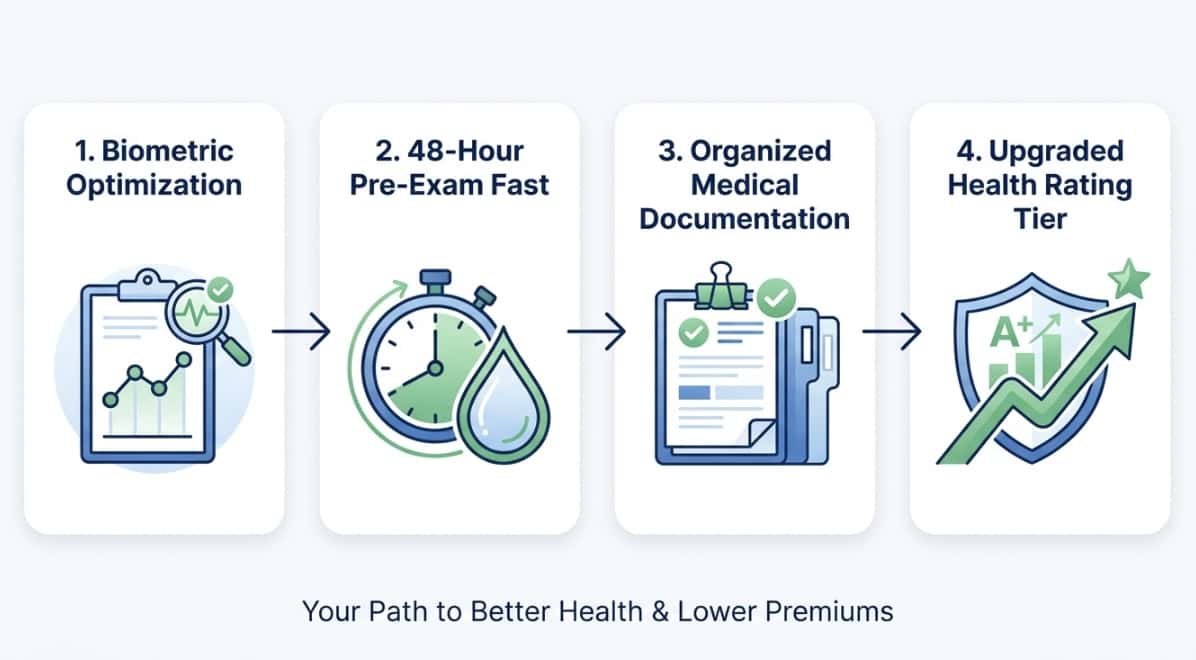
If you have a life insurance medical exam scheduled in the coming weeks, you do not have time to reverse years of health habits. However, you can prevent artificial spikes in your lab work. Follow this strict protocol to optimize your immediate data metrics and improve life insurance health rating chances on exam day.
1. Master the 48-Hour Pre-Exam Fast
What you put into your body in the two days leading up to your blood draw and urine test has an immense impact on your liver enzymes, blood sugar, and triglyceride levels.
- Avoid high-sodium, ultra-processed meals that can trigger temporary fluid retention and spike your blood pressure.
- Avoid all alcohol for at least 48 hours, as alcohol can temporarily raise liver enzymes and skew your cholesterol profiles.
- Drink plenty of water to ensure you are thoroughly hydrated, which makes blood draws easier and flushes out your urinary tract.
2. Eliminate Caffeine and Nicotine Before the Appointment
On the morning of your exam, skip your cup of coffee, energy drinks, or pre-workout supplements. Caffeine is a powerful stimulant that causes temporary vasoconstriction, driving up both your systolic and diastolic blood pressure numbers. Similarly, if you are a light or social smoker, using nicotine on the morning of the exam will send your heart rate skyrocketing. If you want to improve life insurance health rating values, keep your body as calm and rested as possible.
3. Schedule Your Exam for Early Morning
Request that the mobile phlebotomist visit your home or office early in the morning. When you complete the exam first thing after waking up, your body is naturally in its most rested state. You will have a true fasting blood sugar reading, and you will avoid the stressful environmental triggers – like traffic jams, work deadlines, or chaotic family routines – that can elevate your blood pressure later in the afternoon.
4. Organize Your Detailed Medical History Document
Do not force the underwriter to hunt through incomplete medical records. Prepare a clean, clear document listing your current primary care physicians, specialists, exact medication names, precise dosages, and the reasons for your prescriptions. When an underwriter sees a well-managed, highly organized health history, it creates a sense of compliance and stability, which can subconsciously help you improve life insurance health rating tiers during a manual file review.
5. Dress in Light, Comfortable Clothing
When the examiner records your height and weight to calculate your Body Mass Index (BMI), every pound counts. Wear lightweight clothing and be ready to step out of heavy shoes. Getting your weight recorded just two or three pounds lower can sometimes mean the difference between slipping under a strict BMI threshold for a higher health tier or falling into a more expensive premium bracket.
Long-Term Health Improvements That Lower Life Insurance Costs
If you have several months or a year before you plan to buy a major policy, you can implement deep behavioral adjustments. These long-term changes can permanently improve life insurance health rating metrics and save you significant sums over time.
Achieving a Stable, Healthy BMI Range
Insurance companies rely heavily on build charts to determine your baseline risk level. If you carry excess weight, setting up a sustained, safe caloric deficit to lower your weight can significantly alter your underwriting trajectory. However, be aware of the “rapid weight loss” trap. Underwriters know that people fast or crash-diet before an exam, so most carriers will look at your weight history. If you lost 40 pounds in the last six months, they will typically credit you with the average of your old weight and your new weight. To fully improve life insurance health rating tiers based on weight loss, you need to show you have maintained your new, healthier weight for at least 12 consecutive months.
Managing Cardiovascular Health and Blood Pressure
If you suffer from hypertension, working with your doctor to find a stable medication regimen is highly beneficial. Life insurance companies do not penalize you simply for taking blood pressure or cholesterol medications. In fact, an applicant with hypertension that is perfectly controlled to 120/80 via a standard prescription will receive a much better health rating than an unmedicated applicant whose readings constantly fluctuate into dangerous zones. Showing a consistent, documented history of normal readings is an excellent way to improve life insurance health rating classifications.
Establishing Flawless Blood Sugar Control
For individuals living with pre-diabetic markers or type 2 diabetes, your Hemoglobin A1c (HbA1c) reading is the primary metric underwriters analyze. An HbA1c below 6.0% indicates well-controlled blood sugar management. By embracing a diet rich in whole foods, managing carbohydrate intake, and prioritizing daily physical exercise, you can steadily lower your long-term glucose markers. Demonstrating steady control over your metabolic health is a reliable pathway to improve life insurance health rating results.
Embracing a Documented Smoking Cessation Program
Quitting smoking is the single most profitable financial decision an insurance applicant can make. To transition from a tobacco rate to a non-smoker rate, most major insurance carriers require you to be completely free of all nicotine products – including cigarettes, cigars, vapes, nicotine gum, and patches – for a full calendar year. Some ultra-preferred tiers require up to three or five years of total nicotine abstinence. If you use zero-nicotine lifestyle modifications and document your progress through regular physician visits, you can seamlessly improve life insurance health rating scores from a highly expensive smoker tier down to a clean standard or preferred non-smoker tier.
How to Lower Rates on a Policy You Already Own: The Reconsideration Strategy
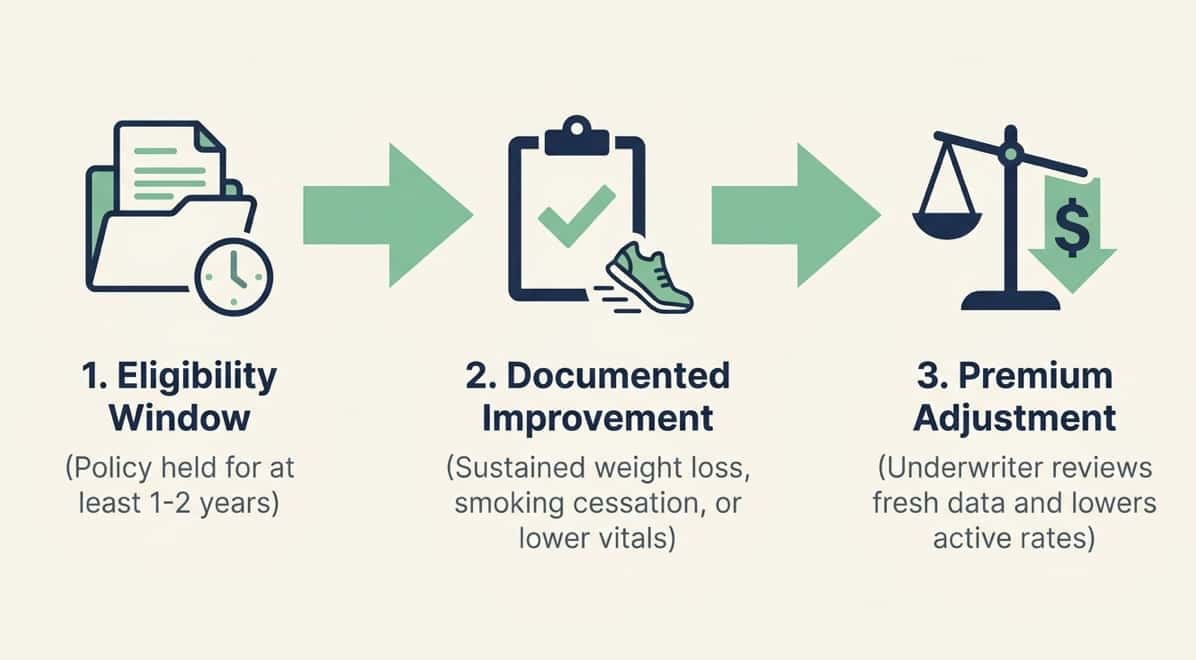
Many consumers do not realize that you can improve life insurance health rating assignments on a policy you already own. If you bought a term or permanent policy years ago when you were overweight, smoking, or dealing with an unmanaged health condition, you are not stuck with those high premiums forever.
You can contact your current insurance provider and request a formal rate reconsideration. During this process, the insurance company will review your current health profile. If you can provide fresh medical evidence showing that you have successfully managed your health, lost weight, or quit smoking for a sustained period, the carrier can legally drop your premium rates to match your new health classification.
Be careful when navigating a rate reconsideration. If you ask for a formal health review and your medical files reveal that you have developed a brand-new, serious health condition since you first bought the policy, the carrier cannot raise the premium on your existing policy – your original contract protects you from that. However, they will flatly deny your request for a rate upgrade.
If your health has improved significantly in some areas but worsened in others, you may want to look into other financial avenues. For instance, seniors mapping out retirement may want to look closely at how to balance their overall healthcare expenditures without jeopardizing their existing life insurance coverage protections by checking out medicare costs and budgeting.
Navigating Special Health Situations and Pre-Existing Conditions
If you are managing a major, chronic pre-existing medical condition, attempting to improve life insurance health rating assessments requires a highly specialized approach. Let’s look at how carriers view specific common health diagnoses in 2026.
Life Insurance with a History of Diabetes
When underwriters look at a diabetic applicant, they evaluate the age of onset, the type of diabetes, and the daily treatment method. If you manage your condition strictly through lifestyle habits or oral medications like Metformin, you can still qualify for highly competitive rates. To improve life insurance health rating categories as a diabetic, ensure your medical records show regular visits to your endocrinologist, zero hospitalizations for ketoacidosis, and a clean history free of secondary complications like neuropathy or retinopathy. You can review detailed options tailored for this profile in our report on life insurance for seniors with diabetes.
Securing Protection After a Cancer Diagnosis
Applying for coverage after fighting cancer requires a strong understanding of look-back periods. Underwriters will examine the specific type of cancer, the stage at diagnosis, the completion date of your treatments, and your subsequent pathology reports. Many carriers impose a mandatory waiting period – often ranging from two to ten years depending on the severity of the illness – before they will consider offering standard rates. To improve life insurance health rating parameters post-cancer, you must demonstrate a consistent schedule of clean, cancer-free oncological follow-up appointments. For historical context and carrier matching, check out the manual for life insurance for seniors with cancer history.
Managing Heart Conditions and Cardiovascular Risks
If you have a history of high blood pressure, an irregular heartbeat, or a past cardiovascular event, underwriters will look closely at your cardiac ejection fraction and stress test results. To improve life insurance health rating metrics here, you must demonstrate complete adherence to your cardiologist’s prescribed treatment plan. Taking your medications exactly as directed and maintaining an active, heart-healthy lifestyle are vital indicators of low risk. Read how carriers grade these conditions over in our guide on life insurance for seniors with heart conditions.
Senior-Specific Strategies for Improving Coverage Outcomes
As we navigate our golden years, our body’s natural biometric baselines change. Underwriters recognize this reality and often use age-routed build and blood pressure charts that are more forgiving for older adults. If you are shopping for coverage later in life, your approach to how you improve life insurance health rating metrics should shift toward age-appropriate financial tools.
Exploring Options Over the Age of 70
For individuals who have passed their 70th birthday, the traditional medical underwriting path can sometimes feel frustratingly strict. If you are seeking coverage to protect a spouse or handle outstanding liabilities, it is smart to analyze term vs permanent mechanics by checking out general strategies for life insurance for seniors over 70. If you specifically require temporary protection to cover a bridge loan or a business continuation agreement, exploring term life insurance for seniors over 70 can offer high-limit protection without forcing you through standard medical hurdles.
Navigating the Landscape Beyond Age 80
Once an applicant crosses the age 80 threshold, traditional fully underwritten policies become rare. At this stage, your focus often shifts from maximizing broad health tiers to protecting your family from sudden out-of-pocket costs. If you are navigating this transition, read through our review on whether can an 80-year-old get life insurance to locate options. If you have had trouble qualifying due to complex health records, it is helpful to look closely at permanent structures like whole life insurance for seniors over 80 or read about plans tailored for an 83-year-old get life insurance to find an optimal balance between premium costs and face value stability.
Leveraging Alternative Policy Types When Health Tiers Are a Barrier
If you have tried your best to improve life insurance health rating parameters but your current medical diagnosis prevents you from qualifying for a traditional plan, do not panic. The modern insurance market provides several alternative policy structures that bypass standard medical underwriting entirely.
No-Medical-Exam Policies
No-exam life insurance policies allow you to bypass the traditional blood draw and physical exam. Instead, underwriters evaluate your risk using digital databases, your prescription history reports, and Motor Vehicle Records (MVR).
- If you have minor, well-managed issues, you can often secure quick coverage through qualifying for no medical exam life insurance as a senior.
- However, keep an eye on the underlying expenses. You can learn about the trade-offs by comparing the no medical exam life insurance vs traditional life insurance for seniors guidelines to see which path fits your budget.
Guaranteed Issue and Final Expense Solutions
When an applicant is facing serious, chronic health challenges, a Guaranteed Acceptance policy provides a safe alternative. These policies feature no health questions and no medical exams – as long as you meet the basic age requirements, you cannot be turned down.
- For managing end-of-life expenses, checking out guaranteed issue whole life for seniors 80 provides a path to permanent protection.
- Alternatively, you can look into traditional burial insurance for seniors over 70 to find small-face-amount coverage designed purely to handle final arrangements and keep your family protected.
Critical Pitfalls and Scams to Avoid in the Insurance Market
When you are working to improve life insurance health rating tiers or shopping for a new policy on a tight budget, you can become a target for predatory sales tactics. Protecting your hard-earned retirement assets is just as vital as finding a lower premium tier.
Industry Warning: Never allow an aggressive independent agent to convince you to hide or omit a known medical diagnosis on your life insurance application. If you intentionally conceal a pre-existing condition to artificially improve life insurance health rating tiers, you are committing material misrepresentation. If you pass away during the policy’s initial two-year contestability period, the carrier will meticulously cross-reference your medical records, discover the omission, deny the death benefit claim completely, and leave your beneficiaries with nothing.
To safeguard your financial data, make sure you know how to identify predatory sales practices by keeping an eye out via our framework to avoid life insurance scams elderly. Concurrently, keeping a broad eye on your retirement security by avoiding financial scams targeting seniors will ensure your savings remain safe from bad actors in the financial landscape.
Deeply Comprehensive Life Insurance FAQ Section
What is the main difference between Preferred and Standard health ratings?
The core difference lies in the calculated actuarial risk you present to the carrier. A Preferred rating signifies that your blood pressure, lipid panels, build metrics, and family longevity history place you well above the population average, resulting in premium discounts of 20% to 35% compared to a Standard rating. A Standard rating assumes baseline average life expectancy with minor, well-managed health variations.
Can taking prescription drugs block me from getting a top tier rating?
No, taking medication does not automatically lock you out of top health tiers. Underwriters look closely at why you take the drug and how well your vital signs respond to it. If you take a low-dose, standard preventive drug that perfectly controls your cholesterol or blood pressure without fluctuations or secondary complications, many major insurers will still grant you a Preferred rating.
How far back do life insurance underwriters check your personal medical records?
Standard fully underwritten applications typically evaluate a five-year to ten-year historical window of your personal medical records. Underwriters look at recent clinical diagnoses, surgical treatments, psychiatric sessions, and prescription databases via automated consumer networks like the MIB (Medical Information Bureau) to verify your historical health trajectory.
Can I request a second medical exam if my first one returns a bad blood pressure reading?
Yes, most competitive life insurance carriers allow you to submit an appeal or request a second test if you experience an anomaly like “white coat syndrome” during your initial appointment. If your doctor can provide a history of stable, normal clinic readings, or if you can pay for a new, independent paramedical screening, carriers will often re-evaluate your file.
Does using a vape, nicotine gum, or a cigar mean I get classified as a smoker?
Yes, the vast majority of traditional life insurance companies treat all forms of nicotine delivery equally. If your urine screening shows traces of cotinine (a byproduct of nicotine breakdown), you will be placed into a high-cost tobacco tier. However, a select group of niche carriers will offer non-tobacco rates to occasional cigar smokers or users of smokeless nicotine alternatives if you disclose it honestly upfront.
How does a rate reconsideration process work for an active policy?
To initiate a rate reconsideration, you must contact the customer service department of your existing policy provider and request a change in risk classification. The carrier will provide a shortened application or ask for fresh medical files. If your new data proves you have resolved past issues – like maintaining significant weight loss or being completely nicotine-free for over 12 to 24 months – they can permanently lower your premium.
Strategic Blueprint: Your Path to Lower Premiums
To systematically improve life insurance health rating scores and lock in the lowest possible long-term rates, follow this simple step-by-step framework to ensure you optimize every single health and lifestyle marker.
- Establish an Independent Baseline: Utilize an independent comparison engine like Policygenius to get an unbiased view of different carrier underwriting requirements. Identify which specific companies offer the most favorable build and health charts for your unique medical background.
- Optimize Your Biometric Markers: Work closely with your primary physician to stabilize your blood pressure, cholesterol, and blood sugar levels through consistent lifestyle improvements or targeted medication management. Ensure all positive developments are formally documented in your medical chart.
- Implement the Pre-Exam Protocol: In the 48 hours leading up to your physical exam, execute a strict health fast. Drink plenty of water, avoid alcohol and high-sodium foods, eliminate caffeine on the morning of the test, and schedule your appointment for early morning to keep your vitals naturally low.
- Execute a Rate Reconsideration: If you already own an active life insurance policy and have maintained significant health improvements – like losing weight or remaining nicotine-free for over 12 months – contact your carrier to request a formal rate review to move to a cheaper tier.
Core Summary of Underwriting Paths
Choosing the right type of policy based on your current health status is a core part of managing your personal finances. The list below breaks down how to match your health condition with the right type of coverage.
- For Mild or Well-Managed Health Conditions: Pursue traditional, fully underwritten term or whole life policies. Focus heavily on short-term exam optimization habits to move from Standard up to Preferred tiers.
- For Moderate, Stable Pre-Existing Conditions: Work with an independent broker who can target carriers with specialized underwriting niches for conditions like diabetes or controlled hypertension.
- For Severe or Unmanaged Chronic Illnesses: Bypass medical exams entirely by utilizing high-quality alternative products like guaranteed acceptance or final expense plans to secure permanent protection without risk of a health decline.
By taking control of your medical exam preparations, collaborating closely with your doctors to stabilize your health markers, and utilizing independent shopping tools to find the most forgiving insurance carriers, you can easily improve life insurance health rating outcomes. Doing so protects your family’s long-term financial safety while keeping more money in your wallet every single month.