
The best riders to add to a senior life policy are optional contract amendments that customize your baseline life insurance coverage to pay out financial benefits while you are still alive. When I first started researching senior insurance options for my own family, I realized that most people view life insurance as a static contract – something that only benefits the people we leave behind. But modern senior policies can do so much more if they are structured properly. Adding specific policy riders can transform a standard death benefit into an active financial safety net that covers expensive late – life emergencies.
As an independent researcher, I am not trying to sell you a policy or steer you toward a specific brand. Instead, my goal is to break down the rules of the insurance landscape so you can easily identify the best riders to add to a senior life policyand make an empowered decision. Senior insurance policies can be complex, and missing out on the right riders is one of the most common mistakes people make. By understanding how these specialized riders function, you can select options that precisely align with your long – term medical needs, budget, and estate planning goals.
Table of Contents
What Are Life Insurance Riders and Why Do Seniors Need Them?
An insurance rider is essentially an endorsement or add – on to a standard life insurance contract. It modifies the policy terms to expand your coverage or provide alternative ways to access your policy’s cash value or death benefit. For older adults, these add – ons are not just minor accessories – they can serve as structural lifelines. As we age, our financial vulnerabilities shift away from income replacement and move toward healthcare costs, long – term care management, and legacy protection.
When you purchase a standard policy, the base contract typically only triggers a payout upon your passing. However, by selecting the best riders to add to a senior life policy, you can gain early access to those funds to handle high – cost medical events. Many insurance carriers bundle basic riders into their standard permanent life contracts, while others require an additional premium. Evaluating these riders before you sign a final contract ensures you do not leave vital living benefits on the table.
Top 5 Riders for Senior Life Insurance Policies
When customizing coverage for older adults, certain riders stand out for their ability to manage retirement risks. Here is an exhaustive breakdown of the most valuable options available in 2026.
1. Accelerated Death Benefit (ADB) Rider
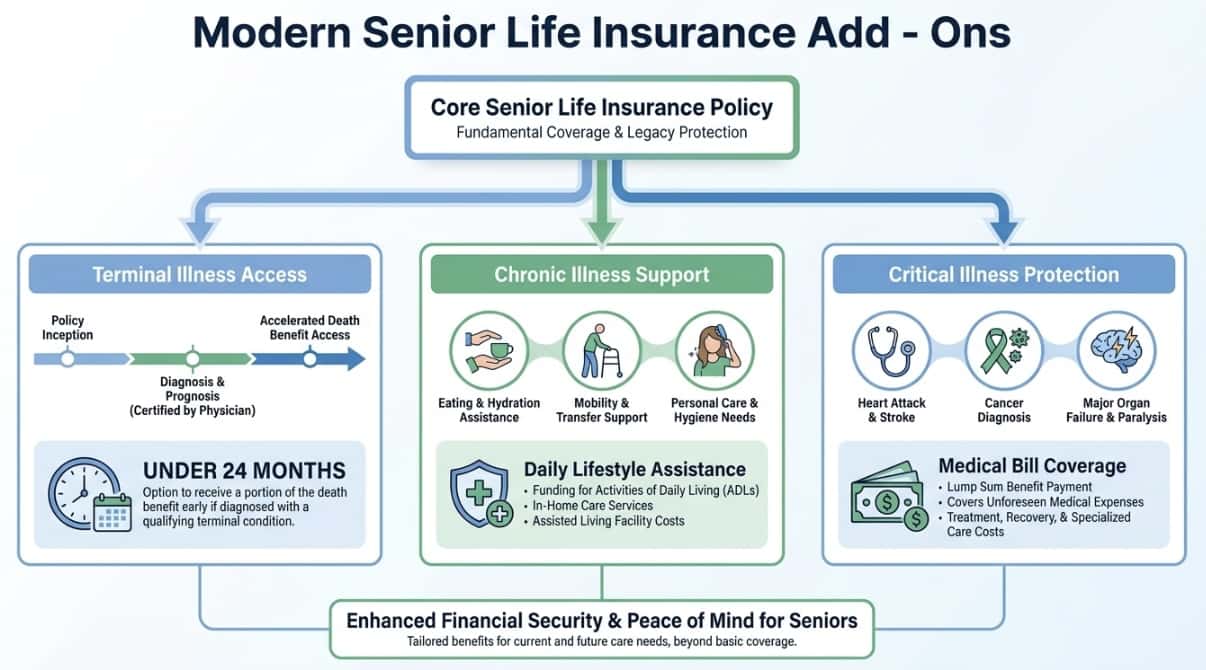
The Accelerated Death Benefit rider is arguably the single most important option for any older policyholder. It allows you to advance a significant percentage of your death benefit if you are diagnosed with a qualifying medical condition. This rider is often divided into distinct categories based on the specific health crisis you face:
- Terminal Illness: Triggers when a licensed physician certifies that your life expectancy is 12 to 24 months or less.
- Chronic Illness: Activates if you become permanently unable to perform at least two out of the six basic Activities of Daily Living (ADLs) – such as bathing, dressing, or eating – or if you experience severe cognitive impairment.
- Critical Illness: Provides a lump – sum advance if you experience a major medical event like a severe stroke, heart attack, or invasive cancer.
Using an accelerated death benefits rider can keep a household from draining retirement savings during a medical crisis. The funds advanced are subtracted from the final amount your beneficiaries receive, helping your family stay financially afloat when medical bills peak.
2. Long-Term Care (LTC) Rider
An LTC rider morphs your life insurance policy into a hybrid vehicle that handles nursing home, assisted living, or home healthcare expenses. Unlike a standalone long – term care insurance policy – which can carry skyrocketing premiums and a “use it or lose it” risk – an LTC rider ensures that your premium dollars serve a purpose.
If you require professional care, the rider pays out monthly pools of money directly from the death benefit. If you pass away without ever needing long – term care, the entire remaining death benefit goes directly to your chosen beneficiaries. This makes it an incredibly efficient way to navigate medicare costs and budgeting while securing a reliable long – term care option.
3. Chronic Illness Rider
While very similar to an LTC rider, a chronic illness riders seniors option provides distinct flexibility. It specifically targets health issues that may not be categorized as terminal but still heavily impact your daily independence. If you cannot perform essential daily routines without assistance, this rider lets you access portions of your policy face value.
The primary difference is that chronic illness riders often do not require you to submit ongoing receipts from an approved nursing facility. Instead, once your medical condition is verified, the funds can be used for any household need – whether that means paying an informal family caregiver or modifying your home for accessibility.
4. Critical Illness Rider
A critical illness life insurance for seniors rider is built for sudden, life – altering health diagnoses. It acts as an immediate financial buffer against high – cost conditions that require intensive medical interventions.
When you add this rider, a major medical event triggers an advance payment that can be utilized to cover specialized treatments, experimental therapies, or out – of – pocket healthcare deductibles. This ensures that a sudden diagnosis does not disrupt your broader estate plans or force your family to take on unexpected debt.
5. Waiver of Premium Rider
For seniors who are still working or managing active business entities, a waiver of premium rider offers excellent protection against a sudden loss of income. If you experience a serious injury or long – term illness that prevents you from working, this rider completely waives your ongoing monthly insurance payments while keeping your policy completely active.
Insider Tip: Pay close attention to the age limitations on waiver of premium riders. Most insurance carriers phase out this specific rider between the ages of 60 and 65, meaning it is rarely available for those purchasing coverage later in life. Always check the fine print regarding age boundaries before relying on this add – on.
Comparing Senior Life Insurance Rider Variables
Choosing the right combination of features requires looking at how different riders alter your premium costs and access rules. The table below outlines the core parameters of the best riders to add to a senior life policy to help you determine which options fit your financial strategy.
| Rider Type | Primary Trigger Condition | Payout Format | Impact on Premium | Best For |
| Terminal Illness (ADB) | Life expectancy under 12 – 24 months | Lump Sum or Installments | Typically Included Free | Covering immediate end – of – life costs |
| Long-Term Care (LTC) | Inability to perform 2+ ADLs or cognitive decline | Monthly Reimbursement or Indemnity | Moderate to High Premium Increase | Avoiding standalone LTC policy premium spikes |
| Chronic Illness | Permanent loss of 2+ ADLs | Flexible Lump Sum or Scheduled Advances | Low to Moderate Cost Add – on | Funding informal home care and modifications |
| Critical Illness | Heart attack, stroke, or invasive cancer diagnosis | One – time Lump Sum Payout | Low Premium Addition | Managing high insurance deductibles and specialized care |
| Waiver of Premium | Total, verified long – term disability | Monthly Premiums Covered by Insurer | Low Premium Addition | Protection against income loss prior to age 65 |
Strategic Policy Matching: Term vs. Permanent Insurance
The value of these add – ons depends heavily on the core structure of your baseline life insurance policy. Different types of insurance accommodate riders in distinct ways, especially when planning for older age demographics.
Term Life Insurance Considerations
If you select term life insurance for seniors over 70, your policy is built to last for a specific timeframe – usually 10, 15, or 20 years. Because term insurance lacks an internal cash value accumulation feature, any living benefit riders you attach will draw directly from the face value of the death benefit. Adding riders to a term policy can offer highly affordable short – term protection, but you must remain mindful that the coverage will expire when the term ends.
Whole Life Insurance and Living Benefits
For permanent protection, exploring whole life insurance for seniors over 70 or whole life insurance for seniors over 80 opens up a wider array of integrated riders. Permanent policies build internal cash value over time, which gives insurance companies a more stable foundation for offering robust living benefit features.
The benefits of whole life insurance for seniors become incredibly clear when you layer on a chronic or terminal illness rider. These features provide a dual – layer safety net: you have guaranteed permanent death benefits for estate planning, alongside accessible pools of money to manage healthcare expenses if your health status shifts unexpectedly.
Navigating Pre-Existing Health Conditions
One question that constantly arises when discussing the best riders to add to a senior life policy is how underlying medical histories affect your eligibility. Insurance underwriters look closely at your current health profile when evaluating rider applications.
Medical Underwriting Requirements
If you opt for standard permanent coverage, you may undergo a health screening process. Having a history of chronic conditions can impact the cost or availability of specific living benefit options. For example, securing life insurance for seniors with heart conditions or life insurance for seniors with diabetes might mean certain accelerated riders will carry stricter eligibility thresholds or higher premium modifications.
Similarly, navigating life insurance for seniors with cancer history requires finding carriers that specialize in lenient clinical underwriting for past illnesses to ensure you can still qualify for vital living benefit riders.
No – Medical – Exam Alternatives
If traditional underwriting presents too many hurdles, looking into no medical exam life insurance for seniorscan be an excellent alternative path. These policies simplify the enrollment process by bypassing physical exams entirely.
When you evaluate no medical exam life insurance vs traditional life insurance for seniors, you will find that simplified issue policies often include standard terminal illness riders automatically. However, more complex add – ons like long – term care riders may be restricted. Understanding the trade – offs in the cost of no medical exam life insurance for seniors will help you find a configuration that matches your health profile perfectly.
Senior Life Insurance Over Age 80: Rider Feasibility
As policyholders move past age 80, the availability of specialized insurance riders changes due to shifting actuarial risks. Understanding what options remain on the table can help families avoid common planning pitfalls.
Realities of Coverage for Octogenarians
Can an older adult over 80 still get access to the best riders to add to a senior life policy? Yes, but the options are more streamlined. When researching if can an 80-year-old get life insurance or even if can an 83-year-old get life insurance, you will discover that final expense or burial policies become the primary tools.
- Age 70 – 75: Full Rider Suite Available (LTC, Chronic, Critical, ADB)
- Age 75 – 80: Restricted LTC Riders; ADB and Chronic Illness Widely Available
- Age 80+: Terminal ADB Standard; Simplified Living Benefits; No Waiver of Premium
At this stage, policies like guaranteed issue whole life for seniors 80 or guaranteed acceptance life insurance for seniors over 80 become highly valuable because they offer approval with zero medical questions. While these policies focus primarily on covering end – of – life costs, many still feature a built – in terminal illness accelerated death benefit rider, ensuring that some form of living benefit protection remains available.
Avoiding Crucial Planning Mistakes
Families assisting an elderly parent must look closely at the fine print of these late – life contracts. One of the most common mistakes to avoid in life insurance for seniors over 80 is assuming that a policy covers nursing home care automatically without an explicit rider.
When structuring buying life insurance for elderly parent options, you must confirm exactly what triggers an accelerated payout. Reviewing contract limitations carefully prevents unexpected surprises during a health crisis and ensures you are choosing the right tools for your family’s needs.
Final Expense and Estate Planning Integration
Integrating riders into your broader estate planning strategy ensures that your insurance coverage coordinates smoothly with your overall financial legacy.
Final Expense and Burial Insurance
For many seniors, the main goal of life insurance is handling final interment costs so these bills do not fall on surviving family members. Selecting options like final expense insurance for seniors or burial insurance for seniors over 70 provides targeted, smaller face – value policies designed for this exact purpose.
Even with smaller policies, verifying the availability of basic life insurance riders for seniors ensures that you maximize your policy’s value. These add – ons provide peace of mind by protecting your budget against sudden shifts in final costs.
Advanced Estate Planning and Legacy Wealth Transfer
For individuals with larger estates, life insurance acts as a key tool for wealth preservation and tax mitigation. Utilizing permanent protection within best life insurance for estate planning strategies allows you to provide liquidity to cover estate taxes or balance inheritances among heirs.
When you configure your policy with the best riders to add to a senior life policy, you protect your main estate assets from being liquidated prematurely to pay for medical care. This keeps your legacy intact and ensures your final wishes are executed exactly as planned.
Key Consumer Protections: Avoiding Senior Financial Scams
The senior insurance market requires a high degree of caution, as older adults are frequently targeted by deceptive marketing practices. Protecting your personal information and financial assets should always be a top priority during your research journey.
Regulatory Warning: Be highly skeptical of any insurance offer that uses high – pressure sales tactics, demands immediate upfront cash payments, or refuses to provide official written policy documentation. Legitimate insurance policies always include a standard “free look period” – typically 10 to 30 days – during which you can review the contract terms and cancel for a full refund if the policy or its attached riders do not match what you were promised.
Educating yourself on how to avoid life insurance scams elderly targets is essential for a safe shopping experience. Working with verified, licensed independent professionals and consulting objective comparison tools allows you to bypass misleading sales calls and protect your hard – earned retirement savings.
Step-by-Step Guide: How to Select and Activate the Right Riders
To help you put this information into practice, follow this step – by – step process to evaluate, select, and manage riders on your senior life insurance policy.
- Assess Current and Future Healthcare Risks: Analyze your family medical history and identify potential long – term care needs. This helps you determine whether a chronic illness, critical illness, or specialized long – term care rider aligns best with your specific risk profile.
- Evaluate Your Baseline Budget: Review your retirement cash flow to establish your premium budget. Decide if you can afford paid riders that increase your monthly costs, or if you need to stick with cost – free, built – in options like standard terminal illness acceleration.
- Gather Information and Document Healthcare History: Organize your medical records, current prescription lists, and physician contact details. Having this documentation ready ensures an efficient underwriting process and helps you confirm which health – related riders you qualify for.
- Compare Multi-Carrier Policies Side-by-Side: Review multiple insurance companies to see how they structure their rider provisions. Look closely at waiting periods, payout caps, and exact eligibility definitions to find the most favorable terms for your situation.
- Confirm Rider Terms During the Free Look Period: Once your policy documents arrive, carefully read through the specific rider sections. Use this time to verify that all requested add – ons are active and that the definitions match your financial expectations before keeping the policy long – term.
Frequently Asked Questions Regarding Senior Policy Riders
What are the best riders to add to a senior life policy if I am on a fixed income?
If you want the best riders to add to a senior life policy without expanding your monthly expenses, focus exclusively on a built – in Accelerated Death Benefit rider for terminal illness. This contract addition is standard with most reputable insurers and usually carries zero added premium fees, giving you living benefits without stressing your monthly household budget.
Can I include the best riders to add to a senior life policy after my contract is already active?
In almost all scenarios, finding the best riders to add to a senior life policy requires you to select these additions during the initial application process before underwriting is finished. Adding complex long – term care or critical illness riders down the road is rarely permitted without replacing the entire insurance contract.
How do the best riders to add to a senior life policy affect the final payout for my beneficiaries?
When you deploy the best riders to add to a senior life policy to accelerate money while living, any cash advanced is subtracted directly from the face value. For example, drawing $30,000 from a $100,000 policy to cover immediate medical treatment will lower the final death benefit payout to $70,000.
Are payouts from the best riders to add to a senior life policy subject to income taxes?
Under prevailing tax regulations, executing the best riders to add to a senior life policy for certified terminal or chronic medical diagnoses allows you to receive the advanced funds completely tax – free. Because individual exceptions apply based on overall policy structure, always verify your scenario with a certified public accountant.
Actionable Next Steps: Comparing Real-Time Market Options
Finding the best riders to add to a senior life policy requires analyzing customized, accurate quote data from multiple top – tier insurance providers. Because insurance rates are highly personalized based on your age, geographic location, and specific health profile, a generic online chart cannot give you a binding price point.
To explore real – time premium costs and see which living benefit riders are available for your specific age bracket, I recommend using a trusted, independent insurance comparison platform. You can check your customized, real – time rates for free using the independent insurance comparison platform Policygenius. This allows you to evaluate multiple top – rated insurance carriers simultaneously without dealing with high – pressure sales pitches, ensuring you find the ideal balance of living benefits and affordable premiums for your household.