Can a 70 year old get term life insurance is a question with a clear yes, though the options narrow considerably compared to what was available in your 50s or 60s. Term coverage at 70 is generally limited to 10- or 15-year lengths, offered by a smaller pool of carriers, and priced meaningfully higher than the same policy would have cost a decade earlier, but it remains a real, purchasable product for most healthy applicants.
When a reader asked me whether her father could still get term coverage at 70, her assumption was that the door had already closed. It had not. Can a 70 year old get term life insurance turned out to be less about age alone and more about which specific carriers still write new term policies at that age, and which health class the applicant falls into.
I am not an insurance agent or a company representative. I am an independent researcher who reads a lot of carrier rate data and underwriting guides so you do not have to compare it all yourself. Consider this the plain-English rundown a well-informed friend would walk you through before you request a quote.
Table of Contents
Yes, Can a 70 Year Old Get Term Life Insurance? Absolutely
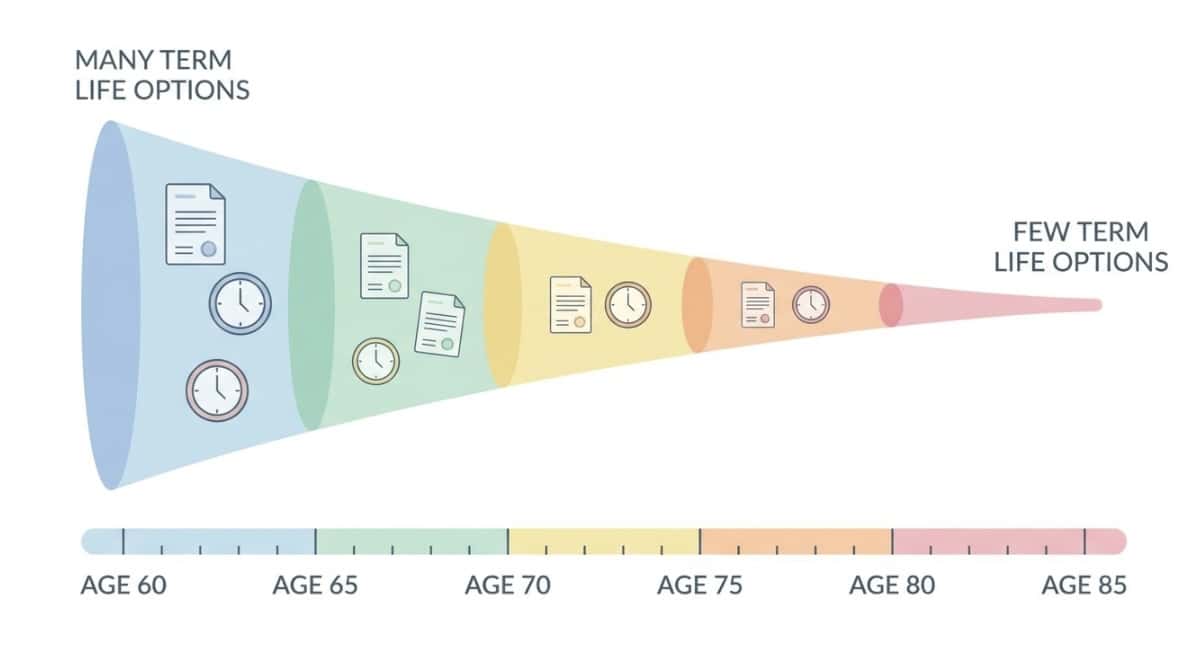
Most people assume term life insurance simply ends at some fixed age, but the reality is more gradual. Healthy applicants can often qualify for term coverage through their mid-70s at most carriers, and it becomes largely unavailable rather than just more expensive after that point. The bigger constraint at 70 is not whether coverage exists at all, but which term lengths and which carriers remain realistic options.
Insider note: Can a 70 year old get term life insurance from the same carrier that offered it at 60? Not always. Some insurers, including Penn Mutual, are highly competitive for applicants under 70 but stop accepting new term applications right at that threshold, which is exactly why comparing carriers matters more at this age than at almost any earlier point.
Term Availability by Age Bracket for Can a 70 Year Old Get Term Life Insurance Shoppers
The table below reflects general 2026 industry patterns for term life insurance eligibility as applicants age. Specific carrier rules vary, and eligibility can differ by state.
| Age Range | Typical Term Lengths Available | General Availability |
|---|---|---|
| 60 to 65 | 10, 15, 20, sometimes 25 or 30 years | Widely available from most carriers |
| 65 to 70 | 10 or 15 years, occasionally longer from select carriers | Available from a solid range of carriers |
| 70 to 75 | 10 or 15 years | Available from a narrower set of carriers |
| 75 to 80 | 10 years | Available from only a small handful of carriers |
| 81 and older | Generally unavailable | Final expense and guaranteed issue become the realistic paths |
Most insurers stop accepting new term life applicants entirely around age 75. A small number of companies, including Pacific Life, Transamerica, and John Hancock, have been noted for extending eligibility up to age 80, which makes them worth prioritizing if you are specifically searching for term coverage past your mid-70s.
Which Companies Answer Can a 70 Year Old Get Term Life Insurance With a Yes
Can a 70 year old get term life insurance really depends on which specific insurer you ask. Some carriers that are highly competitive in your 60s stop offering new term applications right around 70, while others extend meaningfully further. Banner Life has been recognized as a strong overall term life option for seniors, and for applicants between 65 and 70 specifically, Penn Mutual has been noted as a particularly cost-effective starting point, though it stops accepting new term applications at that age threshold. If you are between 75 and 80, Transamerica and Pacific Life have been identified as among the few remaining providers still issuing new policies in that narrower window.
For a deeper look at eligibility and carrier-specific rates in this age bracket, our own guide on term life insurance for seniors over 70 covers this topic in more depth, and our broader overview of life insurance for seniors over 70 is worth reading alongside it.
What Determines Your Rate Class at 70
Once you know can a 70 year old get term life insurance is a yes, health status becomes the primary driver of both eligibility and price at this age, arguably more so than at any earlier stage of life. Well-controlled conditions, including managed type 2 diabetes, treated high blood pressure, and normal cholesterol on medication, often still qualify for Standard or even Preferred rate classes rather than automatically pushing an applicant into a higher-cost category.
If a specific health condition is part of your situation, our pages on life insurance for seniors with heart conditions, life insurance for seniors with diabetes, and life insurance for seniors with cancer history each explain how those conditions are typically underwritten, and our broader guide to whole life insurance for seniors with pre-existing conditions covers this more generally.
Why Premiums Climb So Quickly After 70
Can a 70 year old get term life insurance at the same price next year as this year? Rarely.
Term life premiums rise steadily with age at any stage, but the increase accelerates noticeably in your 70s, with several rate analyses pointing to annual increases in the range of 8 to 12 percent year over year during this decade. Locking in a rate at 70 rather than waiting until 74 can mean a meaningfully lower permanent monthly cost, since term premiums are generally fixed for the length of the policy once issued.
Rule to remember: Can a 70 year old get term life insurance at a reasonable price next year the same way as this year? Not necessarily. Every year of delay both raises the quoted premium and narrows the list of carriers still willing to offer new coverage, making earlier applications meaningfully more valuable than later ones at this stage of life.
Term vs Final Expense: Once You Know Can a 70 Year Old Get Term Life Insurance, Which Fits Better?
Term life is not always the ideal answer, even when it is technically available. For many 70-year-olds, a final expense whole life policy fits the actual goal better than a larger term policy would. The median funeral with burial runs close to $7,800, and a $10,000 to $15,000 final expense policy comfortably covers that cost plus incidental expenses, without the higher premium a much larger permanent policy would require. Our guides on final expense insurance for seniors, final expense insurance costs, and how much final expense insurance costs by age all cover this alternative in more depth.
If income replacement, a mortgage payoff, or a larger legacy goal is still part of your picture, term coverage remains the more appropriate tool, and our guides on whole life insurance for seniors over 70 and whole life insurance for seniors over 80 are worth comparing as permanent alternatives once term eligibility eventually closes.
No Medical Exam and Guaranteed Options at This Age
Even after confirming can a 70 year old get term life insurance is generally a yes, a medical exam can still be a barrier for some applicants, or term coverage may not end up being available to you. several other underwriting paths remain open. Our guides on no medical exam life insurance for seniors, no medical exam versus traditional life insurance for seniors, qualifying for no medical exam life insurance as a senior, and the cost of no medical exam life insurance for seniors all explain how simplified underwriting typically works.
For applicants who do not qualify through traditional or simplified underwriting, guaranteed issue whole life for seniors and guaranteed acceptance life insurance for seniors over 70 remove health questions entirely, typically in exchange for a two-year graded benefit period and a smaller face amount. If you would rather check whether you qualify for immediate, full coverage instead of a graded product, our guide on burial insurance with no waiting period is worth reading before assuming guaranteed issue is your only option.
Burial Coverage Specifically
Once you have your answer to can a 70 year old get term life insurance, it is worth checking whether a smaller, purpose-built policy fits better if funeral costs are your main concern.
If your main concern is covering funeral and burial costs rather than a larger death benefit, our dedicated guides to burial insurance for seniors over 70 and the best burial insurance for seniors over 70 cover this narrower coverage type in more detail. Our roundups of the best final expense insurance companies, the best final expense insurance companies for seniors, and the best companies for final expense coverage for elderly applicants all cover which carriers tend to be most competitive at this stage.
Planning for the Years Beyond 70
If you are researching can a 70 year old get term life insurance because you expect to need coverage well into your 80s, it helps to understand how eligibility continues to narrow. Our pages on life insurance for seniors over 80, can an 80-year-old get life insurance, can an 83-year-old get life insurance, and can an 84-year-old get life insurance all address how each additional year affects eligibility.
If you are also weighing whether coverage makes financial sense at all at this stage, our guide on do I need life insurance after 70 walks through that broader decision directly. Veterans should also check our page on VA life insurance for seniors before assuming private coverage is the only route available.
Comparing Carriers and Avoiding Common Pitfalls
Answering can a 70 year old get term life insurance is only the first step. Our guide on comparing quotes and policies of life insurance over 80 and our list of mistakes to avoid in life insurance for seniors over 80 can help you avoid overpaying at this stage, and if a past health issue affected your rate class, our guide on how to improve your life insurance health rating may help bring your premium down further. If you have already been declined by one carrier, our guide on life insurance application denied senior applicants receive walks through why that happens and what to do next, since a decline from one company rarely reflects every carrier’s underwriting standards.
For an independent, third-party comparison of term life carriers for seniors, MoneyGeek’s 2026 ranking of the best term life insurance for seniors is a useful reference to check alongside anything an agent tells you.
Because eligibility and pricing for term coverage at this age vary so much between carriers, the only reliable way to know your actual options is to compare real, personalized quotes. I am an independent blogger, not an insurance company, so I cannot generate a binding quote myself. What I can tell you is to check your customized, real-time rates for free using the independent comparison platform Policygenius, which lets you compare offers from multiple carriers side by side without committing to a sales call.
Common Mistakes People Make Asking Can a 70 Year Old Get Term Life Insurance
Assuming term life ends abruptly at a fixed age. Can a 70 year old get term life insurance is often answered incorrectly because people assume a hard cutoff exists everywhere, when in reality eligibility narrows gradually and varies significantly by carrier.
Applying to only one company. Since some carriers stop offering new term policies well before others do, checking with a single insurer and accepting a decline as final can mean missing out on real coverage elsewhere.
Waiting another year to apply. Because premiums climb sharply in your 70s and carrier options narrow with each passing year, delaying an application typically costs more in both price and available choices.
Overlooking final expense as a better fit. For many 70-year-olds whose main goal is covering funeral costs, a smaller final expense policy is a more cost-effective match than a larger term policy sized for income replacement.
Not disclosing health conditions accurately. Many controlled conditions still qualify for favorable rate classes, and being upfront about your health history generally produces a better outcome than an application later found to contain inaccuracies.
Frequently Asked Questions: Can a 70 Year Old Get Term Life Insurance
Can a 70 year old get term life insurance?
Yes. Term coverage remains available at 70, typically limited to 10- or 15-year lengths from a somewhat narrower set of carriers than were available in your 60s, with pricing higher than at younger ages.
What term lengths are available at 70?
Most carriers offering term coverage at this age limit new policies to 10 or 15 years, since longer terms become increasingly rare as applicants approach and pass 70.
Which companies still offer term life insurance to people in their 70s?
Pacific Life, Transamerica, and John Hancock have been noted as extending eligibility further into the 70s and even up to 80 in some cases, while other carriers, including Penn Mutual, stop accepting new term applications right around age 70.
Is final expense insurance a better option than term at this age?
For many 70-year-olds whose primary goal is covering funeral and burial costs, yes. A smaller final expense policy sized around $10,000 to $15,000 often fits that specific goal more affordably than a larger term policy would.
Does a health condition rule out term coverage at 70?
Not usually. Many well-managed conditions, including controlled diabetes and treated high blood pressure, can still qualify for Standard or Preferred rate classes rather than automatically disqualifying an applicant.
Where can I compare real term life quotes for someone in their 70s?
Because eligibility and pricing vary so much by carrier at this age, the most reliable way to see accurate options is to compare real-time quotes through an independent platform like Policygenius, rather than assuming one company’s rules apply everywhere.
A Final Word
Can a 70 year old get term life insurance is ultimately a yes, with the honest caveat that the available choices are narrower and the premiums higher than they were a decade earlier. The right move at this stage is comparing more than one carrier, being upfront about your health history, and seriously weighing whether a smaller final expense policy might actually serve your goals better than a larger term policy. Either way, the best time to apply is now, since both price and eligibility only move in one direction from here.