
Life insurance application denied senior applicants receive is more common than most people realize, and it is rarely a permanent dead end. Insurers decline applications for a specific, identifiable reason, whether health-related, financial, or based on inaccurate information, and understanding that reason is the first step toward either appealing the decision or finding a different carrier or policy type that will approve you.
When a friend’s father was declined for a term policy in his late 70s, his first instinct was to assume he was simply uninsurable at his age. That was not actually true. A life insurance application denied senior clients receive from one company often has nothing to do with whether every company will say no, since underwriting standards vary enormously from one insurer to the next.
I am not an insurance agent or an underwriter. I am an independent researcher who reads a lot of underwriting guides and consumer finance data so you do not have to untangle it all yourself. Consider this the honest, practical rundown a well-informed friend would give you before you decide what to do next.
Table of Contents
Why a Life Insurance Application Denied Senior Receives Is Rarely Permanent
Every insurer sets its own underwriting standards, and each company weighs health, age, finances, and lifestyle factors differently. Getting rejected by one carrier does not mean every carrier will reach the same conclusion, since some insurers specialize specifically in higher-risk or older applicants that other companies decline outright.
Insider note: A life insurance application denied senior clients face from one company is a decision about that company’s specific risk tolerance, not a verdict on your overall insurability. Shopping around after a denial is not just acceptable, it is one of the most effective next steps available.
The Most Common Reasons for a Life Insurance Application Denied Senior Applicants Receive
Understanding why a life insurance application denied senior applicants receive actually happened is the necessary first step before deciding what to do next.
| Reason Category | Common Examples |
|---|---|
| Health conditions | Heart disease, cancer, diabetes, high blood pressure, high cholesterol |
| Age-related limits | Many term policies stop new applications around age 75 to 80 |
| Financial concerns | Bankruptcy history, significant outstanding debt, insufficient income to justify the coverage amount |
| Lifestyle and hobbies | High-risk activities like skydiving, or a history of dangerous driving violations |
| Application errors | Inaccurate medical records, a false positive on a drug test, or incomplete information |
| Undisclosed tobacco use | Discovered through prescription history or a medical exam after being left off the application |
A life insurance application denied senior applicants receive due to a medical condition is generally the most common category, though financial and application-error denials are also frequent, and both categories tend to be easier and faster to resolve than a serious health-related decline.
What to Do Immediately After a Life Insurance Application Denied Senior Clients Receive
Ask for the specific reason in writing. Insurers are generally required to disclose the primary reason for a denial, and knowing the exact cause lets you address it directly rather than guessing.
Check whether the denial is temporary or permanent. Some denials are tied to a specific, correctable issue, like a recent health event or an error in your file, while others reflect a more fundamental underwriting limit at that particular company.
Pull your medical records, prescription history, and credit report. A life insurance application denied senior clients receive frequently traces back to information in one of these three sources, and reviewing them yourself often reveals an error or an outdated entry you can correct before reapplying.
Determine whether you have grounds to appeal. If the denial was based on inaccurate information, such as a medical record error or a mistaken data match, most insurers allow you to formally appeal with corrected documentation.
Talk to your doctor about health-related denials. A letter from your physician documenting stable, well-managed treatment can sometimes change an insurer’s decision or improve your standing with a different carrier.
How Long It Takes to Improve Your Odds
If the underlying issue behind your denial needs time to resolve before reapplying, the timeline varies significantly depending on the category.
| Denial Type | Typical Time Before Reapplying Makes Sense |
|---|---|
| Minor health issues | Roughly 3 to 6 months |
| Major health changes | Roughly 12 to 24 months |
| Credit-related concerns | Roughly 6 to 12 months |
| Income documentation gaps | Roughly 3 to 6 months |
| Debt reduction | Roughly 12 to 18 months |
Rule to remember: Disclosing a previous denial to a new insurer is generally required and can influence how that application is reviewed. Working with an experienced agent who knows how to present a prior decline honestly, alongside evidence that the underlying issue has improved, tends to produce better results than hiding it.
Coverage Options Worth Considering After a Life Insurance Application Denied Senior Situation
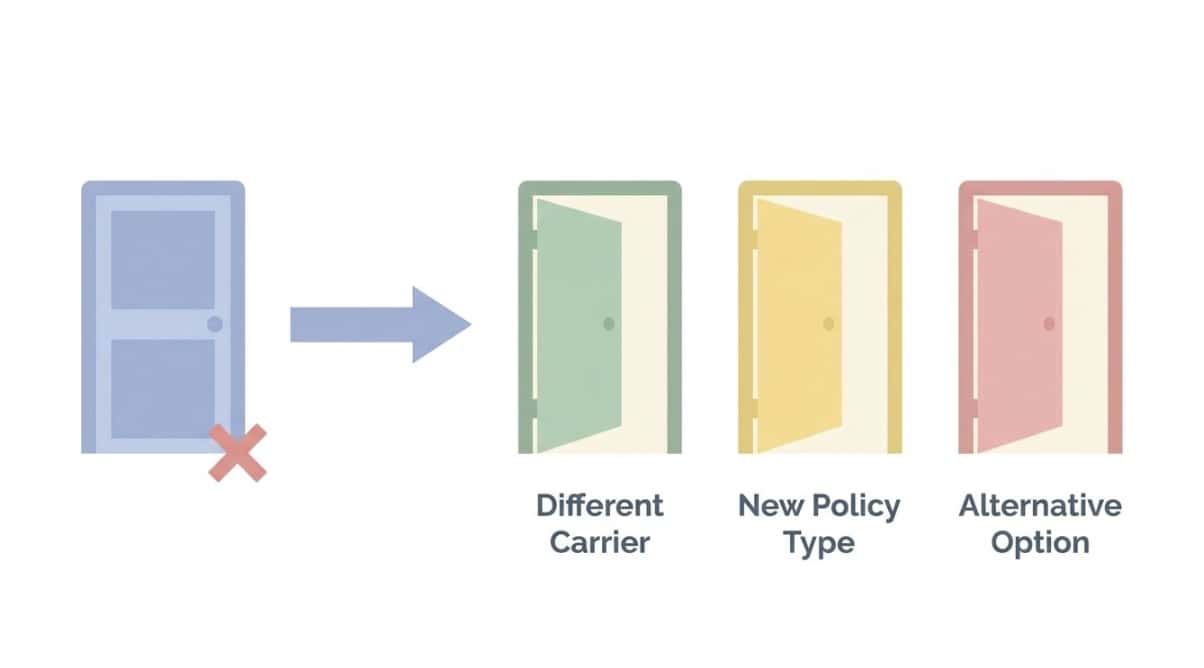
A life insurance application denied senior applicants receive from a fully underwritten policy does not mean every path to coverage is closed. Several alternative policy types are specifically designed for applicants who do not qualify through traditional underwriting.
Guaranteed issue whole life insurance. These policies generally cannot deny applicants within a set age range, often 45 to 85, since no health questions are asked at all. Our guides on guaranteed issue whole life for seniors, guaranteed acceptance life insurance for seniors over 70, and guaranteed acceptance life insurance for seniors over 80 explain how these policies work, including the graded benefit period that typically applies for the first two years.
Simplified issue and no medical exam coverage. These policies rely on a health questionnaire rather than a full medical exam, which can open the door for applicants who were denied specifically due to exam results. Our guides on no medical exam life insurance for seniors, no medical exam versus traditional life insurance for seniors, qualifying for no medical exam life insurance as a senior, and the cost of no medical exam life insurance for seniors all cover this route in more depth. If your coverage needs exceed a typical no-exam cap, high-limit no-exam life insurance is also worth exploring.
Final expense insurance. If your goal is covering funeral and burial costs rather than a larger policy, our guide on qualifying for final expense insurance with health issues, along with our broader guides on final expense insurance for seniors and final expense insurance costs, covers how this type of coverage typically handles a health history that led to a prior denial. If your denial happened because you are on the older end of the age range, our dedicated guide on final expense insurance for seniors over 85 covers the narrower but still real options available at that stage.
A shorter term length. A life insurance application denied senior applicants receive for a longer term, such as 20 or 30 years, sometimes gets approved for a shorter term instead, since many carriers stop offering longer terms to older applicants well before they stop offering any coverage at all.
Immediate coverage without a waiting period. If a graded benefit period feels like a step down after a denial, our guide on burial insurance with no waiting period explains how many applicants with common, well-managed conditions can still qualify for full, immediate coverage rather than assuming guaranteed issue is the only remaining path.
Group or employer-based coverage. If you or a spouse still works, a workplace group life insurance policy typically involves little to no individual underwriting, which can provide coverage while you sort out an individual policy separately.
Veterans’ benefits. If you served in the military, our page on VA life insurance for seniors is worth checking before assuming private coverage is your only remaining option.
How Specific Health Conditions Affect a Life Insurance Application Denied Senior Reapplication
If your denial was tied to a specific diagnosis, understanding how that condition is typically underwritten can help you target the right carrier the next time. Our pages on life insurance for seniors with heart conditions, life insurance for seniors with diabetes, and life insurance for seniors with cancer history each explain how those conditions are typically evaluated, and our broader guide to whole life insurance for seniors with pre-existing conditions and life insurance for seniors over 80 with pre-existing conditions covers this more generally.
If a stroke or cancer recurrence specifically factored into your denial, our guides on life insurance after stroke survival and life insurance after cancer remissionexplain the specific waiting periods and underwriting factors that typically apply.
Age-Specific Eligibility After a Life Insurance Application Denied Senior Applicants Face
If your denial was age-related rather than health-related, it helps to understand how eligibility actually narrows at different ages rather than assuming coverage disappears entirely. Our pages on life insurance for seniors over 70, life insurance for seniors over 80, can an 80-year-old get life insurance, can an 83-year-old get life insurance, and can an 84-year-old get life insurance all address how specific carriers handle applicants at each age.
Working With an Independent Agent After a Life Insurance Application Denied Senior Applicants Face
Because underwriting standards vary so widely, working with an independent agent who has access to many carriers, rather than reapplying to a single company over and over, tends to produce better results after a denial. An experienced agent can often identify which specific carriers are most likely to approve your exact health and financial profile before you formally reapply, saving you from collecting another decline on your record. Our roundups of the best final expense insurance companies, the best final expense insurance companies for seniors, and the best companies for final expense coverage for elderly applicants are useful starting points for that comparison.
Our guide on comparing quotes and policies of life insurance over 80 and our list of mistakes to avoid in life insurance for seniors over 80 can help you avoid the same pitfalls the second time around, and if a health rating specifically affected your outcome, our guide on how to improve your life insurance health rating outlines steps that can help before your next application.
For general background on how the denial and appeal process typically works, MoneyGeek’s guide on what to do if you are denied life insurance and Experian’s overview of application denials are both useful, independent references worth reading alongside anything an agent tells you.
A Word of Caution After a Life Insurance Application Denied Senior Situation
Because a recent denial can leave someone feeling desperate for any option, this is unfortunately a moment that can attract pressured or misleading sales tactics. Our guides on avoiding life insurance scams aimed at the elderly and avoiding financial scams targeting seniors cover the warning signs worth knowing before signing anything, particularly from anyone promising guaranteed approval that sounds too good to be true.
Because underwriting outcomes vary so much between carriers, the only way to know your actual options after a denial is to compare real, personalized quotes. I am an independent blogger, not an insurance company, so I cannot generate a binding quote myself. What I can tell you is to check your customized, real-time rates for free using the independent comparison platform Policygenius, which lets you compare offers from multiple carriers side by side without committing to a sales call.
Common Mistakes After a Life Insurance Application Denied Senior Applicants Receive
Assuming one denial means permanent ineligibility. A life insurance application denied senior applicants receive from one company frequently gets approved by a different insurer with different underwriting standards.
Giving up without asking for the specific reason. Without knowing the exact cause of a denial, it is much harder to address the underlying issue or determine whether an appeal is even worth pursuing.
Hiding a previous denial on a new application. Most applications ask directly whether you have been denied coverage before, and being dishonest about it can jeopardize a future claim even if it helps you get approved initially.
Applying to only one alternative company. Comparing several carriers, rather than settling for the first guaranteed issue quote you receive, often reveals a better rate or a policy type you had not initially considered.
Waiting too long to address a correctable issue. If your denial was based on an error or a manageable financial concern, addressing it promptly rather than letting it linger keeps your options as wide as possible.
Frequently Asked Questions About Life Insurance Application Denied Senior Situations
What are the most common reasons for a life insurance application denied senior applicants receive?
Health conditions like heart disease, cancer, diabetes, and high blood pressure are among the most common reasons, followed by age-related limits, financial concerns like bankruptcy or excessive debt, and application errors such as incorrect medical records.
Does a denial from one company mean I cannot get coverage anywhere?
No. Each insurer sets its own underwriting standards, and a denial from one company does not necessarily reflect what another carrier, particularly one specializing in higher-risk or older applicants, might decide.
How long should I wait before reapplying after a denial?
It depends on the reason. Minor health issues typically warrant a wait of three to six months, major health changes often require twelve to twenty-four months, and financial concerns like debt reduction can take twelve to eighteen months to resolve.
What coverage options exist if I keep getting denied?
Guaranteed issue whole life insurance, simplified issue and no medical exam policies, and final expense insurance are all designed for applicants who do not qualify through traditional underwriting, often with no health questions at all in the case of guaranteed issue coverage.
Should I tell a new insurer about a previous denial?
Yes, generally. Most applications ask directly, and being upfront, along with evidence that any underlying issue has improved, tends to produce better outcomes than an insurer discovering an undisclosed denial later.
Where can I compare quotes after being denied?
Because underwriting standards vary so much by carrier, the most reliable way to see accurate options is to compare real-time quotes through an independent platform like Policygenius, rather than assuming one company’s decision reflects your options everywhere.
A Final Word
A life insurance application denied senior applicants receive is a setback, not a final answer. Every insurer draws its own line for acceptable risk, and the specific reason behind your denial usually points directly to a next step, whether that is an appeal, a different policy type, or simply a different company altogether. Take the time to understand exactly why you were declined, address what you can, and keep shopping. Coverage is very often still available somewhere.