Life insurance after stroke survival is available to the large majority of survivors, though nearly every carrier requires a waiting period, a closer look at your specific stroke type and recovery, and acceptance of a higher premium than someone with no stroke history would pay. It is not the automatic decline many survivors expect. When a close family friend recovered from a transient ischemic attack last year, she assumed her life insurance options were permanently closed. They were not, and getting life insurance after stroke survival turned out to be far more workable than she initially feared.
I am not an insurance agent, an underwriter, or a neurologist. I am an independent researcher who reads a lot of underwriting guides, carrier bulletins, and stroke recovery data so you do not have to untangle it all yourself while you are also focused on recovery. Consider this the plain-English rundown a well-informed friend would hand you before your first call with an agent.
Table of Contents
Can You Actually Get Life Insurance After Stroke Survival?
Yes, in most cases. Life insurance after stroke survival typically results in one of a few outcomes: standard or near-standard rates for survivors with a longer recovery period and no residual complications, a table-rated policy at a higher premium for those closer to the event, a temporary postponement for very recent strokes, or a guaranteed issue policy with no health questions for those who do not yet qualify for traditional underwriting.
Having a stroke on your medical history does not automatically disqualify you from coverage, but it does mean underwriters will scrutinize your recovery, your stroke type, and your ongoing risk factors more closely than they would for an applicant with no cardiovascular history.
Insider note: The single biggest factor in life insurance after stroke survival is time combined with recovery completeness. Underwriters are essentially asking three questions: how long has it been since the stroke, how complete is the recovery, and how well are the remaining risk factors controlled.
Why Waiting Periods Exist for Life Insurance After Stroke Survival
Stroke recurrence risk is the entire reason waiting periods exist. One-year stroke recurrence rates approach 15 percent, with the highest risk concentrated in the first six months after the initial event, and roughly one in four stroke survivors will experience another stroke at some point. Five-year survival after a stroke ranges from about 50 to 70 percent depending on severity, age, and other risk factors, which is meaningfully lower than survival rates for the general population and explains why insurers underwrite this condition so conservatively.
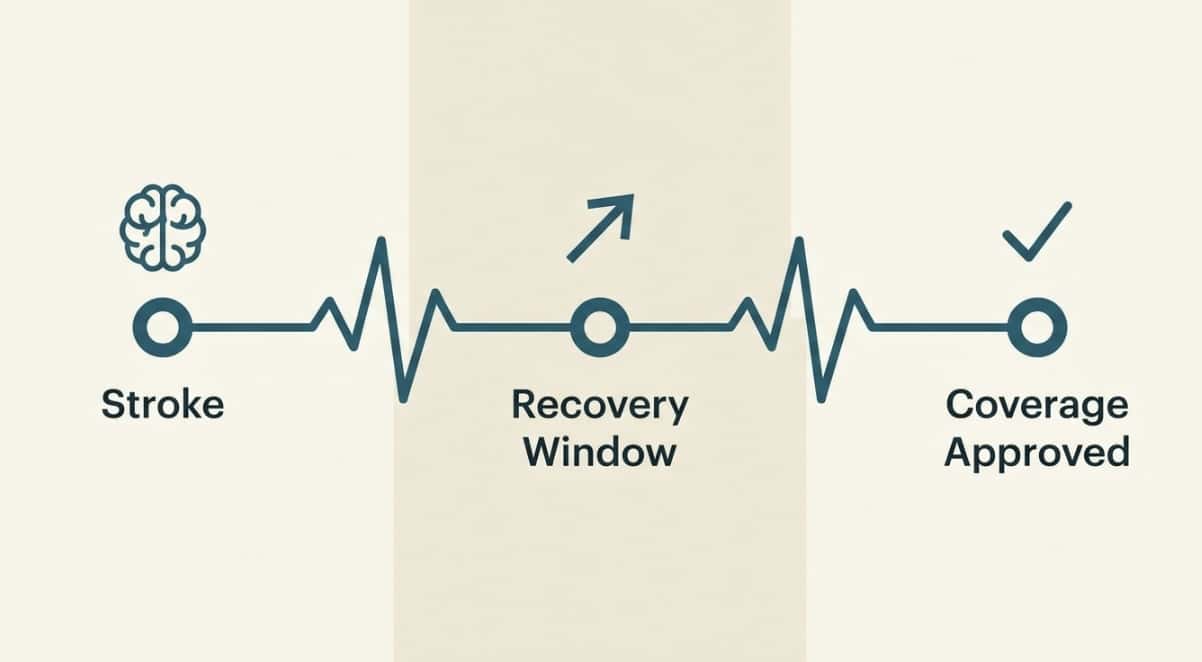
Because of this recurrence risk, most insurers require at least six to twelve months of demonstrated stability before seriously considering an application for life insurance after stroke survival, and some carriers push that requirement out to eighteen or even twenty-four months, particularly for more severe stroke types.
Waiting Periods for Life Insurance After Stroke Survival by Stroke Type
Not every stroke is underwritten the same way. The table below reflects general patterns reported across multiple independent 2026 sources, though your own timeline will depend on your specific diagnosis, recovery, and the individual carrier’s guidelines.
| Stroke Type | Typical Waiting Period | Notes |
|---|---|---|
| Transient ischemic attack (TIA) | 3 to 6 months | Generally the easiest stroke type to insure with a full recovery |
| Ischemic stroke | 6 to 12 months | Makes up roughly 87 percent of all strokes; more favorable than hemorrhagic |
| Hemorrhagic stroke | 12 months or longer | Often requires the longest waiting period and closest underwriting review |
| Stroke under age 45 | 3 to 5 years in some cases | Younger age at stroke onset can suggest more aggressive underlying risk |
Some specialized carriers will consider applications as early as six to nine months post-stroke with a complete recovery, though these tend to come with significantly higher table ratings than waiting the full twelve to eighteen months would produce.
Understanding Table Ratings for Life Insurance After Stroke Survival
Most survivors who successfully secure life insurance after stroke survival are not declined and are not offered standard rates either. They land somewhere in between, in what the industry calls a table rating. Table ratings typically add 25 to 50 percent to the standard premium, with each additional table level reflecting a higher assessed risk.
A relatively straightforward case, such as a single TIA from two years ago with complete recovery, a treated underlying cause, and well-controlled risk factors, might qualify for a Table B or C rating. A more complex case, such as a stroke one year ago with residual weakness, uncontrolled blood pressure, and continued smoking, could face a Table F or G rating, if approved at all. The encouraging part is that many carriers will review and potentially improve your rate class after additional time passes with no recurrence.
The Underwriting Factors That Actually Shape Life Insurance After Stroke Survival
Time since the stroke and recovery completeness. This is consistently the most influential factor, since risk of recurrence drops the longer someone remains stable with no new symptoms.
Stroke type. Ischemic strokes, which account for the large majority of cases, are generally viewed more favorably than hemorrhagic strokes, since survival and recurrence outcomes tend to differ between the two.
Cognitive and physical function. Underwriters evaluate your ability to perform daily tasks independently, since significant residual impairments can reduce available coverage options.
Medical management and follow-up care. Consistent medication adherence and regular follow-up appointments signal to an underwriter that your condition is being actively managed.
Other risk factors. Atrial fibrillation, high cholesterol, carotid artery disease, high blood pressure, and diabetes are all evaluated alongside stroke history. If diabetes or a heart condition is also part of your health history, our guides on life insurance for seniors with heart conditions and life insurance for seniors with diabetes cover how those combinations are typically underwritten.
Smoking status. Continuing to smoke after a stroke is generally considered uninsurable by most carriers, while former smokers typically become insurable again roughly one year after quitting.
Policy Options Worth Comparing for Life Insurance After Stroke Survival
- Fully underwritten term or permanent life insurance. For applicants twelve or more months post-stroke with a good recovery and no major residual effects, a fully underwritten policy is often available and typically offers the best long-term pricing.
- Coverage built around pre-existing conditions generally. Our broader guides to whole life insurance for seniors with pre-existing conditions and life insurance for seniors over 80 with pre-existing conditions both cover how cardiovascular events like stroke are treated alongside other common conditions.
- Final expense insurance. If your main goal is covering funeral and burial costs rather than a larger policy, our guide on qualifying for final expense insurance with health issues explains how simplified and guaranteed issue final expense coverage typically handles a stroke history.
- Coverage alongside other health conditions. If a past cancer diagnosis is also part of your history, our pages on life insurance for seniors with cancer history and life insurance after cancer remission explain how that factor is underwritten separately alongside a stroke history.
- Veterans’ coverage. If you served in the military, our page on VA life insurance for seniors is worth checking before assuming private coverage is the only route available.
Rule to remember: A denial from one company does not mean every company will decline you. Underwriting criteria for stroke history vary widely between insurers, and working with an agent who specializes in high-risk cases can meaningfully improve your odds of finding a carrier that fits your specific situation.
Riders and Add-Ons for Life Insurance After Stroke Survival
It is worth knowing upfront that many carriers limit the availability of certain riders, such as long-term care, living benefits, waiver of premium, and disability riders, for applicants with a stroke history. This does not mean a base policy is unavailable, only that some of the optional add-ons other applicants can access may be restricted or unavailable depending on your specific recovery and risk profile.
Employer Coverage vs Individual Policies for Life Insurance After Stroke Survival
Group life insurance through an employer typically does not require medical underwriting, which makes it considerably easier to obtain immediately after a stroke compared to an individually underwritten policy. Group coverage tends to be more affordable at first, but an individual policy offers more control and stays with you if you change jobs or retire. Keeping both types of coverage in place, where possible, gives stroke survivors a more complete safety net while working through the waiting period for an individually underwritten policy.
Practical Steps to Improve Your Odds of Life Insurance After Stroke Survival
Gather your medical documentation before applying. Complete neurology records, imaging results, a current medication list, and documentation of any treated underlying cause, such as atrial fibrillation, all speed up underwriting and prevent gaps that make underwriters uneasy.
Time your application strategically. If you are close to the six-month, twelve-month, or eighteen-month mark, waiting a few additional months to cross that threshold can meaningfully improve your rating.
Maintain visible treatment compliance. Regular follow-up appointments, consistent medication use, and stable blood pressure and cholesterol readings all signal to an underwriter that your recovery is being actively managed.
Address the rest of your risk profile. Quitting smoking, managing weight, and controlling blood pressure, cholesterol, and diabetes all improve your overall underwriting picture alongside your stroke history.
Work with a high-risk insurance specialist. An agent experienced in placing coverage for stroke survivors can match you with the carriers most likely to offer favorable terms, rather than applying blind to a single company that may not specialize in this type of case.
Get multiple quotes. Rates can vary significantly from one insurer to the next for the exact same stroke history, so comparing several carriers before committing to a policy is worth the extra effort.
Because underwriting for life insurance after stroke survival varies so widely from one carrier to the next, the only way to know your actual options is to compare real, personalized quotes. I am an independent blogger, not an insurance company, so I cannot generate a binding quote myself. What I can tell you is to check your customized, real-time rates for free using the independent comparison platform Policygenius, which lets you compare offers from multiple carriers side by side without committing to a sales call.
For general background on stroke statistics and recovery, the CDC’s stroke data and statistics and the American Stroke Association’s post-stroke recovery resources are both reliable, neutral references worth reading alongside anything an insurance agent tells you.
Common Mistakes That Hurt Your Life Insurance After Stroke Survival Application
Applying too soon. Even if you feel completely recovered a few months after a stroke, most insurers will not seriously consider a traditional application until at least six months have passed, and hemorrhagic strokes often require twelve months or longer.
Being vague about the stroke type. Specifying whether it was a TIA, ischemic stroke, or hemorrhagic stroke, along with the treatment received, helps underwriters make an accurate and often more favorable assessment than a general description would.
Continuing to smoke after a stroke. Most carriers consider continued smoking after a stroke effectively uninsurable, while quitting and maintaining that for about a year can reopen options that were previously closed.
Not comparing more than one carrier. Underwriting guidelines for stroke history differ significantly between companies, and one insurer’s decline can be another’s approval at a reasonable table rating.
Frequently Asked Questions About Life Insurance After Stroke Survival
Can you get life insurance after stroke survival?
Yes, in most cases. The majority of stroke survivors can eventually qualify for coverage, though the required waiting period and resulting rate class depend heavily on the stroke type, recovery completeness, and remaining risk factors.
How long do you have to wait for life insurance after stroke survival?
Waiting periods generally range from three to six months for a TIA, six to twelve months for an ischemic stroke, and twelve months or longer for a hemorrhagic stroke, though some specialized carriers may consider earlier applications at a higher rating.
Will a stroke automatically raise my life insurance premium?
Yes. A stroke is considered a pre-existing medical condition, and insurers will assess your specific risk and set your premium based on your overall health, recovery, and medical history rather than offering standard rates automatically.
What if I am declined for traditional coverage after a stroke?
Guaranteed issue and simplified issue final expense policies are often available even when traditional underwriting results in a decline, typically in exchange for a smaller death benefit and, in some cases, a graded benefit period.
Does the type of stroke affect my life insurance options?
Yes, significantly. Ischemic strokes are generally viewed more favorably than hemorrhagic strokes, and transient ischemic attacks are typically the easiest to insure of the three, assuming a full recovery.
Where can I get a free, real quote after stroke survival?
Because underwriting guidelines vary so much by carrier, the most reliable way to see accurate numbers is to compare real-time quotes through an independent platform like Policygenius, rather than assuming a single company’s decision reflects your options everywhere.
A Final Word
Life insurance after stroke survival is rarely as bleak as it first feels. Most survivors who gather their medical records, wait for a reasonable recovery milestone, and compare more than one carrier end up with real, workable coverage, even if the premium is higher than it would have been before the stroke. The single best thing you can do is start the conversation now rather than assuming you already know the answer. You got through the hardest part. The next step is simply making sure your family is financially protected too.