
Emergency fund for seniors means a dedicated pool of easily accessible cash, kept separate from retirement accounts, sized to cover unexpected costs like a major home repair, an uncovered medical bill, or a temporary gap between Social Security income and monthly expenses. It is one of the few pieces of financial advice that actually gets more important with age rather than less, since retirees generally cannot simply pick up overtime hours or a second job to absorb a surprise cost.
When I helped my own parents rebuild their savings after a costly furnace replacement drained nearly everything they had set aside, the thing that stood out most was how differently an emergency fund for seniors needs to function compared to one built during working years. There is no next paycheck coming to refill it quickly, and dipping into a retirement account instead can trigger taxes and penalties that make a bad month even worse.
I am not a financial advisor. I am an independent researcher who reads a lot of retirement planning data, savings statistics, and budgeting guidance so you do not have to piece it all together yourself. Consider this the honest, practical rundown a financially literate friend would walk you through before the next surprise bill shows up.
Table of Contents
Why an Emergency Fund for Seniors Needs to Be Bigger Than the Standard Advice
The classic rule of thumb, three to six months of expenses, was built around the risk of losing a job and needing time to find a new one. An emergency fund for seniors serves a different purpose entirely, since income in retirement usually comes from Social Security, a pension, or investment withdrawals rather than a paycheck that could disappear overnight. That shifts the real risks toward large, lumpy expenses: a new roof, a costly dental procedure, an out-of-network hospital stay, or a family emergency requiring travel.
Because of this shift, many financial experts now recommend that an emergency fund for seniors run closer to six months as an absolute minimum, with some retirees comfortable holding a full year or even two years of expenses in cash, particularly if they own an older home or manage a chronic health condition. Our own breakdown of Medicare costs and budgeting is worth reading alongside this guide, since rising healthcare premiums are one of the most common reasons retirees dip into savings unexpectedly.
Insider note: A larger retirement account balance is not the same thing as a strong emergency fund for seniors. Withdrawing from a 401(k) or IRA outside of planned distributions can trigger taxes, and in some cases penalties, turning a one-time emergency into a longer-term financial setback.
How Much Should Be in an Emergency Fund for Seniors
There is no single number that fits every household, but a simple gap calculation is a useful starting point. Take your total monthly expenses, subtract your guaranteed monthly income from Social Security or a pension, and multiply the remaining gap by however many months of cushion feels right for your situation.
| Monthly Expenses | Guaranteed Monthly Income | Monthly Gap | 6-Month Fund | 12-Month Fund |
|---|---|---|---|---|
| $3,000 | $2,000 | $1,000 | $6,000 | $12,000 |
| $4,000 | $2,500 | $1,500 | $9,000 | $18,000 |
| $5,000 | $3,200 | $1,800 | $10,800 | $21,600 |
Since guaranteed income like Social Security does not stop, an emergency fund for seniors only needs to cover the portion of expenses that guaranteed income does not already handle, which is why the target amount is often smaller than the full monthly spending figure might suggest at first glance.
How Real Households Compare
It helps to see where other households actually stand. Recent survey data shows that roughly 60 percent of Americans aged 60 and older report having at least three months of emergency savings, a notably higher share than younger age groups manage. Baby boomers hold the largest average emergency savings balance of any generation, at roughly $22,190, though median balances tell a more modest story: households in the 55 to 64 age range report a median transaction account balance of about $8,000, while those 45 to 54 report roughly $8,700.
| Age Group | Reported Emergency Savings Behavior |
|---|---|
| 60 and older | About 60 percent have at least three months of expenses saved |
| 55 to 64 | Median transaction account balance around $8,000 |
| 45 to 54 | Median transaction account balance around $8,700 |
| Baby boomers overall | Highest average balance of any generation, around $22,190 |
Nationally, the picture is more strained than these age-specific numbers suggest on their own. Recent surveys have found that a substantial share of Americans, sometimes cited as high as 40 to 60 percent depending on the survey, cannot cover a $1,000 emergency without borrowing. An emergency fund for seniors that clears even the basic three-month threshold already puts a household ahead of a meaningful share of the broader population.
Where to Actually Keep the Money
An emergency fund for seniors should live somewhere liquid and stable, not in the stock market and not locked inside a retirement account. A high-yield savings account, a money market account, or a short-term certificate of deposit ladder are all reasonable choices, since the goal is guaranteed access without risking the principal to market swings right when you might need it most.
Retirement accounts like a 401(k) or IRA are specifically discouraged as a primary emergency fund, since early or unplanned withdrawals can trigger income tax, and in some cases an additional penalty, along with the lost opportunity for that money to keep growing tax-deferred. Keeping emergency cash entirely separate from retirement savings avoids that costly mistake.
Building an Emergency Fund for Seniors on a Fixed Income
Building or rebuilding an emergency fund for seniors while living on a fixed income takes a different approach than saving during working years, since there is no bonus or raise to redirect toward savings. A few practical strategies make a real difference.
Trim recurring costs first. Reviewing insurance premiums is often one of the easier places to start. Our guides on affordable life insurance options for seniors on a fixed income and lowering life insurance premiums for seniors on a fixed income cover concrete ways to free up monthly cash without dropping coverage entirely.
Address existing debt. Carrying a car loan, credit card balance, or lingering mortgage into retirement makes it harder to redirect money toward savings. Our guide on avoiding debt in retirement pairs well with the goal of building an emergency fund for seniors, since reducing fixed monthly obligations frees up room for savings contributions.
Consider downsizing. A smaller home with lower ongoing maintenance costs can free up both monthly cash flow and a lump sum of equity that can partially seed an emergency fund. Our detailed guide on downsizing finances for seniorswalks through how that decision affects both ongoing costs and available savings.
Automate small, consistent contributions. Even $25 or $50 a month adds up meaningfully over a year or two, and automating the transfer removes the temptation to skip a month.
Common Emergencies Retirees Actually Face
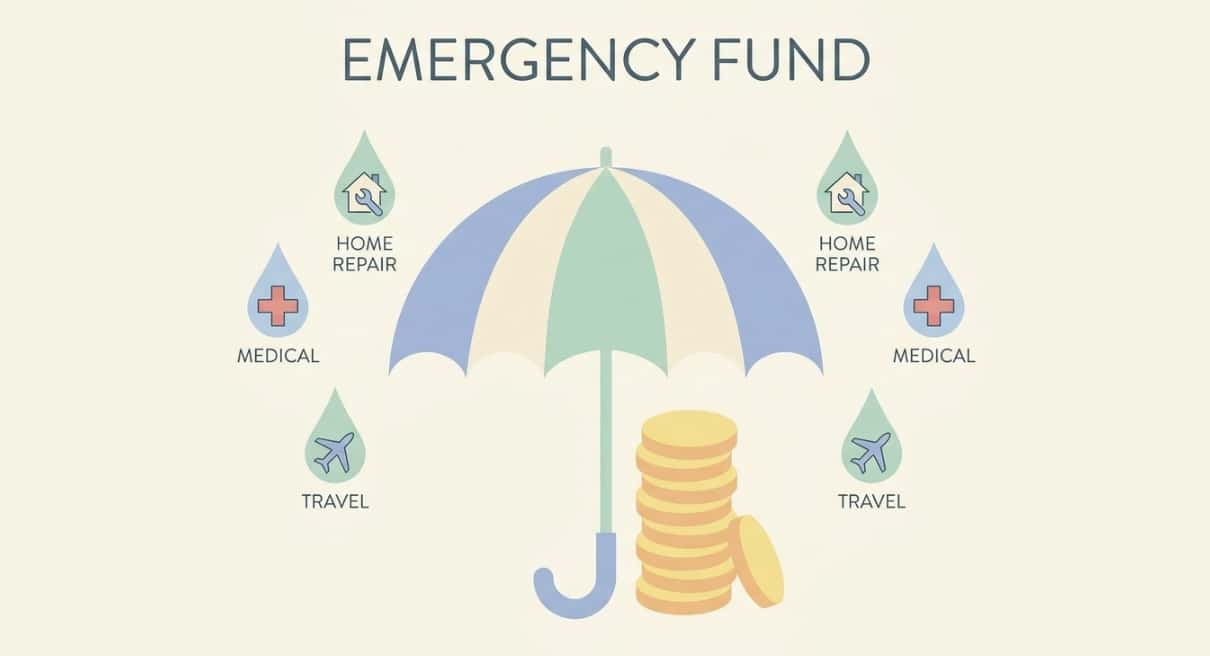
An emergency fund for seniors typically ends up covering a fairly predictable set of costs, even though the specific event is always a surprise. Major home repairs, like a failed furnace, roof, or water heater, are among the most common. Medical costs not fully covered by Medicare, including dental work, hearing aids, and certain prescriptions, are another frequent drain. Vehicle repairs, travel for a family emergency, and unexpected funeral costs for a spouse or close family member round out the most common categories. Our state-by-state breakdown of the average funeral cost by state is worth reviewing, since funeral costs specifically are a common and often underestimated emergency expense at this stage of life.
How Life Insurance and Estate Planning Fit Alongside an Emergency Fund
An emergency fund for seniors and a life insurance policy serve different purposes, but they often intersect in retirement planning conversations. Cash value in a permanent policy can sometimes serve as a secondary source of emergency funds through a policy loan, though this should be treated as a backup option rather than a replacement for a proper cash reserve, since unpaid policy loans reduce the eventual death benefit. If you are weighing whether coverage still makes sense at this stage, our guide on do I need life insurance after 70 walks through that decision directly.
If your broader financial picture includes estate planning goals alongside building an emergency fund for seniors, our guides on the best life insurance for estate planning, life insurance for seniors over 80 and estate planning benefits, and our related guide on estate planning benefits are worth reading together. Our page on beneficiary considerations for seniors over 80 is also useful if you are updating your broader financial plan at the same time you are rebuilding savings. If you are helping a parent think through both an emergency fund and a life insurance decision, our guide on buying life insurance for an elderly parent covers many of the same conversations that come up in both areas.
If you are comparing life insurance policies as part of freeing up monthly cash for savings, our guide on comparing quotes and policies of life insurance over 80 and our list of mistakes to avoid in life insurance for seniors over 80 can help you avoid overpaying for coverage while you are also trying to build savings. And if a past health issue affected your rate class, our guide on how to improve your life insurance health rating may help lower a premium that is currently competing with your savings goals.
Rule to remember: An emergency fund for seniors and a life insurance policy solve different problems. One protects you while you are alive and facing an unexpected cost. The other protects your family after you are gone. Both matter, but neither should be treated as a substitute for the other.
Protecting Your Savings From Scams
Because retirees with visible savings are often targeted specifically, protecting an emergency fund for seniors is not just about building it, it is also about defending it. Our guides on avoiding financial scams targeting seniors and avoiding life insurance scams aimed at the elderly cover common warning signs worth knowing, since a scammer draining an emergency fund defeats the entire purpose of having built one in the first place.
Common Mistakes People Make
Keeping the fund in a retirement account. Treating an IRA or 401(k) balance as an emergency fund invites tax consequences and penalties that a dedicated savings account avoids entirely.
Using the standard three-to-six-month rule without adjusting it. An emergency fund for seniors often needs to be sized differently than the classic working-age guideline, since guaranteed income changes the math and large, lumpy expenses tend to replace the risk of job loss.
Not replenishing the fund after using it. Treating an emergency withdrawal as a one-time event without a plan to rebuild the balance leaves the household exposed to the next surprise expense.
Mixing emergency savings with everyday spending. Keeping the fund in a separate account, rather than blended with a checking account used for daily expenses, makes it far less likely to be spent on non-emergencies.
Ignoring the interest rate the fund earns. Leaving emergency savings in a low-yield account when a comparable high-yield savings account is readily available means giving up meaningful interest for no real benefit.
Frequently Asked Questions
How much should an emergency fund for seniors actually contain?
A common starting point is calculating the monthly gap between your expenses and your guaranteed income, then multiplying that gap by six to twelve months. Many experts recommend at least six months as a minimum for retirees, with some preferring a full year or two given the reduced ability to quickly replace lost income.
Should retirement savings count as part of an emergency fund for seniors?
Generally, no. Withdrawing from a 401(k) or IRA outside of planned distributions can trigger income tax and sometimes penalties, so a dedicated, separate cash account is the safer place to hold emergency savings.
Where should an emergency fund for seniors be kept?
A high-yield savings account, money market account, or short-term certificate of deposit ladder are all reasonable options, since the priority is guaranteed access and principal protection rather than growth.
What are the most common expenses an emergency fund for seniors ends up covering?
Major home repairs, medical costs not fully covered by Medicare, vehicle repairs, and unexpected funeral or family travel expenses are among the most frequently cited categories.
Can life insurance replace the need for an emergency fund?
Major home repairs, medical costs not fully covered by Medicare, vehicle repairs, and unexpected funeral or family travel expenses are among the most frequently cited categories.
How do I start building an emergency fund for seniors on a limited budget?
Start by reviewing recurring costs like insurance premiums and any remaining debt for potential savings, then automate even a small, consistent monthly contribution into a dedicated, separate savings account.
A Final Word
An emergency fund for seniors is not a luxury reserved for people with generous retirement savings. It is one of the most practical tools available for protecting the retirement you have already built. Start with the gap calculation above, keep the money separate and liquid, and rebuild the balance every time life pulls from it. A well-funded cushion will not prevent the next surprise expense, but it will keep that expense from turning into a much larger financial setback.