
Downsizing finances for seniors means deliberately shrinking housing costs, possessions, and monthly obligations in retirement, usually by moving to a smaller home, in order to free up cash, lower fixed expenses, and reduce the burden of maintaining more space than is actually needed. It sounds simple on paper, but downsizing finances for seniors is really a financial decision wearing an emotional costume, and untangling the two is where most people get stuck.
When I helped my own parents think through whether to sell the house I grew up in, the thing that surprised me most was how much of the conversation had nothing to do with money at first. We had to work through the sentimental attachment before we could even get to the spreadsheet. That is exactly why downsizing finances for seniors deserves a clear-eyed framework rather than a gut decision made during a stressful season.
I am not a financial advisor, a real estate agent, or a tax professional. I am an independent researcher who reads a lot of retirement planning data, tax guidance, and housing cost reports so you do not have to piece it all together yourself. Consider this the honest rundown a financially literate friend would walk you through before you call a realtor.
Table of Contents
Why Downsizing Finances for Seniors Looks Different in 2026
Retirement budgets are under a specific kind of pressure this year that makes downsizing finances for seniors a more urgent question for many households. Social Security’s 2026 cost-of-living adjustment came in at 2.8 percent, adding roughly $56 a month for the average retiree, but that increase is being quietly absorbed elsewhere. The standard Medicare Part B premium jumped to $202.90 a month in 2026, an increase of nearly $18, which on its own can eat up close to half of a modest COLA raise before it ever reaches a bank account. Our own breakdown of Medicare costs and budgeting goes deeper into how this squeeze plays out month to month.
Housing costs are the other half of the equation, and they are the piece most within a retiree’s control. The average annual cost to maintain a single-family home has continued climbing, and for many retirees, housing remains the single largest line item in the budget. This is precisely why downsizing finances for seniors has become less of a lifestyle preference and more of a practical response to two costs rising at once while income moves only a little.
Insider note: A COLA increase is not the same as a raise you get to keep. Once Medicare premiums and general inflation are factored in, several recent analyses have found that the real purchasing power of a Social Security check has effectively declined for multiple years running. That gap is a major reason downsizing finances for seniors keeps coming up in retirement planning conversations.
The Core Reasons Seniors Actually Downsize
Roughly half of retirees aged 50 and older move into a smaller home at some point after retirement, most commonly to cut costs, simplify their lifestyle, or address logistical needs like reduced mobility. At the same time, a large share of older homeowners say they never plan to sell, which tells you downsizing finances for seniors is not a universal decision, it is a personal one shaped by specific circumstances.
| Common Reason for Downsizing | What It Actually Addresses |
|---|---|
| Cutting monthly housing costs | Lower mortgage, utilities, insurance, and maintenance |
| Simplifying daily life | Less cleaning, fewer repairs, easier mobility |
| Freeing up home equity | Cash for retirement income, healthcare, or gifting |
| Relocating closer to family or care | Reduced travel costs, easier caregiving logistics |
| Avoiding costly age-in-place renovations | Skipping expensive walk-in showers, ramps, or widened doorways |
| Escaping rising property taxes or HOA costs | Predictable, sometimes lower ongoing costs |
Notice that not every reason on this list is purely financial. Downsizing finances for seniors often starts as a money question and ends up touching health, family logistics, and simple quality of life, which is part of why the decision can feel more complicated than a straightforward cost comparison.
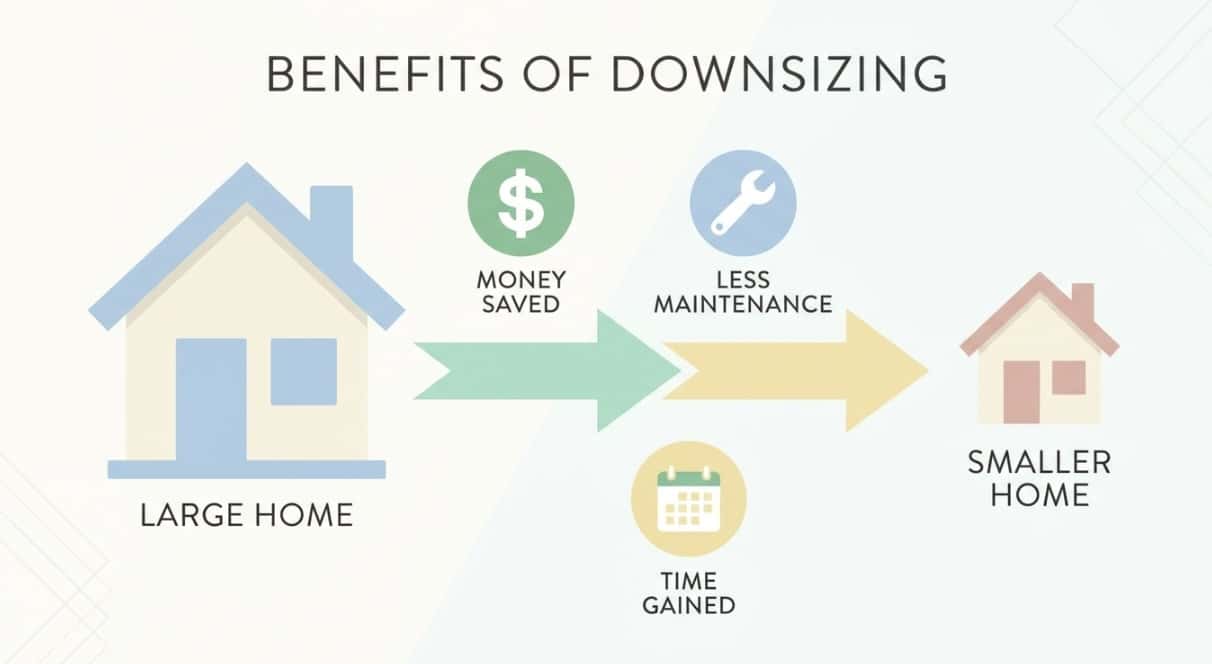
What Downsizing Finances for Seniors Can Actually Save
The math behind downsizing finances for seniors usually centers on the ongoing cost of maintaining a home, not just the sale price. The average annual cost to maintain a single-family home has recently run around $10,600, compared to roughly $8,800 for a townhome and about $3,300 for a condo. That gap alone, before even factoring in a smaller mortgage or no mortgage at all, can represent thousands of dollars in annual savings.
| Home Type | Approximate Annual Maintenance Cost |
|---|---|
| Single-family home | About $10,600 |
| Townhome | About $8,800 |
| Condominium | About $3,300 |
A move that lowers monthly housing costs by $1,000 or more is generally considered a meaningful win in downsizing finances for seniors, since that kind of reduction can meaningfully extend how long retirement savings last. The average homeowner also currently holds a substantial amount of tappable home equity, which means for many retirees, downsizing is not just about cutting costs, it is about unlocking cash that has been sitting untouched in the walls of the house.
Tax Considerations That Affect Downsizing Finances for Seniors
Taxes are one of the most overlooked pieces of downsizing finances for seniors, and getting them wrong can quietly erase a chunk of the financial benefit. The sale of a primary residence is generally exempt from capital gains taxes up to $250,000 for single filers and $500,000 for married couples filing jointly, provided the home was lived in for at least two of the last five years. For homes that have appreciated significantly, though, more retirees are finding their gain exceeds even that generous exemption.
If gifting part of a property to family is part of the plan, the 2026 annual gift tax exclusion allows up to $19,000 per recipient for single filers, or $38,000 for married couples filing jointly, without triggering gift tax reporting. Whoever receives a gifted property, however, does not get a stepped-up tax basis, which can mean a larger capital gains bill for them later if they eventually sell. Anyone weighing this option should talk with a tax professional before finalizing anything, since the details genuinely depend on individual circumstances.
For a deeper dive into the tax mechanics, Kiplinger’s coverage of downsizing tax strategies for 2026 is a solid, neutral starting point, and the IRS’s official page on gift tax rules confirms current exclusion amounts directly from the source.
The Hidden Costs That Undercut the Savings
Downsizing finances for seniors is not automatically a financial win, and this is the part many people skip past too quickly. Selling a home typically costs somewhere between 8 and 10 percent of the sale price once real estate agent commissions, repairs, and closing costs are factored in. On top of that, moving expenses, a storage unit for furniture that will not fit in a smaller space, and possible real estate transfer taxes can all chip away at whatever equity gets freed up.
Rule to remember: Going from one expensive home to another high-cost property does not actually help. The real benefit in downsizing finances for seniors comes specifically from lowering ongoing monthly costs, not simply from the size of the check at closing.
The Motley Fool’s breakdown of overlooked downsizing costs and AARP’s look at the current housing market for retireesboth walk through these hidden costs in more detail, and are worth reading before assuming a move will pay for itself.
Downsizing Finances for Seniors: A Quick Decision Table
| Your Situation | Downsizing Finances for Seniors Likely Makes Sense If | Staying Put May Make More Sense If |
|---|---|---|
| Home maintenance costs | Repairs and upkeep are eating a large share of your budget | Your home is paid off with low ongoing costs |
| Mobility and safety | Stairs, a large yard, or multiple floors are becoming difficult | Simple, affordable modifications could solve the issue |
| Emotional attachment | You feel ready for a new chapter | The home holds significant sentimental value you are not ready to release |
| Family and community ties | Family or support network is elsewhere | Grandchildren or close friends visit often and easily |
| Housing market timing | Home equity is strong and moving costs are manageable | Selling costs and market conditions would erase most of the benefit |
Building a Downsizing Finances for Seniors Budget Framework
Once the decision leans toward moving, downsizing finances for seniors benefits from the same kind of structured approach used in any major retirement financial decision.
Step 1: Calculate your true current housing cost. Add mortgage or rent, property taxes, insurance, utilities, and average annual maintenance and repairs together to see the full picture, not just the mortgage payment.
Step 2: Estimate net proceeds realistically. Subtract the typical 8 to 10 percent selling cost range, plus any remaining mortgage balance, from your home’s estimated market value.
Step 3: Price the new housing cost honestly. Include the new mortgage or purchase price, HOA fees if applicable, taxes, insurance, and expected maintenance, since condos and smaller homes still carry ongoing costs even without a yard to maintain.
Step 4: Account for moving and transition costs. Movers, storage, minor repairs to prepare the old home for sale, and any furniture or downsizing services should all be budgeted for upfront rather than treated as an afterthought.
Step 5: Revisit your retirement income plan. Freed-up equity can supplement retirement income, pay down other debt, or simply sit in savings as a larger emergency cushion. If debt reduction is part of the plan, our guide on avoiding debt in retirement pairs well with this step.
How Life Insurance and Estate Planning Fit Into Downsizing Finances for Seniors
Downsizing finances for seniors often overlaps with broader estate and legacy planning, since selling or gifting a family home is frequently one of the larger financial events of retirement. If you are gifting property or restructuring your estate as part of a move, our guides on the best life insurance for estate planning, life insurance for seniors over 80 and estate planning benefits, and beneficiary considerations for seniors over 80 are worth reading alongside a conversation with your tax professional.
Freed-up equity from downsizing can also change how much life insurance coverage you actually need, or how affordable it becomes. If you are reconsidering coverage as part of this transition, our guide on do I need life insurance after 70walks through that decision directly, and our pages on affordable life insurance options for seniors on a fixed income and lowering life insurance premiums for seniors on a fixed income are useful if freed-up cash is earmarked partly for a premium you had been putting off.
If part of your goal in downsizing finances for seniors is simplifying what you leave behind for family, a modest final expense policy can complement the plan. Our guides on final expense insurance for seniors, final expense insurance costs, and the best companies for final expense coverage for elderly applicants are good starting points, and our state-by-state breakdown of the average funeral cost by state helps size that coverage realistically. Our dedicated page on burial insurance for seniors over 70 covers a narrower, typically lower-cost version of the same idea.
If you are helping a parent think through both a move and their broader financial picture, our guide on buying life insurance for an elderly parent covers many of the same conversations that come up around downsizing finances for seniors.
For those keeping or adding permanent coverage as part of a broader plan, our overviews of whole life insurance for seniors over 70, whole life insurance for seniors over 80, the benefits of whole life insurance for seniors, and term life insurance for seniors over 70 explain how each type fits into a retirement plan that now has more available cash than before.
A Word of Caution Before You Sell
Because downsizing finances for seniors often involves a large sum of money changing hands at once, whether through a home sale or a gifted property, this is exactly the kind of moment scammers target. Our guides on avoiding financial scams targeting seniors and avoiding life insurance scams aimed at the elderly cover common warning signs worth knowing before you sign anything or move a large sum of money.

Common Mistakes People Make When Downsizing Finances for Seniors
Trading one expensive home for another. Moving to a smaller square footage does not automatically lower costs if the new home sits in a pricier neighborhood or carries steep HOA fees.
Underestimating selling costs. Budgeting for the full 8 to 10 percent range of agent commissions, repairs, and closing costs prevents an unpleasant surprise at the closing table.
Ignoring the emotional timeline. Rushing a decision that is really about grief, identity, or fear of decline rarely produces a good financial outcome. Giving the decision real time tends to produce better results on both fronts.
Forgetting the tax basis issue when gifting property. Gifting a home to a family member skips the step-up in basis they would otherwise receive, which can create a larger capital gains bill for them down the road.
Not revisiting insurance and estate planning at the same time. A major move is a natural moment to review beneficiaries, coverage amounts, and whether existing policies still match your current goals.
Because every retiree’s housing market, health situation, and family circumstances differ, the numbers above are general guidance rather than a personalized plan. If insurance is part of what you are reconsidering during this transition, I am an independent blogger, not an insurance company, so I cannot generate a binding quote myself. What I can tell you is to check your customized, real-time rates for free using the independent comparison platform Policygenius, which lets you compare offers from multiple carriers side by side without committing to a sales call.
Frequently Asked Questions
What does downsizing finances for seniors actually involve?
It generally means shrinking housing costs and possessions in retirement, often by selling a larger home and moving to a smaller one, in order to lower monthly expenses, free up equity, and reduce the burden of maintenance.
Does downsizing always save money?
Not automatically. Selling costs typically run 8 to 10 percent of a home’s value, and moving to a similarly priced or pricier home can erase most of the expected savings. The benefit mainly comes from lowering ongoing monthly costs, not the size of the sale price alone.
Are there tax benefits to downsizing in retirement?
Yes, in many cases. The sale of a primary residence is generally exempt from capital gains taxes up to $250,000 for single filers and $500,000 for married couples, provided ownership and residency requirements are met. Gifting property instead of selling has its own separate tax considerations worth reviewing with a professional.
How much can downsizing finances for seniors actually save on home maintenance?
Recent data shows single-family homes cost roughly $10,600 a year to maintain on average, compared to about $8,800 for a townhome and $3,300 for a condo, though these figures vary significantly by location and home condition.
Is it better to downsize or age in place?
It depends on the individual situation. Age-in-place modifications like a walk-in shower or wider doorways can sometimes be more affordable than the full cost of selling, moving, and buying, especially for retirees who are strongly attached to their current home and community.
How does downsizing affect life insurance or estate planning?
Freed-up equity from downsizing can change how much coverage you need or how affordable premiums become, and a home sale or gift is often a natural moment to revisit beneficiaries and overall estate planning goals.
A Final Word
Downsizing finances for seniors is rarely a purely financial decision, even though the spreadsheet matters. The retirees who navigate it most successfully are the ones who separate the emotional timeline from the financial one, run the real numbers including the hidden costs, and revisit their broader retirement and estate plan at the same time as the move itself. There is no universal right answer here, only the answer that fits your specific home, health, and family situation.