
Life insurance after cancer remission is available to the large majority of survivors, though the timeline, rate class, and policy type you qualify for depend heavily on your specific cancer type, stage, treatment history, and how long you have been cancer-free. It is not the automatic decline many survivors expect. When my aunt finished treatment for early-stage breast cancer, she assumed her life insurance options were permanently closed. They were not, and the process of getting life insurance after cancer remission turned out to be far more workable than she had feared.
I am not an insurance agent, an underwriter, or an oncologist. I am an independent researcher who reads a lot of underwriting guides, carrier bulletins, and cancer survivorship data so you do not have to untangle it all yourself while you are also focused on recovery. Consider this the plain-English rundown a well-informed friend would hand you before your first call with an agent.
Table of Contents
Can You Actually Get Life Insurance After Cancer Remission?
Yes, in most cases. Cancer survival rates have improved significantly, with the five-year survival rate across all cancer types now approaching 70 percent, and the number of cancer survivors in the United States is projected to exceed 22 million by 2030. Insurers have adjusted their underwriting accordingly, and life insurance after cancer remission is now a routine part of many carriers’ business rather than a rare exception.
The outcome you get generally falls into one of several categories: standard or even preferred rates for survivors with a long remission history and a lower-risk cancer type, a table-rated policy at a higher premium for those closer to their treatment date, a temporary postponement for very recent diagnoses, or a guaranteed issue policy with no health questions at all for those who do not yet qualify for traditional coverage.
Insider note: The single biggest factor in life insurance after cancer remission is time. The longer you have been cancer-free, the lower your perceived risk, and the better your odds of standard pricing rather than a table rating or a decline.
Why Remission Length Matters So Much for Life Insurance After Cancer Remission
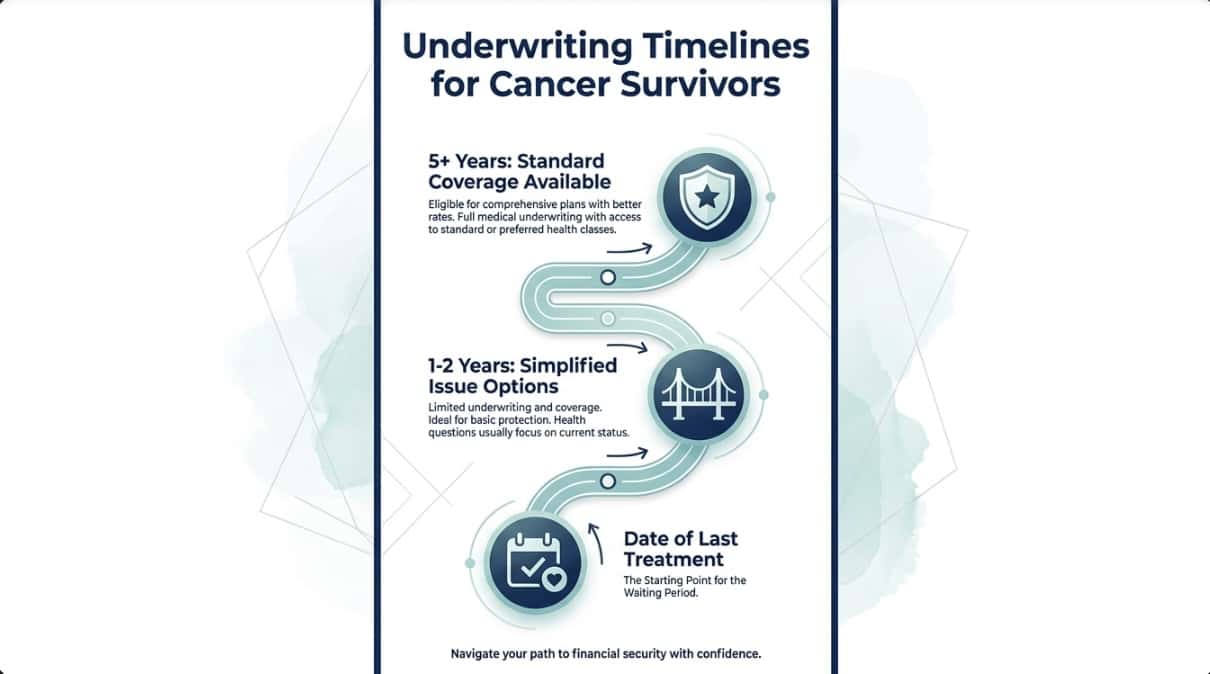
Every carrier builds its underwriting around one central question: how likely is a recurrence. That is why life insurance after cancer remission depends so heavily on time elapsed since treatment ended rather than simply on the diagnosis itself. Most insurers require at least two to five years in remission before offering traditional term or whole life coverage, and some more aggressive or historically higher-recurrence cancers can require a remission period of ten years or longer.
Skin cancers, particularly some non-melanoma types, are sometimes treated differently and may carry little to no waiting period at all, while certain aggressive cancers sit at the far end of the waiting period spectrum. This wide range is exactly why life insurance after cancer remission cannot be answered with a single blanket timeline, it genuinely depends on the specific diagnosis.
Waiting Periods for Life Insurance After Cancer Remission by Cancer Type
The table below reflects general patterns reported across multiple independent 2026 sources. Your own timeline will depend on your specific diagnosis, stage, treatment response, and the individual carrier’s underwriting guidelines.
| Cancer Type | Typical Remission Period Before Traditional Coverage | Notes |
|---|---|---|
| Basal or squamous cell skin cancer | Often no waiting period, or a very short one | Frequently treated as low risk once fully removed |
| Early-stage breast cancer | 2 to 5 years | Some insurers may consider applications as early as 3 years post-treatment |
| Prostate cancer | 2 to 5 years | Lower stage and grade generally improve odds sooner |
| Colorectal cancer | 3 to 5 years | Stage and lymph node involvement affect timing |
| Melanoma | 3 to 5 years, longer for advanced stages | Depth and stage at diagnosis matter significantly |
| Lymphoma or leukemia | 5 to 10 years | Type and response to treatment heavily influence timing |
| Aggressive or late-stage cancers | Up to 10 years or longer | Some carriers may require guaranteed issue coverage indefinitely |
The Underwriting Factors That Actually Shape Your Life Insurance After Cancer Remission Offer
When an underwriter reviews an application for life insurance after cancer remission, they are building a complete risk profile rather than simply checking a box for “cancer history.”
Time since diagnosis and treatment completion. This is consistently the single most influential factor, since risk of recurrence drops the longer someone remains cancer-free.
Cancer type, stage, and grade. A stage 1 diagnosis with clean margins carries a very different risk profile than a stage 3 or 4 diagnosis, even for the same type of cancer.
Treatment response and follow-up results. Clean follow-up scans, stable tumor markers, and consistent oncology visits all signal lower ongoing risk to an underwriter.
Other health factors. Smoking status, weight, and other pre-existing conditions are evaluated alongside cancer history, since insurers look at your complete health picture. If a heart condition or diabetes is also part of your history, our guides on life insurance for seniors with heart conditions and life insurance for seniors with diabetes cover how those combinations are typically underwritten.
Family history and genetic factors. Some carriers ask about family cancer history, particularly for cancers with a known hereditary component, which can factor into the overall risk assessment.
Understanding Rate Classes for Life Insurance After Cancer Remission
Life insurance after cancer remission rarely results in an automatic decline, but it also rarely results in the very best available rate immediately. Most survivors land somewhere in a spectrum of outcomes.
Preferred or standard rates. Generally reserved for survivors with five or more years in remission from a lower-risk cancer type, with no other significant health concerns.
Table ratings. A common outcome for survivors within two to five years of remission. Table ratings add an increasing percentage to the standard premium, often in the range of 25 percent per table level, reflecting elevated but manageable risk.
Postponement. Applications submitted too soon after diagnosis or treatment are frequently postponed rather than declined outright, meaning the insurer will reconsider once more time has passed.
Guaranteed issue coverage. For those currently in treatment, recently diagnosed, or otherwise unable to qualify for traditional underwriting, guaranteed issue policies accept applicants without health questions, typically in exchange for a smaller death benefit and a two-year graded benefit period.
Rule to remember: Many carriers will review and potentially improve your rate class after a few more years of continued remission. The premium you are quoted today is not necessarily the premium you are stuck with permanently. Our guide on how to improve your life insurance health rating covers concrete steps that can help move you into a better table over time.
Guaranteed Issue Policies and the Graded Benefit Period for Life Insurance After Cancer Remission
If you are recently diagnosed, still in treatment, or have not yet reached the remission period a traditional carrier requires, guaranteed issue coverage is often the most realistic starting point. Because a guaranteed issue carrier accepts applicants without any health screening, it manages its risk through a graded benefit period that typically lasts two years.
During that graded period, if the policyholder passes away from natural causes, including cancer-related causes, the beneficiary generally receives all premiums paid back plus interest rather than the full death benefit. Accidental death, however, is usually covered in full from day one. Once the graded period ends, the policy pays the full death benefit for any cause of death, including cancer recurrence.

Policy Options Worth Comparing for Life Insurance After Cancer Remission
- Fully underwritten term or whole life. This route requires a medical exam and complete records, but it offers the best long-term pricing once you clear underwriting. Our overviews of term life insurance for seniors over 70, whole life insurance for seniors over 70, whole life insurance for seniors over 80, and the benefits of whole life insurance for seniors explain how each type is priced.
- No medical exam life insurance. If you would rather skip the physical exam, no medical exam life insurance for seniors, our comparison of no medical exam versus traditional life insurance for seniors, our guide to qualifying for no medical exam life insurance as a senior, and our breakdown of the cost of no medical exam life insurance for seniors are all worth comparing.
- Higher coverage amounts without an exam. If your needs exceed a typical no-exam cap, high-limit no-exam life insurance is worth exploring before assuming a larger policy requires a full medical exam.
- Guaranteed issue and guaranteed acceptance policies. For more recent diagnoses or ongoing treatment, guaranteed issue whole life for seniors and guaranteed acceptance life insurance for seniors over 70 and over 80remove medical underwriting entirely.
- Final expense insurance. If your main goal is covering funeral and burial costs rather than income replacement, final expense insurance for seniors, our detailed look at final expense insurance costs, our guide on qualifying for final expense insurance with health issues, and our roundup of the best companies for final expense coverage for elderly applicants are all good starting points.
- Coverage built around pre-existing conditions generally. Our broader guides to whole life insurance for seniors with pre-existing conditions and life insurance for seniors over 80 with pre-existing conditions, along with our page specifically on life insurance for seniors with cancer history, all cover how cancer and other conditions are treated in underwriting.
- Coverage at an older age. If you are researching this for yourself, a parent, or a spouse who is older, life insurance for seniors over 70, life insurance for seniors over 80, can an 80-year-old get life insurance, can an 83-year-old get life insurance, and can an 84-year-old get life insurance all address how age and cancer history interact.
Riders Worth Considering With Life Insurance After Cancer Remission
If you want additional protection tied to your health history, it is worth reviewing what riders might strengthen a policy. Our overview of life insurance riders for seniors and the best riders to add to a senior life policy cover the most common options, while our pages on chronic illness riders for seniors, critical illness life insurance for seniors, and the best life insurance riders for chronic illness protection describe how you can access part of your death benefit while still living, should a serious health decline or recurrence occur.
If you are unsure which of these two paths fits your situation, our comparison of critical illness rider vs chronic illness rider breaks down exactly how each one is triggered. Our explainer on accelerated death benefits and our breakdown of the cost of life insurance with living benefits for senior citizens both cover the underlying mechanics further.
Practical Steps to Improve Your Odds of Life Insurance After Cancer Remission
Gather your oncology records before applying. Pathology reports, treatment summaries, follow-up scan results, and a current medication list all speed up underwriting and prevent gaps that make underwriters uneasy.
Time your application strategically. If you are close to a meaningful remission milestone, like the two-year or five-year mark for your specific cancer type, waiting a few extra months can meaningfully improve your rating.
Maintain visible follow-up care. Regular oncology visits and consistent adherence to any ongoing monitoring signal to an underwriter that your condition is being actively tracked rather than ignored.
Disclose everything, every time. Leaving out a recurrence, a second cancer, or a treatment detail will not help your application, and it can jeopardize a claim later if discovered.
Compare more than one carrier. Underwriting guidelines for cancer history vary significantly between companies, and one insurer’s standard rate can be another’s table rating. Our guide on comparing quotes and policies of life insurance over 80 and our list of mistakes to avoid in life insurance for seniors over 80 can help you avoid accepting the first offer you receive.
A Word of Caution Before You Buy Life Insurance After Cancer Remission
Because this decision often comes up during a vulnerable period, whether that is shortly after finishing treatment or while still processing a diagnosis, survivors are unfortunately a frequent target for pressured or misleading sales tactics. Our guides on avoiding life insurance scams aimed at the elderly and avoiding financial scams targeting seniors cover the warning signs worth knowing before you sign anything. If you are helping a parent navigate life insurance after cancer remission, our guide on buying life insurance for an elderly parent addresses the specific consent and conversation issues that come up in that situation.
Because underwriting for life insurance after cancer remission varies so widely from one carrier to the next, the only way to know your actual options is to compare real, personalized quotes. I am an independent blogger, not an insurance company, so I cannot generate a binding quote myself. What I can tell you is to check your customized, real-time rates for free using the independent comparison platform Policygenius, which lets you compare offers from multiple carriers side by side without committing to a sales call.
For general background on cancer survival trends and statistics, the American Cancer Society’s cancer statistics center and the National Cancer Institute’s survivorship statistics are both reliable, neutral references worth reading alongside anything an insurance agent tells you. Forbes Advisor’s overview of life insurance for cancer survivors also offers a useful, independent look at how different insurers approach remission timelines.
Common Mistakes That Hurt Your Life Insurance After Cancer Remission Application
Applying too soon. Even if you feel completely healthy shortly after finishing treatment, most insurers will not seriously consider a traditional application until at least two years have passed, and some cancers require much longer.
Assuming one decline means permanent ineligibility. A postponement or decline from one carrier does not mean every carrier will respond the same way, since underwriting guidelines for cancer history differ significantly between companies.
Being vague about the diagnosis. Providing a specific cancer type, stage, and treatment history, rather than a general description, helps underwriters make an accurate and often more favorable assessment.
Skipping oncology follow-up before applying. Scheduling a recent follow-up appointment before you apply gives underwriters current, favorable data to work with rather than an outdated snapshot.
Frequently Asked Questions About Life Insurance After Cancer Remission
Can you get life insurance after cancer remission?
Yes, in most cases. The large majority of cancer survivors can eventually qualify for traditional coverage, though the required remission period and resulting rate class depend heavily on the specific cancer type, stage, and treatment history.
How long do you have to wait for life insurance after cancer remission?
Waiting periods generally range from two to five years for many common cancers, though some aggressive or historically higher-recurrence cancers can require ten years or longer. Some minor skin cancers may have little to no waiting period at all.
What if I am still in treatment or was recently diagnosed?
Guaranteed issue policies are specifically designed for this situation. They require no medical exam and no health questions, though they typically include a two-year graded benefit period and a smaller death benefit than traditional coverage.
Will my premium always stay this high after a cancer diagnosis?
Not necessarily. Many carriers will review and potentially improve your rate class after additional years of continued remission, meaning your initial premium is not necessarily permanent.
Does the type of cancer affect my life insurance options?
Yes, significantly. Cancer type, stage, and grade all affect both the required waiting period and the resulting rate class, with lower-stage, lower-recurrence cancers generally qualifying sooner and at better rates.
Where can I get a free, real quote after cancer remission?
Because underwriting guidelines vary so much by carrier, the most reliable way to see accurate numbers is to compare real-time quotes through an independent platform like Policygenius, rather than assuming a single company’s decision reflects your options everywhere.
A Final Word
Life insurance after cancer remission is rarely as bleak as it first feels. Most survivors who gather their records, wait for a reasonable remission milestone, and compare more than one carrier end up with real, workable coverage, even if the premium is higher than it would have been before the diagnosis. The single best thing you can do is start the conversation now rather than assuming you already know the answer. You got through treatment. The next step is simply making sure your family is financially protected too.