Life insurance after a heart attack is absolutely still possible, though it usually requires a waiting period, more detailed underwriting, and acceptance of a higher premium than someone with no cardiac history would pay. It is not the automatic decline that a lot of people assume it is. When I started digging into this topic after a family friend survived a mild heart attack in his sixties, the thing that surprised me most about life insurance after a heart attack was how many legitimate paths to approval actually exist, once you know which door to knock on.
I want to be upfront about who I am. I am not an insurance agent, an underwriter, or a cardiologist. I am an independent researcher who has spent hours reading underwriting guides, carrier bulletins, and cardiology-linked underwriting criteria so that you do not have to wade through all of it yourself while you are also busy recovering. Think of this as the notes a well-informed friend would hand you before your first phone call with an agent.
Table of Contents
Can You Actually Get Life Insurance After a Heart Attack?
Yes. A heart attack, also called a myocardial infarction, does not disqualify you from coverage on its own. What it does is shift you out of the “preferred” and often the “standard” rate classes and into a more detailed underwriting review. Life insurance after a heart attack typically lands in one of three outcomes: a table-rated policy at a higher premium, a simplified issue or guaranteed issue policy with no medical exam, or, in rare severe cases, a temporary decline until your health stabilizes further.
Insurers weigh the severity of the heart attack itself along with how effective your subsequent treatment has been, and more thorough, successful treatment tends to work in your favor during underwriting. In other words, the story your medical records tell matters just as much as the fact that the event happened at all.
Insider note: The best rating a fully underwritten applicant with a heart attack history can typically reach is standard, since preferred rates are almost never offered after a cardiac event. If an agent promises you preferred pricing right after a heart attack, that is worth double-checking.
Why Insurers Require a Waiting Period
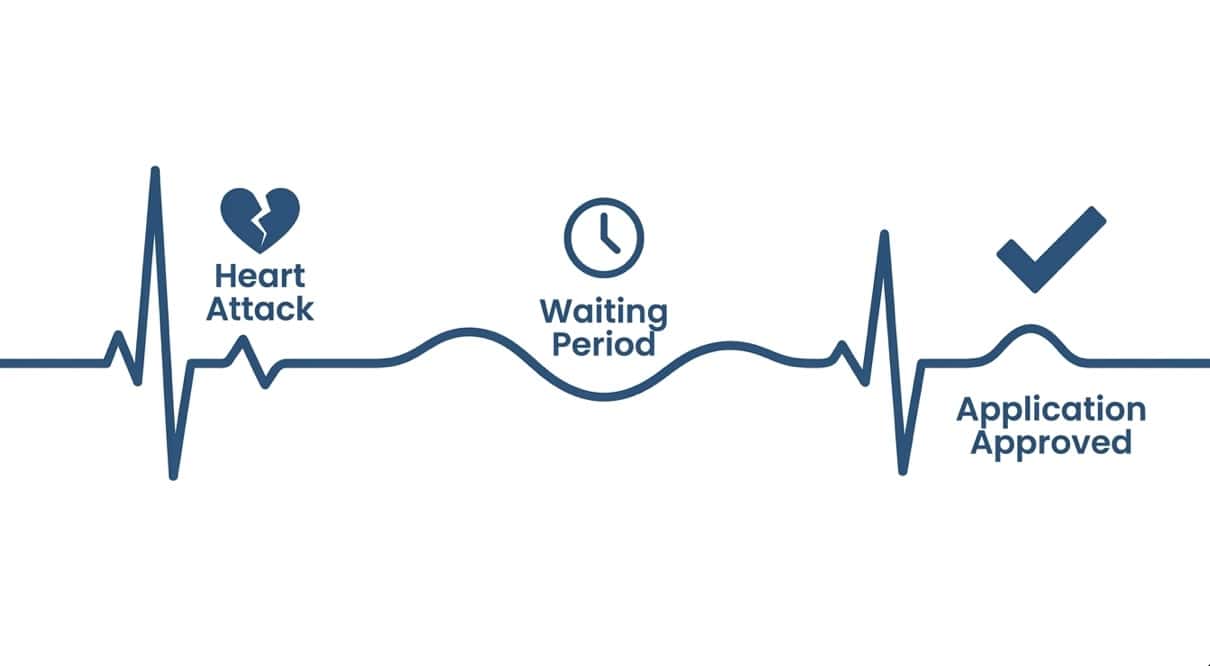
Every carrier builds in some kind of waiting period before they will even look at an application for life insurance after a heart attack. Most carriers want to see at least a year post-event before they will consider an application, and some require two. Waiting periods after cardiac events generally run anywhere from three months for a straightforward stent placement up to twelve months for a full heart attack, depending on how the event was treated.
The logic is simple. The months right after a heart attack carry the statistically highest risk of a repeat event. Underwriters use that window to see how your recovery, treatment response, and risk of recurrence actually play out before pricing your risk. Applying too early is one of the most common and most expensive mistakes people make when shopping for life insurance after a heart attack.
Applying too soon after your event is a frequent misstep. Carriers regularly see clients apply within a few months of a heart attack out of understandable urgency, but doing so almost always results in a postponement or a rating so high it barely makes financial sense. Sometimes waiting another six to nine months saves thousands of dollars in premiums over the life of the policy.
Waiting Periods by Cardiac Event Type
Not every cardiac event is underwritten the same way. The table below gives you a general sense of how long carriers typically wait before considering an application, though your own timeline will depend on your specific diagnosis, treatment, and follow-up results.
| Cardiac Event | Typical Waiting Period | What Improves Your Odds |
|---|---|---|
| Heart attack (myocardial infarction) | 6 to 12 months, sometimes up to 2 years for severe cases | Stable ejection fraction, no recurrence, medication compliance |
| Stent placement (angioplasty) | 3 to 6 months | Fewer stents, single vessel, clean follow-up imaging |
| Coronary bypass surgery (CABG) | 3 to 12 months | Fewer vessels bypassed, strong post-surgical recovery |
| Congestive heart failure | Often guaranteed issue only | Improved ejection fraction, symptom control |
| Heart transplant | 2 to 5 years post-transplant | Full compliance with anti-rejection regimen |
Age at the time of the cardiac event also factors into underwriting, since a heart attack at a younger age tends to suggest more aggressive underlying disease than the same event later in life. This is one reason two people with an almost identical heart attack history can still receive very different offers for life insurance after a heart attack.
The Underwriting Factors That Actually Move Your Rate
When an underwriter reviews an application for life insurance after a heart attack, they are not just checking a box that says “yes” or “no” to a cardiac event. They are building a full risk profile using several specific data points.
Ejection fraction. This single number, taken from your echocardiogram, carries enormous weight. A reading of 55 percent or higher is generally viewed as a strong sign, while anything below 45 percent tends to push rates significantly higher.
Time since the event. Someone whose heart attack happened three years ago with zero complications since sits in a completely different risk category than someone only six months out.
Treatment and intervention history. Whether you had a stent, bypass surgery, or medication-only management all factor into how underwriters read your file, along with how many vessels were involved.
Medication compliance and follow-up care. Consistent cardiology visits and taking medications exactly as prescribed signal to an underwriter that your condition is being actively managed rather than ignored.
Other risk factors. Smoking status, weight, cholesterol, blood pressure, and diabetes are all evaluated alongside your cardiac history, since underwriters look at your complete health picture rather than your heart in isolation. If diabetes is also part of your health history, our guide to life insurance for seniors with diabetes covers how that combination is typically underwritten.
Devices. A pacemaker or an implantable cardioverter defibrillator must be disclosed, since an ICD in particular signals serious arrhythmia risk and will factor heavily into the underwriting decision. Trying to leave a device off your application will not help your case and can jeopardize the policy later.
Understanding Table Ratings
Most people who successfully get life insurance after a heart attack are not declined and are not offered standard rates either. They land somewhere in between, in what the industry calls a table rating.
Table ratings use letters or numbers to indicate increasing levels of risk, with each step typically adding roughly 25 percent to the standard premium. So a policy that would cost $100 a month at standard rates might run closer to $150 a month at a Table 2 rating, or approach $300 a month at a Table 8 rating. The encouraging part is that many carriers will review and potentially lower your table rating after two to five years of demonstrated stability, which means the premium you are quoted today is not necessarily the premium you are stuck with for life.
Our guide on how to improve your life insurance health rating walks through concrete steps, like documented weight loss or better blood pressure control, that can help move you into a lower table over time.
Policy Options If You Have Had a Heart Attack
There is no single right answer here. The best policy type depends on how recent your event was, how stable your current health is, and what you are trying to accomplish.
- Fully underwritten term or whole life. This route requires a medical exam, complete records, and often cardiac-specific testing, but it offers the best long-term pricing once you clear underwriting. Our overview of term life insurance for seniors over 70 and whole life insurance for seniors over 70 explains how each type is priced.
- No medical exam life insurance. If you would rather skip the physical exam, no medical exam life insurance for seniors is worth comparing, along with our breakdown of no medical exam versus traditional life insurance for seniors and how to qualify for no medical exam life insurance as a senior.
- Simplified issue and guaranteed issue policies. For more severe cardiac histories, or if you have been declined for traditional coverage, guaranteed issue whole life for seniors and guaranteed acceptance life insurance for seniors over 70 remove medical underwriting entirely, typically in exchange for a lower face amount and a graded death benefit period.
- Final expense insurance. If your main goal is covering funeral and burial costs rather than income replacement, final expense insurance for seniors and our detailed look at final expense insurance costs are a good place to start.
- Coverage built around pre-existing conditions generally. Our broader guide to whole life insurance for seniors with pre-existing conditions and our page specifically on life insurance for seniors with heart conditions both cover how cardiac history is treated relative to other common conditions.
- Higher coverage amounts. If you need a larger death benefit than a typical no-exam policy allows, high-limit no-exam life insurance is worth exploring before assuming a large policy requires a full medical exam.
Guaranteed Issue Policies and the Graded Benefit Period
If your heart attack was recent, severe, or accompanied by ongoing symptoms, guaranteed issue coverage may be the most realistic starting point, and it is worth understanding exactly how it works before you buy. Because a guaranteed issue carrier accepts applicants without any health screening, it manages its risk through a graded benefit period that typically lasts two to three years.
During that graded period, if the policyholder passes away from natural causes, the beneficiary does not receive the full death benefit, but instead receives all premiums paid back plus interest, often around 10 percent. Accidental death, however, is usually covered at the full benefit amount from day one. Once the graded period ends, the policy pays the full death benefit for any cause of death.
Rule to remember: A graded death benefit is not a scam, it is how guaranteed issue coverage stays financially viable for the carrier. Just make sure you understand the graded period in writing before you buy, so there are no surprises for your beneficiaries.
Practical Steps to Improve Your Odds and Your Rate
A few concrete moves consistently make a real difference for anyone shopping for life insurance after a heart attack.
Gather your documentation before applying. Your most recent cardiology evaluation, echo results, any stress test report, cardiac catheterization report, and a current medication list with exact dosages all speed up the underwriting process and prevent gaps that make underwriters uneasy.
Time your application strategically. If your heart attack happened close to the one-year or two-year mark, waiting a few extra months to cross that threshold can meaningfully improve your rating. At the same time, waiting indefinitely has its own cost, since premiums rise with age regardless of health.
Maintain visible treatment compliance. Regular cardiology follow-up appointments and consistent medication use are not just good for your health, they are also concrete evidence an underwriter uses to justify a better rate class.
Address the rest of your risk profile. Quitting smoking, managing cholesterol and blood pressure, and controlling any diabetes all improve your overall underwriting picture, since insurers evaluate your complete health, not your heart in isolation.
Disclose everything, every time. Leaving out a pacemaker, a second cardiac event, or a medication will not help your application. It will usually surface anyway during the records review, and it damages your credibility on the entire file.
Consider a rider instead of a separate policy. If you want extra protection for a future cardiac event, our guides on chronic illness riders for seniors, critical illness life insurance for seniors, the best life insurance riders for chronic illness protection, and accelerated death benefits explain how these add-ons work alongside a base policy. Our general overview of life insurance riders for seniors and the best riders to add to a senior life policy is a useful starting reference too.
Compare more than one carrier. Underwriting guidelines for cardiac history vary significantly between companies. Our piece on comparing quotes and policies of life insurance over 80 and our list of mistakes to avoid in life insurance for seniors over 80 can help you avoid accepting the first offer you receive.
Because underwriting for life insurance after a heart attack varies so widely from one carrier to the next, the only way to know your actual options is to compare real, personalized quotes. I am an independent blogger, not an insurance company, so I cannot generate a binding quote myself. What I can tell you is to check your customized, real-time rates for free using the independent comparison platform Policygenius, which lets you compare offers from multiple carriers side by side without committing to a sales call.
Common Mistakes That Hurt Your Application
Applying too soon. Even if you feel completely fine three months after your heart attack, most insurers will not seriously consider your application until at least six months have passed, and some prefer a full year or two for more severe events.
Being vague about the event. Saying “heart problem” instead of specifying that it was a myocardial infarction, how extensive it was, and what interventions followed almost always triggers worst-case assumptions from an underwriter.
Assuming coverage is unaffordable. Many people never actually request a quote because they assume a cardiac history prices them out entirely, when in reality even a table-rated policy is often more affordable than expected.
Skipping cardiology follow-up before applying. If you have not seen your cardiologist recently, scheduling an appointment before you apply gives underwriters current, favorable data to work with rather than an outdated snapshot.
For general background on how heart disease and recovery are understood medically, the American Heart Association’s heart attack recovery resources and the CDC’s heart disease data and statistics are both reliable, free references worth reading alongside anything an insurance agent tells you.
Frequently Asked Questions
Can you get life insurance after a heart attack?
Yes. A heart attack does not automatically disqualify you, though most carriers require a waiting period of six months to two years and will typically offer a table-rated policy rather than standard or preferred pricing.
How long do you have to wait to get life insurance after a heart attack?
Most insurers require at least six to twelve months of recovery time before they will consider an application, and some carriers prefer waiting a full year or two, especially for more severe events involving reduced heart function.
What is a table rating, and will I have one forever?
A table rating is an added premium, typically around 25 percent per table level, that reflects your elevated risk after a cardiac event. Many carriers will review your table rating after two to five years of demonstrated stability and may lower it if your health has held steady.
What if I am declined for traditional life insurance after a heart attack?
Guaranteed issue final expense policies are specifically designed for this situation. They require no medical exam and no health questions, though they typically include a graded benefit period of two to three years and a smaller death benefit than traditional coverage.
Does the type of treatment I received matter?
Yes. Whether you had a stent, bypass surgery, or medication-only management all affects how an underwriter views your case, along with your current ejection fraction and how many follow-up tests show stable heart function.
Where can I get a free, real quote after a heart attack?
Because underwriting guidelines for cardiac history vary so much by carrier, the most reliable way to see accurate numbers is to compare real-time quotes through an independent platform like Policygenius, rather than assuming a single company’s decision reflects your options everywhere.
A Final Word
Life insurance after a heart attack is rarely as bleak as it first feels. Most survivors who take the time to gather their records, wait for a reasonable stabilization period, and compare more than one carrier end up with real, workable coverage, even if the premium is higher than it would have been before the event. The single best thing you can do is start the conversation now rather than assuming you already know the answer. Your heart attack happened. You survived it. The next step is simply making sure your family is financially protected too.