
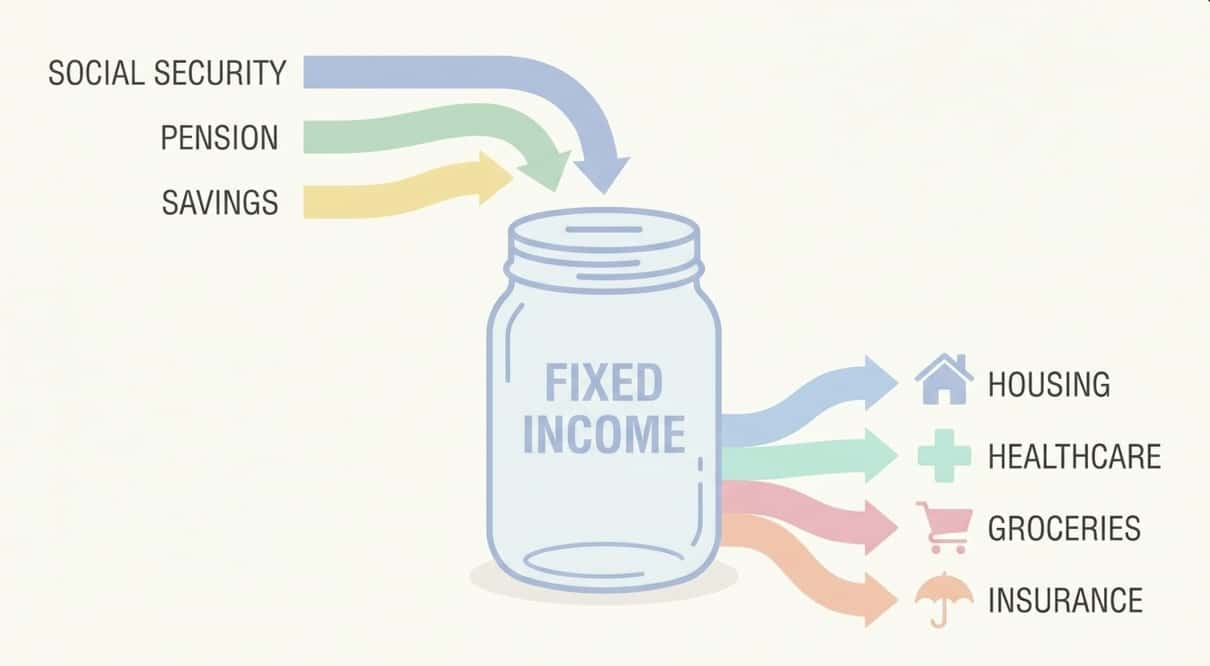
Budgeting on a fixed income for seniors means building a monthly spending plan around income sources, like Social Security, a pension, or SSI, that stay largely flat while everyday costs like groceries, healthcare, and housing keep climbing. It is a different kind of budgeting than most of us learned in our twenties, because there is no raise coming next year to bail you out if the numbers do not work.
When I was helping my own mother sort through her monthly statements last year, the thing that struck me most about budgeting on a fixed income for seniors was not that she was overspending. It was that nobody had ever sat down and shown her a simple, honest framework for matching her income to her real expenses.
That is exactly what this guide is for. I am not an insurance agent, a financial planner, or a bank representative. I am an independent researcher who has spent a lot of hours reading Social Security Administration data, Medicare bulletins, and cost-of-living reports so that you do not have to. Consider me the friend who did the homework on budgeting on a fixed income for seniors and is now walking you through it over coffee.
Table of Contents
What “Fixed Income” Really Means for Retirees in 2026
The phrase “fixed income” gets used loosely, but it has a precise meaning for retirement planning. It refers to income that does not grow with your performance or your effort. It is set by a formula, a pension contract, or an annuity schedule, and it typically only moves once a year, if at all. This is exactly why budgeting on a fixed income for seniors requires a different mindset than budgeting during your working years.
For most retirees, this income comes from a mix of:
- Social Security retirement benefits, adjusted annually by a cost-of-living adjustment (COLA)
- Supplemental Security Income (SSI) for those with limited income and resources
- Pension payments from a former employer, which are often flat for life
- Annuity income purchased with retirement savings
- Investment income, such as dividends or required minimum distributions
You can see the official 2026 COLA figures directly on the Social Security Administration’s 2026 COLA Fact Sheet, and a full breakdown of what counts toward income and resource limits is available through the SSA’s Supplemental Security Income program page.
The core challenge of budgeting on a fixed income for seniors is that while your income moves in small, predictable steps, your expenses, especially healthcare, do not move in step with it. Social Security’s 2026 cost-of-living adjustment came in at 2.8 percent, a modest bump from the 2.5 percent increase in 2025, marking the fifth straight year of a COLA at 2.5 percent or higher, the longest such streak since the 1990s. That sounds reassuring until you look at what is eating into it.
Insider note: A COLA increase is not the same as a raise you get to keep. The 2026 Medicare Part B premium is deducted directly from most people’s Social Security checks before the money ever reaches their bank account. Always budget with your net deposit, not your gross benefit amount. You can confirm current Part B premium figures directly on Medicare.gov’s official costs page.
The 2026 Numbers Every Senior Budgeting on a Fixed Income Should Know
Before you can build a workable plan, it helps to see where the actual dollars stand this year. These figures come directly from the Social Security Administration’s 2026 fact sheet and related federal announcements, and they form the backbone of any realistic approach to budgeting on a fixed income for seniors.
| 2026 Figure | Amount | What Changed From 2025 |
|---|---|---|
| Social Security COLA | 2.8 percent | Up from 2.5 percent |
| Average retired worker benefit | About $2,064 per month | Up about $56 per month |
| Average SSDI benefit | About $1,630 per month | Up about $44 per month |
| Maximum federal SSI, individual | $994 per month | Up $27 from $967 |
| Maximum federal SSI, couple | $1,491 per month | Up $41 from $1,450 |
| Standard Medicare Part B premium | $202.90 per month | Up $17.90, a 9.7 percent jump |
| Social Security earnings limit (under full retirement age) | $24,480 per year | Increased from 2025 |
| Earnings limit (reaching full retirement age in 2026) | $65,160 per year | Increased from 2025 |
Notice the gap between the first row and the sixth row of that table. A 2.8 percent income increase is being partly absorbed by a 9.7 percent jump in a single recurring healthcare cost. That is the single most important dynamic in budgeting on a fixed income for seniors right now, and it is why a generic budgeting template rarely fits a retiree’s real life.
As one retiree in AARP’s coverage of this year’s COLA put it, living on a Social Security check alone can feel like walking a “razor-thin” margin every month, especially once medical premiums are subtracted before the deposit even lands. You can read AARP’s full breakdown on the 2026 Social Security COLA increase.
Building a Fixed-Income Budget Framework That Actually Works
Most budgeting advice assumes your paycheck is the variable and your bills are somewhat controllable. For seniors, it is often the reverse: your income is the fixed variable, and your job is to make every recurring bill fit inside it. Here is the four-step framework I recommend to family members and readers who are serious about budgeting on a fixed income for seniors.
Step 1: Total Your Net Monthly Income, Not Your Gross Benefit
List every income source after deductions. That means your Social Security deposit after the Part B premium comes out, your pension after taxes withheld, and any annuity payment after fees. This is the real number you are working with, and it is the starting point for any honest attempt at budgeting on a fixed income for seniors.
Step 2: Separate Fixed Necessities From Flexible Spending
Fixed necessities are the bills that show up every month no matter what: rent or mortgage, utilities, insurance premiums, prescription copays, and minimum debt payments. Flexible spending covers groceries, transportation, entertainment, and gifts. Seniors budgeting on a fixed income typically find that necessities eat up 70 to 85 percent of monthly income, leaving a thin margin for everything else.
Step 3: Build a Healthcare Reserve Line Item
This is the step most generic budgeting guides skip entirely. Out-of-pocket healthcare costs, from copays to dental work that Medicare does not cover, tend to be the single biggest destabilizer of a fixed-income budget. Even a modest $50 to $100 monthly reserve, treated as untouchable, can prevent a single unexpected bill from derailing the whole plan. The Centers for Medicare & Medicaid Services newsroom publishes annual cost updates worth bookmarking. Our related breakdown of Medicare costs and budgeting walks through how to estimate this line item more precisely based on your specific plan.
Step 4: Plan for the Predictable “Someday” Expenses
Funeral costs, estate settlement fees, and final medical bills are predictable in the sense that they will happen, even if the timing is not. Many readers I talk to are surprised at how widely funeral costs actually vary by location. Our state-by-state breakdown of the average funeral cost by state is a useful reference point when you are deciding how much of a reserve, or how much coverage, you actually need. If estate planning is part of your picture, our guide to the best life insurance for estate planning is worth reading alongside this one.
A Sample Monthly Allocation for Seniors on a Fixed Income
The table below is a general starting framework, not a prescription. Your own approach to budgeting on a fixed income for seniors will look different depending on whether you own your home outright, carry debt, or live in a high-cost state.
| Budget Category | Suggested Share of Net Income | Common Pitfall |
|---|---|---|
| Housing (rent, mortgage, taxes, insurance) | 30 to 35 percent | Underestimating property tax increases |
| Healthcare (premiums, copays, prescriptions) | 15 to 20 percent | Ignoring Part B and supplemental premium hikes |
| Food and household goods | 10 to 12 percent | Not adjusting for grocery inflation |
| Utilities and transportation | 10 to 12 percent | Skipping seasonal utility spikes |
| Debt payments | 0 to 10 percent | Carrying credit card balances into retirement |
| Insurance (life, final expense) | 3 to 6 percent | Overbuying or underbuying coverage |
| Discretionary and emergency reserve | 10 to 15 percent | Treating this as optional rather than essential |
A quick gut check: if your housing and healthcare rows alone already exceed 50 percent of your net income, that is a signal worth addressing directly rather than trying to squeeze savings out of the grocery bill. This kind of category-by-category check is really the heart of budgeting on a fixed income for seniors.
Where Fixed-Income Budgets Actually Break Down
Three things consistently derail even a carefully built plan for budgeting on a fixed income for seniors.
Healthcare cost creep. Premiums, deductibles, and prescription costs rise most years, often faster than the annual COLA. This is the mismatch we already covered above, and it is the single biggest reason a budget that worked in January feels impossible by November.
Debt carried into retirement. Credit card balances, a car loan, or even a lingering mortgage put fixed monthly obligations against a fixed income, with almost no flexibility to absorb a bad month. If this describes your situation, our guide on avoiding debt in retirement covers practical strategies for reducing that pressure before it compounds.
Scams and predatory offers. Seniors on fixed incomes are unfortunately a frequent target for financial fraud, precisely because a scammer knows that a single bad decision can be devastating when there is no paycheck coming to recover from it. The Federal Trade Commission’s consumer fraud resources and the Consumer Financial Protection Bureau’s fraud prevention guides are both excellent, free, government-run resources on this topic. We also cover common warning signs in our own pieces on avoiding financial scams targeting seniors and, specific to our own niche, avoiding life insurance scams aimed at the elderly.
Rule to remember: No legitimate government agency, Medicare representative, or Social Security employee will ever ask for payment by gift card or wire transfer to “release” a benefit. If you hear that request, hang up and report it directly to the CFPB.
How Life Insurance and Final Expense Coverage Fit Into a Fixed-Income Budget
This is where I want to be very direct with you: not every senior needs life insurance, and not every senior needs the same kind of coverage. But for many people budgeting on a fixed income for seniors, a modest final expense or whole life policy is less about leaving an inheritance and more about closing a specific gap, the cost of a funeral, a small remaining debt, or final medical bills that Medicare will not touch.
The trick is fitting the premium into your budget without displacing something more urgent. A few practical starting points, all of which tie back into a realistic plan for budgeting on a fixed income for seniors:
- If your goal is simply covering funeral and burial costs, look specifically at burial insurance for seniors over 70, which tends to carry lower face amounts and correspondingly lower premiums.
- If you have health conditions that make traditional underwriting difficult, no medical exam life insurance for seniors and guaranteed acceptance life insurance for seniors over 70 are worth comparing, though they typically cost more per dollar of coverage. Our guide on whole life insurance for seniors with pre-existing conditions goes deeper on this.
- If premium affordability is your main concern, our dedicated guides on affordable life insurance options for seniors on a fixed income and lowering life insurance premiums for seniors on a fixed income go into specific tactics for keeping the monthly cost manageable.
- For a broader look at how final expense policies are priced in 2026, see the cost of final expense insurance for seniors and final expense insurance for seniors more generally.
- If you are researching coverage for someone in their 70s or 80s specifically, life insurance for seniors over 70 and life insurance for seniors over 80 are good starting overviews, and our answer to whether an 80-year-old can get life insurance addresses a question we get constantly.
- Term coverage is sometimes the better fit for a tighter budget. Our guide to term life insurance for seniors over 70explains when that makes sense.
- Adding a rider for chronic or critical illness can also change your monthly premium math. See our breakdowns of chronic illness riders for seniors, critical illness life insurance for seniors, and life insurance riders for seniorsgenerally before adding anything to a policy.
- If you are comparing multiple offers, our piece on comparing quotes and policies of life insurance over 80 and our list of mistakes to avoid in life insurance for seniors over 80 can help you avoid overpaying.
- If a past health rating pushed your quoted premium higher than expected, our guide on how to improve your life insurance health rating outlines steps that can bring the cost back down.
Because every insurer prices risk differently based on age, health, and state, the only way to know what a policy will actually cost you is to get a real, personalized quote. I am an independent blogger, not an insurance company, so I cannot generate a binding quote myself. What I can tell you is to check your customized, real-time rates for free using the independent comparison platform Policygenius, which lets you compare multiple carriers side by side without a sales call, all while staying inside whatever budget you have carved out for insurance in your fixed-income plan.

Practical Strategies to Stretch a Fixed Income Further
A few tactics that consistently make a real difference for anyone serious about budgeting on a fixed income for seniors, based on the research and reader questions I see most often:
Automate the boring stuff. Setting bills to autopay from a dedicated account tied directly to your Social Security deposit removes the temptation to spend that money before the mortgage or the insurance premium clears.
Review supplemental Medicare coverage every fall. Plans and premiums change annually. The Medicare Plan Compare tool lets you check this directly each open enrollment period. What was the cheapest option two years ago may not be today, and comparing plans can meaningfully change your monthly healthcare row in the budget table above.
Ask about senior discounts on everything. Utilities, property tax freezes, pharmacy programs, and even some insurance riders offer senior-specific savings that are easy to miss if you do not ask directly. The Benefits.gov screening tool is a free federal resource for finding programs you may already qualify for.
Right-size insurance coverage rather than canceling it outright. If a policy premium is straining the budget, look into reducing the face amount or converting to a smaller final expense policy rather than dropping coverage entirely and losing years of paid-in value.
Build the emergency reserve before anything else. Even $25 a month set aside consistently adds up to a meaningful cushion within a couple of years, and it is the single best protection against a fixed-income budget getting derailed by one unplanned expense.
Frequently Asked Questions
What is considered a fixed income for budgeting purposes?
A fixed income generally refers to income that does not change based on your effort or investment performance, such as Social Security benefits, a traditional pension, or annuity payments. It typically only adjusts once a year through a cost-of-living adjustment, if at all, which is the foundation of budgeting on a fixed income for seniors.
How much of my Social Security check should go toward housing?
A common guideline is keeping housing costs, including rent or mortgage, property taxes, and homeowners or renters insurance, to no more than 30 to 35 percent of your net monthly income, though local cost of living will shift this somewhat.
Does the Social Security COLA actually keep up with inflation for seniors?
Not always. Critics of the current CPI-W formula argue it does not fully reflect the specific spending habits of older Americans, who tend to face larger increases in healthcare and long-term care costs than the general population. This is why budgeting on a fixed income for seniors often requires a larger healthcare buffer than the COLA percentage alone would suggest.
Is final expense insurance worth it on a limited budget?
For many seniors, a modest final expense policy is worth it specifically because it prevents funeral and burial costs from becoming a burden on family members. Whether it fits your particular budget depends on your health, your existing savings, and your state’s average funeral costs, which is why comparing real quotes matters more than following a blanket recommendation.
What is the biggest mistake seniors make when budgeting on a fixed income?
Budgeting off the gross Social Security benefit amount rather than the net deposit after Medicare Part B and any supplemental premiums are withheld. This single miscalculation is responsible for more budget shortfalls than any single spending category, and it is the first thing I check whenever someone asks me for help with budgeting on a fixed income for seniors.
Where can I get a free, real quote for senior life insurance?
Because rates vary significantly by carrier, age, health, and state, the most reliable way to see accurate numbers is to compare real-time quotes through an independent platform like Policygenius, rather than relying on generic published averages.
A Final Word
Budgeting on a fixed income for seniors is not about deprivation. It is about precision. The retirees I have seen handle this most gracefully are not the ones with the biggest pensions, they are the ones who know their real net numbers cold, who treat their healthcare reserve as non-negotiable, and who revisit their plan at least once a year as premiums and COLAs shift. Start with the framework above, be honest about where your money actually goes, and adjust in small steps rather than trying to overhaul everything at once. That, more than any single trick, is what successful budgeting on a fixed income for seniors really looks like.