
Life insurance for COPD seniors is available through several policy types, including guaranteed issue whole life, simplified issue whole life, and graded benefit final expense plans, even when a traditional medically underwritten policy is out of reach. That’s the short answer. The longer answer, the one that actually matters when you’re staring down a stack of health questions on an application, is a lot more nuanced, and that’s what I want to walk through with you here.
When I first started digging into this topic for a family member who’d been diagnosed with moderate COPD a few years back, I expected a flat “no” from most insurers. What I found instead was a patchwork of options, some generous, some genuinely predatory, and a whole lot of confusing terminology standing between COPD patients and coverage they can actually afford. This guide is my attempt to clear that fog and lay out, step by step, exactly how life insurance for COPD seniors actually works in practice.
Table of Contents
Why Life Insurance for COPD Seniors Gets Complicated in Underwriting
Chronic Obstructive Pulmonary Disease, which includes both emphysema and chronic bronchitis, sits high on every carrier’s risk matrix. Underwriters aren’t being cruel here, they’re pricing risk based on actuarial tables, and COPD is strongly correlated with hospitalizations, respiratory failure, and shortened life expectancy compared to the general senior population.
Insurers evaluate COPD applicants using a mix of factors, not just the diagnosis itself:
- Stage of the disease (using GOLD classification, Stages 1 through 4)
- Whether you use supplemental oxygen, and how often
- History of hospitalizations or ER visits tied to breathing episodes
- Smoking status, current or former
- Pulmonary function test results (FEV1 readings specifically)
- Other comorbidities like heart disease or diabetes
Insider note: Most carriers won’t even look at your application holistically until they see your FEV1 percentage, a measurement of how much air you can forcefully exhale in one second compared to a healthy baseline. A reading above 65% often keeps you in consideration for traditional underwriting. Drop below 40%, and you’re almost certainly routed toward simplified or guaranteed issue products instead.
This is the single biggest thing people misunderstand: a COPD diagnosis alone doesn’t disqualify you. It’s the severity and management of the condition that determines which door you walk through.
Life Insurance for COPD Seniors: Can You Actually Get Approved? Yes, Here’s How
The honest answer depends heavily on where you land on the severity spectrum. I’ll break this into three realistic tiers, because lumping “mild COPD diagnosed five years ago and well controlled” in with “Stage 4, on oxygen full time” does a real disservice to readers trying to figure out where they fit.
Life Insurance for COPD Seniors With Mild to Moderate Disease (Stage 1-2, No Oxygen Use)
If you’re in this bucket, you may still qualify for fully underwritten term or whole life insurance, though expect a substandard or “table rated” premium rather than standard pricing. Some carriers will approve you at Table 2 to Table 4 ratings, which typically adds 50% to 100% onto standard premiums but still keeps the door open to real death benefits in the $100,000 to $500,000 range.
If a full medical exam feels overwhelming, or your recent labs aren’t flattering, simplified issue life insurance (no exam, just health questions) becomes the more realistic path, though you’ll want to compare it against traditional underwriting first since it typically costs more per dollar of coverage. If you’re weighing that trade-off, this breakdown of no-medical-exam life insurance versus traditional coverage for seniors is worth reading before you commit.
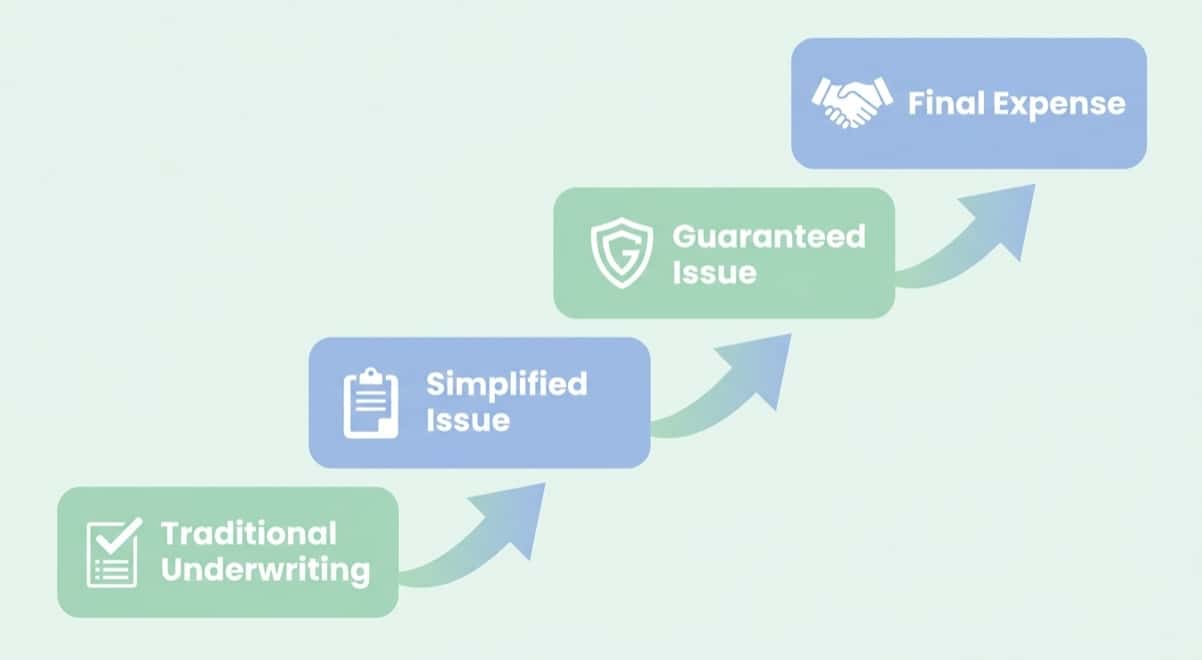
Life Insurance for COPD Seniors With Moderate to Severe Disease (Stage 3, Occasional Oxygen)
At this stage, fully underwritten policies become far less likely. Most applicants here end up in simplified issue whole lifeterritory, where you’re accepted or declined based on a health questionnaire rather than a paramedical exam. Coverage amounts tend to cap between $25,000 and $50,000, which is often plenty for final expense purposes but won’t replace income for a surviving spouse.
Life Insurance for COPD Seniors With Severe Disease (Stage 4, Daily Oxygen Dependence)
This is where guaranteed issue whole life insurance becomes the primary realistic option. No health questions, no medical exam, guaranteed acceptance for anyone in the eligible age range (typically 50 to 85). The tradeoff is a graded death benefit, meaning if you pass away from natural causes within the first two to three years of the policy, beneficiaries receive a refund of premiums paid plus interest rather than the full face value. Death from an accident is typically covered in full from day one.
I’ve written a deeper dive on how these policies work for the oldest applicants specifically in this piece on guaranteed issue whole life for seniors over 80, which covers a lot of the fine print worth understanding before you sign anything.
Comparing Your Realistic Life Insurance for COPD Seniors Options
Here’s the table I wish someone had handed me when I started this research. It maps out the four main paths available for life insurance for COPD seniors, side by side.
| Policy Type | Medical Exam Required | Typical Coverage Range | COPD Severity Fit | Waiting Period on Natural Death |
|---|---|---|---|---|
| Traditional Term/Whole Life | Yes | $100,000 – $1M+ | Mild, well-controlled | None (if approved standard) |
| Simplified Issue Whole Life | No (health questions only) | $25,000 – $50,000 | Mild to Moderate | Usually none, some 1-2 yr graded |
| Guaranteed Issue Whole Life | No | $5,000 – $25,000 | Moderate to Severe | 2-3 years graded benefit |
| Group/Employer Life | Sometimes | Varies by employer | Any stage, while employed | None typically |
A few things stand out about life insurance for COPD seniors when you look at it laid out this way. Notice how coverage amounts shrink as underwriting requirements loosen, that’s the tradeoff insurers make to offset the risk of not medically screening you. It’s also why so many people shopping for life insurance for COPD seniors end up combining a smaller guaranteed issue policy with other financial tools rather than relying on one product to do everything.
The Real Cost of Life Insurance for COPD Seniors
Pricing for life insurance for COPD seniors varies enormously based on your age, gender, disease stage, and whether you’ve smoked. As a rough benchmark, a 70-year-old with moderate COPD shopping for a $25,000 guaranteed issue whole life policy might see monthly premiums somewhere between $140 and $220, depending on the carrier and state. That’s meaningfully higher than the same coverage amount for a healthy applicant of the same age, sometimes by 30% to 60%.
Cost warning: Never accept the first quote you receive. I’ve seen premium differences of $40 to $60 a month for identical coverage amounts between carriers, purely because underwriting guidelines for respiratory conditions differ so widely from company to company. Some insurers specialize in higher-risk applicants and price accordingly; others simply decline and move on.
If budget is your primary concern when shopping for life insurance for COPD seniors, it’s worth reading through this guide on lowering life insurance premiums for seniors on a fixed income before you finalize a purchase, since a few strategic adjustments (payment frequency, coverage amount, riders you actually need versus ones you don’t) can meaningfully change your monthly outlay.
What Insurers Ask When You Apply for Life Insurance for COPD Seniors
Application questionnaires for simplified issue and even some guaranteed issue policies still ask targeted health questions. Knowing what’s coming helps you answer accurately and avoid a rescission down the road (insurers can deny claims within the contestability period, usually two years, if they discover material misrepresentation).
Typical questions include:
- Have you been hospitalized for COPD, emphysema, or chronic bronchitis in the last 12-24 months?
- Do you currently use supplemental oxygen?
- Have you been advised by a physician to use oxygen but have declined?
- Are you currently taking more than two prescription medications for a respiratory condition?
- Have you smoked in the last 12 months?
- Do you have a diagnosed comorbid condition, such as COPD paired with congestive heart failure?
Answering honestly matters more than trying to present your health in the best possible light. Misrepresenting oxygen use or a recent hospitalization is one of the fastest ways to get a claim denied later, which defeats the entire purpose of buying the policy. If you’re unsure how your specific combination of conditions will be viewed, this resource on improving your life insurance health rating walks through practical steps that can shift you into a better rate class before you apply.
Riders Worth Adding to Life Insurance for COPD Seniors
A base policy is rarely the whole story. Riders, optional add-ons that modify your coverage, can matter enormously when you’re shopping for life insurance for COPD seniors and managing a chronic respiratory condition.
- Accelerated death benefit rider: Lets you access a portion of your death benefit while still living if diagnosed with a qualifying terminal illness. Many COPD policies include this at no extra cost, but always confirm the qualifying criteria.
- Chronic illness rider: Distinct from the terminal illness version, this pays out if you become unable to perform a set number of activities of daily living, which becomes increasingly relevant as COPD progresses.
- Waiver of premium rider: Waives your premium payments if you become totally disabled, protecting the policy from lapsing during a health crisis.
Understanding the difference between a chronic illness rider and a critical illness rider trips up a lot of readers I talk to, and the distinction genuinely matters for COPD specifically since it’s classified as chronic rather than acute. I broke down the differences in detail in this critical illness rider versus chronic illness rider comparison, and it’s worth five minutes of your time before choosing a policy.
Final Expense Insurance: A Practical Middle Ground for Life Insurance for COPD Seniors
For many seniors weighing life insurance for COPD seniors’ options, the actual financial goal isn’t leaving behind a large inheritance, it’s making sure funeral costs, medical bills, and small debts don’t fall on family members. Final expense insurance is purpose-built for exactly this scenario. Coverage amounts are modest (typically $5,000 to $20,000), premiums are level for life, and many policies use simplified underwriting that’s far more forgiving of respiratory diagnoses than full medical underwriting would be.
Given that average funeral costs continue climbing nationally, this smaller-scale coverage often makes more practical sense than stretching for a larger policy you might not qualify for anyway. You can see how costs vary depending on where you live in this breakdown of average funeral costs by state, which helps you right-size your coverage amount rather than guessing.
If health issues beyond COPD are also part of your picture, it’s worth reading whether you can qualify for final expense insurance with health issues more broadly, since carriers vary widely in how they weigh combinations of conditions.
Common Mistakes Buyers of Life Insurance for COPD Seniors Make
I’ve talked to enough readers shopping for life insurance for COPD seniors to notice the same handful of missteps showing up repeatedly.
- Applying to only one carrier. Underwriting guidelines for respiratory conditions vary so much between insurers that a decline from one company tells you almost nothing about your odds elsewhere.
- Not disclosing occasional or “as-needed” oxygen use. Even intermittent use needs to be reported. Insurers cross-reference medical records (through the MIB database and pharmacy records) during the contestability period, and gaps get discovered.
- Assuming guaranteed issue is always the cheapest per dollar of coverage. It’s often the most expensive per thousand dollars of death benefit, because there’s no health screening offsetting the insurer’s risk.
- Ignoring the graded benefit period. Some families assume full coverage kicks in immediately with guaranteed issue policies. It doesn’t, in most cases, for the first two to three years on natural causes of death.
- Skipping riders that would have actually helped. A chronic illness rider costs relatively little but can provide real financial flexibility as COPD symptoms progress.
For a broader look at pitfalls beyond just COPD specifically, this guide on mistakes to avoid in life insurance for seniors over 80 rounds out a lot of what I’ve seen go wrong.

What If Your Life Insurance for COPD Seniors Application Was Denied?
A denial isn’t the end of the road, and I say that having watched several readers get approved on their second or third application after an initial rejection. Carriers weigh COPD severity, comorbidities, and even the specific medications you’re on quite differently. A decline from a company that leans conservative on respiratory risk doesn’t predict how a company specializing in impaired-risk life insurance will view your file.
Don’t reapply blind. If you were declined, ask the carrier (or your agent) for the specific reason code. Reapplying to a different insurer with the same unresolved red flag, like an unreported recent hospitalization, often results in the same outcome.
This guide on what to do after a life insurance application is denied walks through the appeal process and next steps in more depth than I can cover here.
How Life Insurance for COPD Seniors Compares to Other Chronic Conditions
It helps to see life insurance for COPD seniors in context. Readers managing multiple conditions often ask how it stacks up against other common senior health issues in terms of insurability.
Diabetes, for instance, is generally viewed more favorably than COPD when well-controlled, since it’s more predictable and manageable with medication and monitoring. Heart conditions tend to draw similarly cautious underwriting to COPD, particularly when combined with a respiratory diagnosis. If you’re navigating COPD alongside diabetes or a cardiac condition, it’s worth reading how insurers separately assess life insurance for seniors with diabetes and life insurance for seniors with heart conditions, since combined conditions often push you toward the same guaranteed issue or simplified issue products discussed above, just with a slightly higher premium loading.
Frequently Asked Questions About Life Insurance for COPD Seniors
Can you get life insurance if you’re on oxygen for COPD?
Yes, though your options narrow to guaranteed issue or select simplified issue policies. Full underwriting with oxygen dependence is rare, and when available, comes with substantial premium loading.
Does COPD automatically disqualify you from term life insurance?
No, mild and well-controlled COPD often still qualifies for term coverage, typically at a substandard rate class rather than a decline.
Is a medical exam required for COPD applicants?
It depends on the product. Traditional term and whole life usually require one. Simplified issue skips the exam but asks health questions. Guaranteed issue requires neither.
How long is the graded benefit period on guaranteed issue policies?
Typically two to three years, varying by carrier and state. Accidental death is usually covered in full from day one regardless of the graded period.
Will smoking history affect my COPD life insurance rates?
Significantly. Current smokers with COPD face the steepest premium increases, while former smokers who’ve quit for a documented period often see meaningfully better offers.
Getting Your Actual Life Insurance for COPD Seniors Rate
Every number in this guide is a benchmark, not a quote, and I want to be straightforward about that since I’m an independent researcher, not an insurance company. Pricing for life insurance for COPD seniors varies so much by carrier that the only way to know what you’ll actually pay is to compare real, personalized quotes side by side.
The most efficient way to do that without a dozen separate phone calls is through Policygenius, an independent insurance comparison marketplace that lets you check customized, real-time rates across multiple carriers for free, without any obligation to buy. You can start that comparison directly at policygenius.com.
Whatever stage of COPD you’re managing, the coverage landscape is far more workable in 2026 than most people assume walking in. The key is matching your specific severity level to the right product category rather than assuming a single “no” from one company is the final word.