
Determine the amount of accelerated death benefits available to you by looking at three numbers together: your policy’s total face value, the percentage cap your carrier allows for your specific qualifying condition, and any actuarial discount or administrative fee subtracted before the payment is issued. Most insurers let policyholders access somewhere between 25 percent and 95 percent of the death benefit, with dollar caps that typically fall between $250,000 and $500,000 depending on the carrier and rider.
When I first tried to help a family member work out how much she could actually access from her policy after a serious diagnosis, the thing that surprised me most was how many separate pieces went into that one final number. It is not simply a straight percentage of the face value. Learning how to determine the amount of accelerated death benefits available meant understanding the discount calculation, the administrative fee, and the difference between what the rider allows and what the insurer ultimately approves.
I am not an insurance agent, an actuary, or a financial advisor. I am an independent researcher who reads a lot of policy language, state insurance regulations, and carrier disclosures so you do not have to piece it all together yourself. Consider this the plain-English walkthrough a well-informed friend would give you before you file a claim.
Table of Contents
What Goes Into How You Determine the Amount of Accelerated Death Benefits You Can Access
To determine the amount of accelerated death benefits your policy allows, start with your rider type, since terminal illness, critical illness, and chronic illness riders are not underwritten or capped identically. A basic terminal illness acceleration is close to universal on modern term and permanent policies and is often included at no extra cost, while critical illness and chronic illness riders may carry separate percentage limits and sometimes an added premium.
Insider note: The percentage listed in your policy is a ceiling, not a guarantee. Insurers determine the amount of accelerated death benefits actually payable after reviewing your specific diagnosis, life expectancy estimate, and remaining policy terms, which means the real number is often lower than the maximum stated in your contract.
Typical Percentage Ranges Used to Determine the Amount of Accelerated Death Benefits by Rider Type
The table below shows how the maximum available percentage tends to differ depending on which type of living benefit rider is triggering the claim.
| Rider Type | Typical Percentage of Face Value Available | Common Dollar Cap |
|---|---|---|
| Terminal illness rider | 50 percent to 100 percent | Often up to $1,000,000 depending on carrier |
| Critical illness rider | 25 percent to 95 percent | Frequently $250,000 to $500,000 |
| Chronic illness rider | 25 percent to 95 percent | Frequently $250,000 to $500,000 |
These figures vary meaningfully by insurer, so the only reliable way to determine the amount of accelerated death benefits your specific policy allows is to read your rider language directly or call your carrier’s claims department.
How Insurers Calculate the Exact Payout
Once you know the percentage cap, the next step to determine the amount of accelerated death benefits you will actually receive involves understanding the discount methods insurers are required to disclose. Most states require carriers to use either a present value actuarial discount or, for terminal illness specifically, a simpler interest-only discount method.
The present value method reduces your payout to reflect the time value of money, essentially accounting for the fact that you are receiving funds earlier than the policy would have otherwise paid them. The interest-only method, more common for terminal illness claims, applies the policy’s stated loan interest rate rather than a full present value calculation, which generally results in a smaller reduction than the present value approach.
On top of the discount, most carriers also apply a modest administrative fee, frequently capped around $150 to $250 depending on the state, along with interest charged on the accelerated amount, similar to how a policy loan accrues interest.
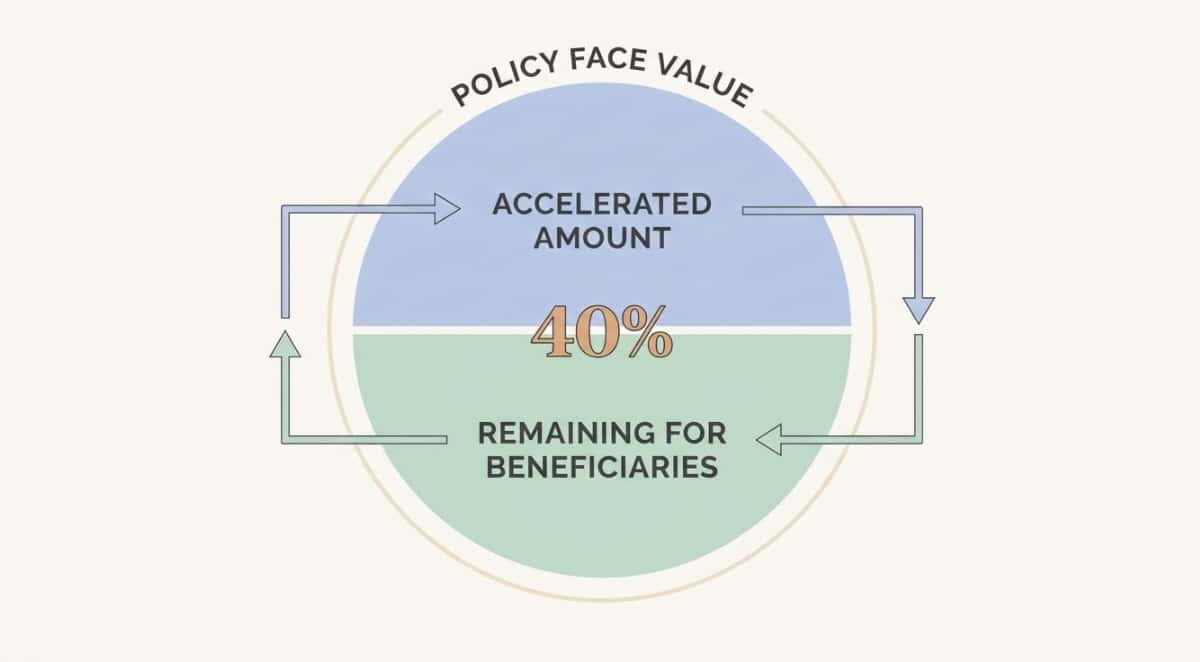
A Sample Calculation to Determine the Amount of Accelerated Death Benefits
Numbers make this easier to follow than percentages alone. The table below walks through a simplified example to help determine the amount of accelerated death benefits in a real scenario.
| Step | Example Figure |
|---|---|
| Policy face value | $250,000 |
| Rider allows up to | 50 percent of face value |
| Requested acceleration amount | $125,000 |
| Actuarial discount applied | Approximately $8,000 to $15,000, depending on life expectancy and interest rate |
| Administrative fee | Up to $150 to $250 |
| Approximate net payout to policyholder | Roughly $110,000 to $117,000 |
| Remaining death benefit for beneficiaries | Approximately $125,000, minus the accelerated amount plus accrued interest |
Your actual numbers will differ based on your carrier, your state’s regulations, and your specific life expectancy estimate, but this framework is exactly how most insurers determine the amount of accelerated death benefits owed on an actual claim.
Factors That Change How Insurers Determine the Amount of Accelerated Death Benefits
Life expectancy estimate. A shorter estimated life expectancy generally results in a smaller actuarial discount, since the insurer expects to pay the remaining death benefit sooner regardless.
Rider type triggered. Terminal illness claims typically use the simpler interest-only method and result in a higher percentage of face value being available compared to critical or chronic illness claims.
State regulations. Some states cap the administrative fee and the maximum allowable discount rate, which directly affects how carriers determine the amount of accelerated death benefits within that jurisdiction.
Policy loans or existing debt against the policy. Any outstanding policy loan is typically deducted from the payout, since the insurer nets out existing obligations before releasing funds.
Whether the policy has cash value. For permanent policies, cash value can factor into how the discount and fee structure is applied, which can shift the net amount up or down compared to a similarly sized term policy.
Accelerated Death Benefits vs Viatical Settlements
It is worth understanding one important distinction while you determine the amount of accelerated death benefits available through your own carrier. An accelerated death benefit is paid directly by your own insurer under your existing policy’s rider, and your policy typically continues afterward with a reduced death benefit. A viatical settlement, by contrast, involves selling your policy entirely to a third-party investor for a lump sum, which is sometimes larger than an accelerated benefit but permanently ends your coverage and assigns the full death benefit to the buyer. These are genuinely different products, and confusing the two can lead to a much larger, permanent loss of coverage than intended.
Tax Treatment of the Amount of Accelerated Death Benefits
Funds received to determine the amount of accelerated death benefits you ultimately keep are generally excluded from federal income tax when the insured is certified as terminally or chronically ill, under the relevant federal tax code provisions. That said, receiving a large accelerated payout can affect eligibility for certain public assistance programs, including Medicaid and Supplemental Security Income, since the funds may count as a countable asset depending on the program. Speaking with a tax professional before filing a claim is a reasonable step if you are also relying on any means-tested benefit programs.
For an official, neutral overview of these tax rules, the IRS’s guidance on accelerated death benefits under Section 101(g)is worth reviewing, and the National Association of Insurance Commissioners’ consumer guide to accelerated benefitsexplains how state regulators generally oversee these provisions.
How This Fits Into Your Broader Policy and Riders
Understanding how to determine the amount of accelerated death benefits available is easier once you understand how these riders relate to the rest of your coverage. Our own pillar page on accelerated death benefits covers the broader mechanics of how these features work across different policy types. If you are comparing the two most common living benefit riders, our guide on critical illness life insurance for seniors, our page on chronic illness riders for seniors, and our direct comparison of critical illness rider vs chronic illness rider explain how the two are triggered differently, which in turn affects how much you can access under each one.
For a broader look at which riders are worth adding to a policy in the first place, our overview of life insurance riders for seniors, the best riders to add to a senior life policy, and the best life insurance riders for chronic illness protection are useful starting points. Our detailed breakdown of the cost of life insurance with living benefits for senior citizens covers how much these riders typically add to a premium in the first place.
If a specific health condition is part of why you are researching this topic, our pages on life insurance for seniors with cancer history, life insurance for seniors with heart conditions, and life insurance for seniors with diabetes explain how those conditions are typically underwritten alongside living benefit riders. Our broader guide on whole life insurance for seniors with pre-existing conditions is worth reading as well.
If you are still deciding whether a policy with these riders is worth carrying at all, our guide on do I need life insurance after 70 and our overviews of term life insurance for seniors over 70, whole life insurance for seniors over 70, whole life insurance for seniors over 80, and the benefits of whole life insurance for seniors all cover how base policy choice interacts with rider availability.
If final expense coverage is more your speed than a larger policy with living benefits, our guides on final expense insurance for seniors, final expense insurance costs, and the best companies for final expense coverage for elderly applicants are worth a look, and estate planning goals are covered in our guides to the best life insurance for estate planning and life insurance for seniors over 80 and estate planning benefits.
Common Mistakes People Make When Trying to Determine the Amount of Accelerated Death Benefits
Assuming the maximum percentage is automatic. The percentage listed in your policy is a ceiling. Insurers still determine the amount of accelerated death benefits actually owed based on your specific diagnosis and remaining policy terms, so the real payout is often lower than the advertised maximum.
Not asking for the fee and discount breakdown in writing. A reputable carrier should be able to show you exactly how the administrative fee and actuarial discount were calculated before you accept the payout.
Forgetting the impact on beneficiaries. Every dollar accelerated reduces the remaining death benefit, plus accrued interest, so it is worth discussing the decision openly with whoever is named on the policy.
Confusing an accelerated benefit with a viatical settlement. These are structurally different products with very different long-term consequences for your coverage.
Not comparing carriers before buying a new policy. If you are shopping for a policy specifically because of its living benefit riders, our guide on comparing quotes and policies of life insurance over 80 and our list of mistakes to avoid in life insurance for seniors over 80 can help you avoid picking a policy with a weaker rider than a competitor offers.

A Word of Caution Before You Determine the Amount of Accelerated Death Benefits
Because accelerated death benefit claims often come up during a genuinely difficult health situation, this is unfortunately a moment scammers and aggressive sales tactics sometimes target. Our guides on avoiding life insurance scams aimed at the elderly and avoiding financial scams targeting seniors cover warning signs worth knowing before signing anything, and if a past health issue affected your rate class on a policy, our guide on how to improve your life insurance health rating may still be relevant if you are shopping for additional coverage.
Because carrier rules, state regulations, and rider language vary so widely, the only way to precisely determine the amount of accelerated death benefits available to you is to contact your specific carrier’s claims department or compare policies directly. I am an independent blogger, not an insurance company, so I cannot generate a binding quote myself. What I can tell you is to check your customized, real-time rates for free using the independent comparison platform Policygenius, which lets you compare policies and their available riders across multiple carriers side by side.
Frequently Asked Questions About How to Determine the Amount of Accelerated Death Benefits
How do I determine the amount of accelerated death benefits I can access?
Start with your policy’s face value, then check your rider’s maximum percentage, typically 25 to 95 percent depending on the rider type, and subtract any actuarial discount and administrative fee your carrier applies. Contacting your carrier’s claims department gives you the most accurate figure for your specific situation.
Is the maximum percentage in my policy the amount I will actually receive?
Not necessarily. The percentage listed is a ceiling. Your insurer will determine the amount of accelerated death benefits actually payable based on your diagnosis, life expectancy estimate, and any applicable discount or fee.
Are accelerated death benefits taxable?
Generally, no. Funds received under a terminal or chronic illness acceleration are typically excluded from federal income tax, though receiving a large payout can affect eligibility for certain means-tested public assistance programs.
Does accepting an accelerated death benefit end my policy?
No. Your policy typically continues with a reduced death benefit reflecting the amount already paid out, plus accrued interest, as long as you continue paying any required premiums.
What is the difference between an accelerated death benefit and a viatical settlement?
An accelerated death benefit is paid by your own insurer under your existing policy, which usually continues afterward at a reduced amount. A viatical settlement involves selling your policy entirely to a third party, which ends your coverage completely.
Where can I compare policies with strong living benefit riders?
Because rider terms and payout percentages vary so much by carrier, the most reliable way to compare real options is through an independent platform like Policygenius, rather than assuming every policy calculates payouts the same way.
A Final Word
Learning to determine the amount of accelerated death benefits available to you is really about understanding three moving pieces at once: the percentage your rider allows, the discount and fee your carrier applies, and how the remaining death benefit changes for your beneficiaries afterward. None of this needs to be a mystery. Ask your carrier for a written breakdown before you file a claim, compare that against your policy’s actual language, and make the decision with a clear picture of exactly what you and your family will end up with.